Loretto, Jacksonville
Updated · 6,673 residents
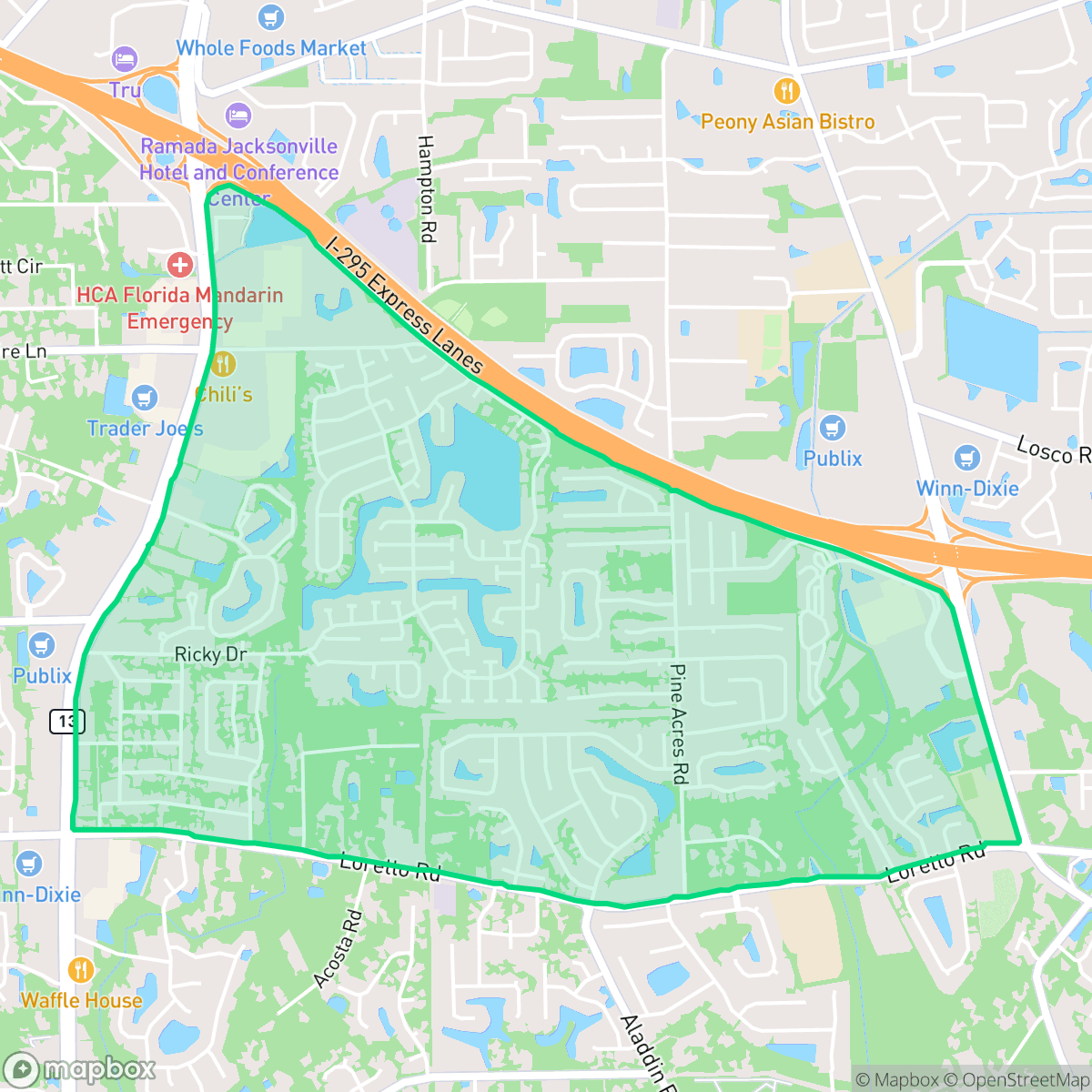
Loretto is a semi-rural residential community known for its well-maintained, upscale homes and spacious, tree-lined streets. While the area offers a pleasant, stroller-friendly environment with clean air and high health insurance coverage, it remains susceptible to noise from nearby major traffic corridors.
Key Highlights
About Loretto
Historically a distinct village separate from neighboring Mandarin, Loretto traces its roots to an 18th-century Catholic mission. The community gained formal recognition in the late 19th century when Father James Veale established a post office there. The neighborhood's character was long defined by St. Joseph’s Parish and the Loretto Academy, founded in 1867 by the Sisters of St. Joseph, which served as a vital educational and social hub for nearly a century. Once a rural frontier area, Loretto underwent significant transformation in the early 1970s following the construction of I-295 and the Buckman Bridge. This infrastructure development catalyzed the transition from a quiet, mission-centered village into the suburban residential neighborhood that characterizes the area today.
The area maintains a distinct suburban character defined by its manicured lawns, private swimming pools, and a mix of housing densities that provide a balance of privacy and community. Residents benefit from a semi-rural atmosphere featuring significant tree cover and managed water bodies, which distinguishes the landscape from the denser parts of Jacksonville. The neighborhood supports a diverse age demographic, fostering a steady rhythm of local commerce and wellness services that cater to various lifestyle needs.
Prospective residents should consider the trade-offs between the area's visual appeal and its acoustic environment, as the proximity to major roadways and rail lines results in higher noise levels than the city average. While the neighborhood boasts reliable flood safety and excellent air quality, families should research specific school zoning within the Duval County district, which currently navigates budget challenges and consolidation efforts. Overall, the area is well-suited for those seeking an established, affluent residential setting with convenient access to suburban amenities.
Neighborhood Scores Across 15 Qualities
Residential spacing offers a balanced mix of yard buffers and wooded separation, providing more privacy than the Jacksonville average. According to iHuus data, housing density varies from dense apartment clusters near the center to single-family homes with moderate distance between neighbors.
Low traffic residential loops and main collectors offer much better pedestrian accessibility than the Jacksonville average. While sidewalks are intermittently obscured by tree canopy, most residential streets remain stroller friendly and safe for walking.
Large homes featuring private swimming pools and well-maintained landscapes characterize this area, providing a visual quality that is significantly higher than the Jacksonville average. According to iHuus data, the neighborhood presents an affluent aesthetic with spacious driveways and manicured lawns.
Tree-lined streets, wide yards, and accessible green buffers around retention ponds provide much more space for pet exercise than the Jacksonville average. Many residential areas feature continuous grassy verges and shaded paths suitable for daily walks.
Open land and woodland are more common here than in the typical Jacksonville landscape. Residents will experience a suburban layout characterized by scattered homes, significant tree cover, and managed water bodies.
Local activity levels are notably higher than the Jacksonville average, offering a blend of quiet residential streets and active pockets of dining and wellness services. While some areas remain purely residential and subdued, certain hubs provide a steady rhythm of commerce and community interest.
Persistent noise from nearby major roadways and rail lines characterizes the area. According to iHuus data, acoustic comfort in Loretto is significantly lower than the Jacksonville average.
Air quality in Loretto remains consistently high with rare instances of elevated readings. This level of cleanliness is significantly better than the Jacksonville city average, according to iHuus data.
Residential tranquility prevails due to a lack of heavy industry, which makes this area significantly cleaner than the Jacksonville average. While some light commercial activity and transit traffic exist near major roadways, there are no detectable industrial hazards or toxic facilities in the neighborhood.
Health insurance access among residents is significantly higher than the Jacksonville average, according to iHuus data.
Conservative-leaning political views represent the majority of the population, reflecting a more traditional ideological profile than the Jacksonville average.
Residents experience a balanced demographic spread ranging from young adults to seniors. According to iHuus data, this age distribution is notably more varied than the typical profile found across Jacksonville.
Flood risk in this area is significantly lower than the Jacksonville average, though some residual risk remains due to its location within a secondary floodplain. Residents should account for minor drainage considerations during extreme weather events according to iHuus data.
Address-Level Insights for Loretto


iHuus Neighborhood Intelligence Insights
Get address-level neighborhood insights for Loretto
- Street-level scores — see how individual blocks compare, not just neighborhood averages
- Micro-zone boundaries — identify quiet pockets, flood boundaries, and walkable clusters before you visit
- 15 dimensions in full — walkability, noise, air quality, school quality, insurance coverage, population age profile, urban/rural index, and more
- Boundary risk alerts — know if your address sits near a block boundary where scores drop, the kind of detail no listing will ever mention
- School insights — individual school ratings and insights, not just district-level data
- Compare before you commit — side-by-side data across neighborhoods, down to block precision
No credit card required
Compare with Any Neighborhood
| Dimension | Loretto | 29th and Chase |
|---|---|---|
| 🚶 Walkabilityavg 3.96 | ||
| 🔊 Acoustic Comfortavg 4.37 | ||
| 🤫 Privacy Indexavg 4.3 | ||
| 🎨 Visual Appealavg 4.24 | ||
| 🐕 Dog Friendlinessavg 4.28 | ||
| 🗺️ Urban-Rural Indexavg 5.22 | ||
| ✨ Neighborhood Vibeavg 1.5 | ||
| 🏥 Health Insurance Coverageavg 4.35 | ||
| 🌿 Air Qualityavg 3.84 | ||
| 🏭 Industrial Proximityavg 5.11 | ||
| 🌊 Flood Safetyavg 4.01 | ||
| 🗳️ Ideological Leanavg 2.75 | ||
| 👥 Population Age Profileavg 3.26 | ||
| 🔥 Fire Safety | ||
| 🏫 School Quality |
Loretto Rankings
School Districts Serving Loretto
School Insights for Loretto
Below average outcomes; significant attendance and academic challenges.
School Insights
See what's really behind every school rating near Loretto
- Individual school ratings — each school's own score with outcome context, not just a district average
- Enrollment & class size data — student-to-teacher ratio and how it compares to the state average
- Full demographics breakdown — ethnicity and gender composition for every school in the enrollment zone
- Every school in the district — all schools within the enrollment boundary ranked by rating, not just the closest one
- Grade levels & benchmarks — elementary through high school, with below/above state-average flags
No credit card required