Lakewood, Jacksonville
Updated · 4,559 residents
Lakewood is a well-established community defined by its mid-century modern architecture and tree-lined streets named after prominent universities. The area offers a spacious, semi-rural atmosphere with a diverse demographic and a balanced mix of quiet residential pockets and active commercial hubs.
Key Highlights
About Lakewood
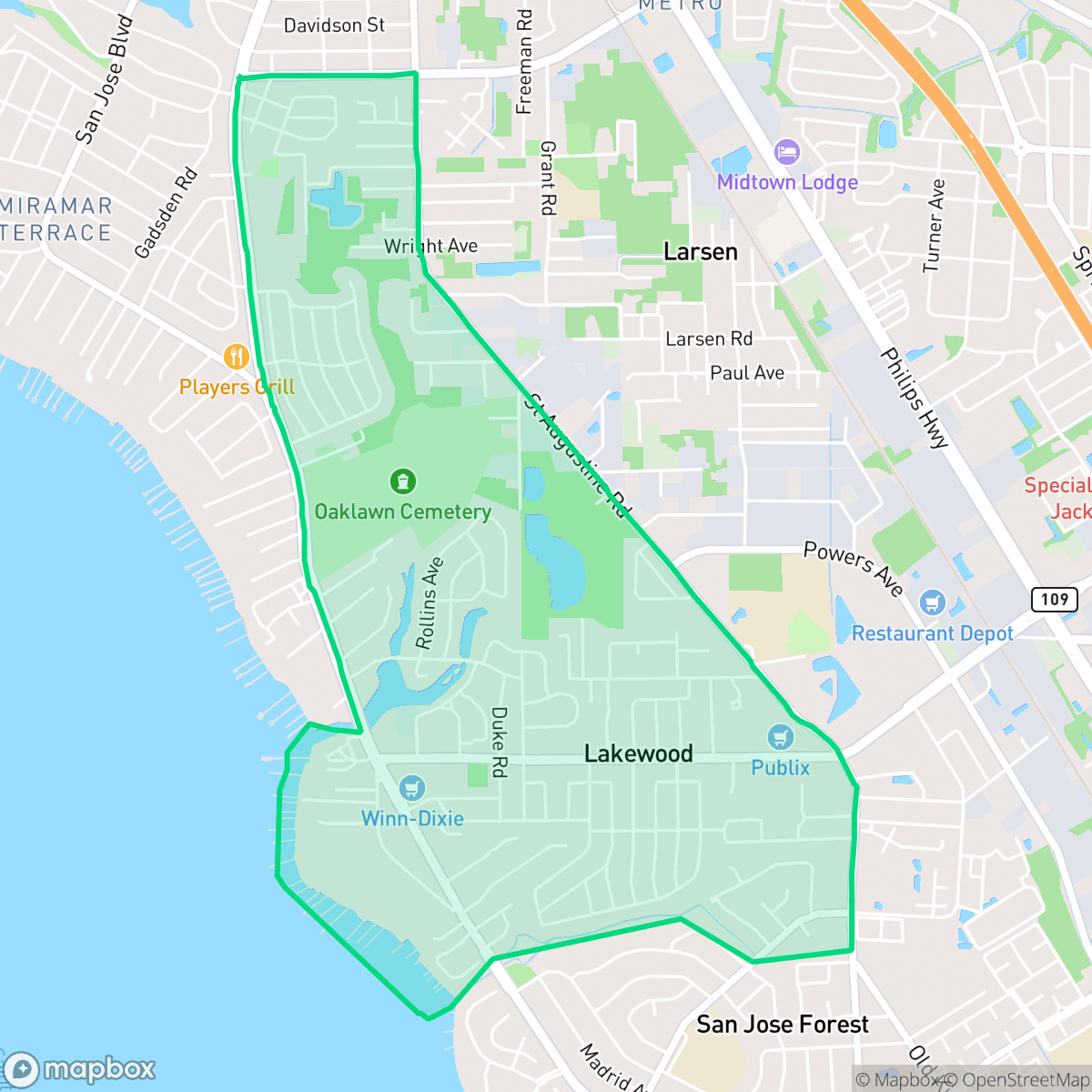
Lakewood, a neighborhood in Jacksonville, Florida, was established in 1946 by developer Walter Crabtree. Emerging during the post-World War II era, the community was designed to accommodate veterans utilizing the G.I. Bill and was originally located outside the Jacksonville city limits. The neighborhood is characterized by its mature landscaping and mid-century modern architectural stock. A distinctive feature of Lakewood is its street naming convention, with many roads named after prominent private colleges and universities, such as Cornell, Clemson, and Fordham. The area's history extends back to the 18th century, when the land was part of the 3,000-acre Jericho Plantation, a significant site for indigo and timber production. Today, Lakewood remains a well-established residential area centered around the intersection of San Jose and University Boulevards.
The neighborhood is characterized by a polished visual landscape featuring large homes, private pools, and waterfront estates. Residents benefit from a notably clean environment with minimal industrial presence, creating a sense of separation and privacy that exceeds the city average. The area maintains a semi-rural feel through its abundance of open land and wooded sections, while simultaneously providing access to lively local dining and retail corridors centered around the intersection of San Jose and University Boulevards. This combination of upscale curb appeal and natural surroundings makes it a distinct residential destination within the broader city.
Living in the area involves a few trade-offs, such as a steady hum of traffic noise from nearby arterial roads and a lack of continuous sidewalks, though the quiet residential loops remain safe and popular for walking. The demographic profile is broad, including young professionals, families, and seniors, which contributes to a politically balanced and varied social energy. Families should note that while the Duval County Public School District provides access to elite magnet and advanced studies programs, the district is currently navigating a complex period of budget adjustments and school consolidations. Overall, the neighborhood is best suited for those seeking a spacious, established environment with high levels of health insurance coverage and a strong sense of community.
Neighborhood Scores Across 15 Qualities
Residential spacing offers a balanced level of separation between neighbors, providing more personal buffer than the Jacksonville average. According to iHuus data, lot layouts vary from denser apartment clusters to suburban homes with natural tree buffers.
Low-traffic residential loops and streets offer safe walking conditions despite a lack of continuous sidewalks. This level of pedestrian accessibility is notably higher than the Jacksonville average, though caution is advised near arterial roads.
Large homes, private pools, and waterfront estates contribute to a visual landscape that is significantly more upscale than the Jacksonville average. While many areas feature standard residential layouts, the presence of spacious driveways and well-maintained amenities provides a high level of curb appeal according to iHuus data.
Extensive tree canopies and grassy road verges throughout the residential blocks offer ample space for pet owners. According to iHuus data, this level of accessibility to green verges is notably higher than the Jacksonville average.
Open land and wooded areas are more prevalent here than in most parts of Jacksonville. According to iHuus data, the landscape features a blend of low density residential pockets and suburban developments.
Activity levels fluctuate between quiet residential pockets and lively local hubs featuring diverse dining and retail. This neighborhood offers a notably higher level of social activity and commercial density than the Jacksonville average.
A steady hum of local traffic from nearby busy streets defines the acoustic environment. According to iHuus data, this level of ambient noise is slightly higher than the average for Jacksonville.
Air quality in Lakewood typically fluctuates between acceptable and unhealthy levels, though it remains notably better than the Jacksonville average according to iHuus data. Residents with respiratory sensitivities may notice occasional periods of concern.
Residential life dominates the area with very little heavy industry nearby, making it significantly cleaner than the Jacksonville average. While some northeast sections contain warehouses and logistics yards, most of the neighborhood consists of quiet streets, parks, and light commercial services.
Health insurance access among residents is notably higher than the Jacksonville average, according to iHuus data.
Political leanings in this area are split relatively evenly between conservative and liberal voters. According to iHuus data, the neighborhood displays a more moderate ideological profile than the average Jacksonville community.
Residents live alongside a broad range of age groups, including young professionals, families, and seniors. This demographic spread is notably more varied than the average seen across Jacksonville.
Residual flood risk exists within the area, though safety levels are notably higher than the Jacksonville average according to iHuus data.
Address-Level Insights for Lakewood


iHuus Neighborhood Intelligence Insights
Get address-level neighborhood insights for Lakewood
- Street-level scores — see how individual blocks compare, not just neighborhood averages
- Micro-zone boundaries — identify quiet pockets, flood boundaries, and walkable clusters before you visit
- 15 dimensions in full — walkability, noise, air quality, school quality, insurance coverage, population age profile, urban/rural index, and more
- Boundary risk alerts — know if your address sits near a block boundary where scores drop, the kind of detail no listing will ever mention
- School insights — individual school ratings and insights, not just district-level data
- Compare before you commit — side-by-side data across neighborhoods, down to block precision
No credit card required
Compare with Any Neighborhood
| Dimension | Lakewood | 29th and Chase |
|---|---|---|
| 🚶 Walkabilityavg 3.96 | ||
| 🔊 Acoustic Comfortavg 4.37 | ||
| 🤫 Privacy Indexavg 4.3 | ||
| 🎨 Visual Appealavg 4.24 | ||
| 🐕 Dog Friendlinessavg 4.28 | ||
| 🗺️ Urban-Rural Indexavg 5.22 | ||
| ✨ Neighborhood Vibeavg 1.5 | ||
| 🏥 Health Insurance Coverageavg 4.35 | ||
| 🌿 Air Qualityavg 3.84 | ||
| 🏭 Industrial Proximityavg 5.11 | ||
| 🌊 Flood Safetyavg 4.01 | ||
| 🗳️ Ideological Leanavg 2.75 | ||
| 👥 Population Age Profileavg 3.26 | ||
| 🔥 Fire Safety | ||
| 🏫 School Quality |
Lakewood Rankings
School Districts Serving Lakewood
School Insights for Lakewood
Below average outcomes; significant attendance and academic challenges.
School Insights
See what's really behind every school rating near Lakewood
- Individual school ratings — each school's own score with outcome context, not just a district average
- Enrollment & class size data — student-to-teacher ratio and how it compares to the state average
- Full demographics breakdown — ethnicity and gender composition for every school in the enrollment zone
- Every school in the district — all schools within the enrollment boundary ranked by rating, not just the closest one
- Grade levels & benchmarks — elementary through high school, with below/above state-average flags
No credit card required