Lakeshore, Jacksonville
Updated · 4,453 residents
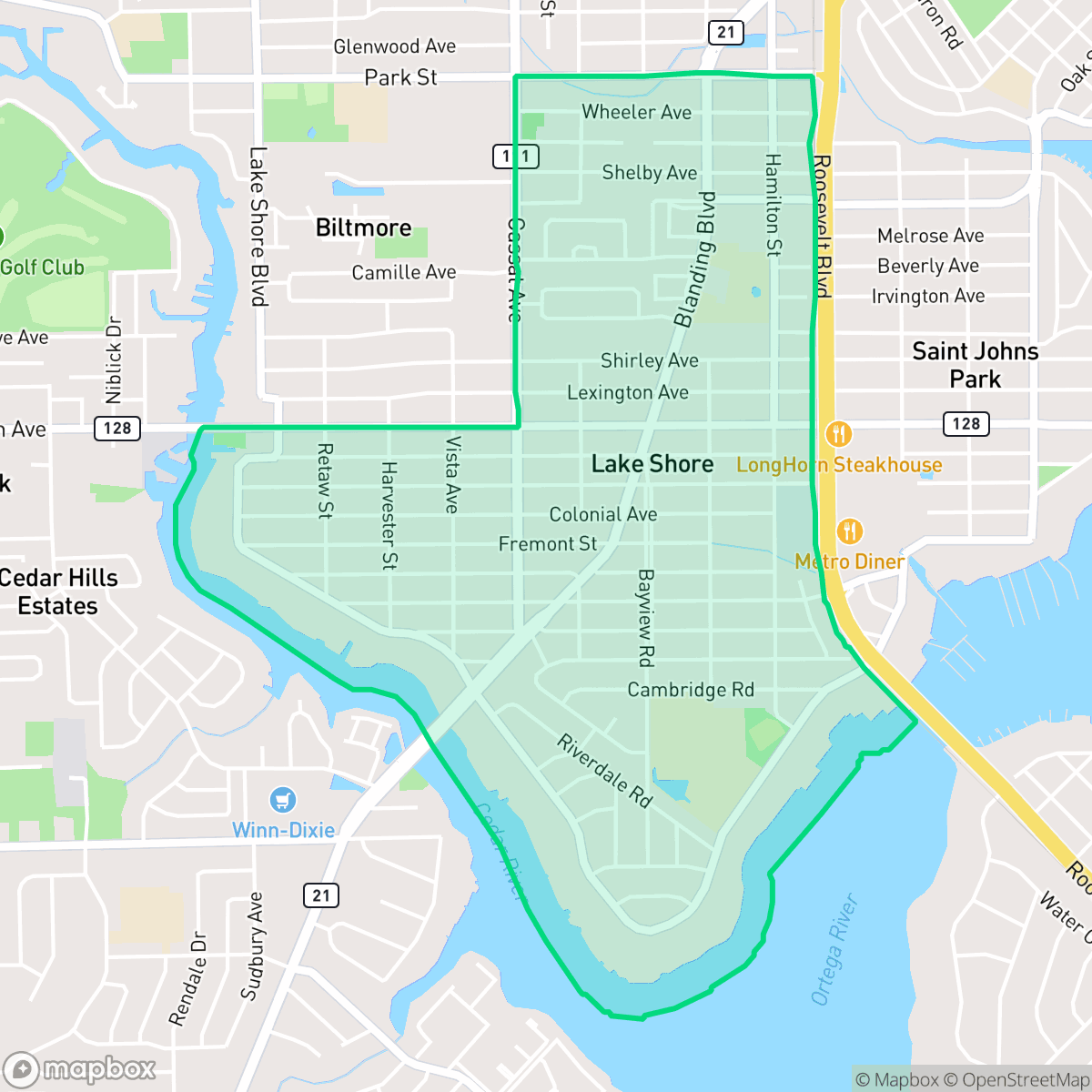
Lakeshore is a distinct Jacksonville neighborhood known for its Mediterranean-inspired architecture and status as a hub for recreational boating along the Ortega River. The area offers a semi-rural atmosphere with spacious, well-maintained properties and a quiet residential environment that balances suburban calm with accessible local services.
Key Highlights
About Lakeshore
Located along the Ortega River and Cedar Creek, Lakeshore’s development was sparked by the 1920s Florida Land Boom, which introduced Mediterranean-style architecture, a distinctive boulevard with a central park, and Spanish Mission-style entryway gates. While the 1926 real estate crash halted initial progress, the neighborhood saw significant expansion during the 1940s and 1950s, driven by the opening of Naval Air Station Jacksonville. Today, Lakeshore is recognized as Jacksonville’s "Marina Mile," a hub for recreational boating and yacht services. The neighborhood's commercial core at the intersection of Blanding Boulevard and San Juan Avenue historically served as a pedestrian-friendly node. In 2009, the community’s original arched gateways on Bayview Road were restored and designated as historic landmarks by the City of Jacksonville, preserving a tangible link to the area’s early development.
The neighborhood features a mix of upscale suburban aesthetics and a relaxed, semi-rural feel characterized by wooded areas and scattered, well-spaced homes. Residents enjoy a quieter pace of life compared to the broader city, with tree-lined streets that facilitate pleasant neighborhood walks. According to iHuus data, the local environment is largely free from industrial activity, contributing to a clean and residential-focused atmosphere that appeals to a diverse demographic of young adults, families, and long-term residents.
Potential residents should be aware that while the area offers a high quality of life with strong health insurance coverage, it does experience moderate traffic noise from nearby thoroughfares. The neighborhood provides limited public space for pets, and those interested in the area should monitor ongoing flood safety assessments as official maps are finalized. Families moving to the area will navigate the Duval County school system, which offers both specialized magnet programs and a transition-heavy landscape that requires careful consideration of specific school zoning.
Neighborhood Scores Across 15 Qualities
Housing density is moderate, providing more distance between neighbors than the Jacksonville average. Most properties feature typical suburban spacing with some buffer between homes, though certain apartment areas offer a more condensed living arrangement.
Low-speed residential roads and tree-lined streets provide a safer environment for walking than the city average. While sidewalk coverage varies, main access roads feature continuous paths that support pedestrian movement.
Large homes and frequent upscale amenities, such as private and communal pools, create a visual environment significantly more polished than the Jacksonville average. According to iHuus data, the area features spacious driveways and well-maintained properties alongside some standard suburban tract housing.
Walking opportunities for pets are restricted by narrow street verges and a lack of large public parks, although some waterfront green spaces are available. According to iHuus data, the availability of shared outdoor space for dogs is roughly comparable to the Jacksonville average.
Open land and wooded areas are common throughout the neighborhood, providing a more spread out atmosphere than much of Jacksonville. According to iHuus data, this area features a mix of scattered homes and suburban pockets that feel less dense than the city average.
Local activity levels are notably higher than the Jacksonville average, offering a varied mix of calm residential streets and surprisingly lively pockets of dining and retail. While some blocks remain low-key and primarily residential, other areas function as active suburban hubs with accessible services and local eateries.
Steady sound from nearby busy streets creates a consistent background hum. This level of acoustic activity is slightly higher than the Jacksonville average, according to iHuus data.
Air quality in Lakeshore presents a mix of acceptable and unhealthy days. According to iHuus data, conditions are notably better than the Jacksonville average, though sensitive groups should remain cautious during periods of occasional concern.
Primarily residential and light commercial, this area lacks heavy industry and significant warehouses. Residents will find far fewer industrial hazards and much lower levels of heavy manufacturing activity than the Jacksonville average.
Health insurance enrollment among residents is notably higher than the Jacksonville average, according to iHuus data.
Political leanings in Lakeshore are closely divided between conservative and liberal residents. This area displays a more even ideological split than the broader Jacksonville average, according to iHuus data.
A balanced mix of young adults, families, and older residents characterizes the area. According to iHuus data, this demographic variety is notably more diverse than the typical age distribution found across Jacksonville.
Flood risk in this area is higher than the Jacksonville average, though current FEMA assessments lack a detailed study for the neighborhood. Residents should remain cautious as official flood maps for this specific zone are still being finalized.
Address-Level Insights for Lakeshore


iHuus Neighborhood Intelligence Insights
Get address-level neighborhood insights for Lakeshore
- Street-level scores — see how individual blocks compare, not just neighborhood averages
- Micro-zone boundaries — identify quiet pockets, flood boundaries, and walkable clusters before you visit
- 15 dimensions in full — walkability, noise, air quality, school quality, insurance coverage, population age profile, urban/rural index, and more
- Boundary risk alerts — know if your address sits near a block boundary where scores drop, the kind of detail no listing will ever mention
- School insights — individual school ratings and insights, not just district-level data
- Compare before you commit — side-by-side data across neighborhoods, down to block precision
No credit card required
Compare with Any Neighborhood
| Dimension | Lakeshore | 29th and Chase |
|---|---|---|
| 🚶 Walkabilityavg 3.96 | ||
| 🔊 Acoustic Comfortavg 4.37 | ||
| 🤫 Privacy Indexavg 4.3 | ||
| 🎨 Visual Appealavg 4.24 | ||
| 🐕 Dog Friendlinessavg 4.28 | ||
| 🗺️ Urban-Rural Indexavg 5.22 | ||
| ✨ Neighborhood Vibeavg 1.5 | ||
| 🏥 Health Insurance Coverageavg 4.35 | ||
| 🌿 Air Qualityavg 3.84 | ||
| 🏭 Industrial Proximityavg 5.11 | ||
| 🌊 Flood Safetyavg 4.01 | ||
| 🗳️ Ideological Leanavg 2.75 | ||
| 👥 Population Age Profileavg 3.26 | ||
| 🔥 Fire Safety | ||
| 🏫 School Quality |
Lakeshore Rankings
School Districts Serving Lakeshore
School Insights for Lakeshore
Below average outcomes; significant attendance and academic challenges.
School Insights
See what's really behind every school rating near Lakeshore
- Individual school ratings — each school's own score with outcome context, not just a district average
- Enrollment & class size data — student-to-teacher ratio and how it compares to the state average
- Full demographics breakdown — ethnicity and gender composition for every school in the enrollment zone
- Every school in the district — all schools within the enrollment boundary ranked by rating, not just the closest one
- Grade levels & benchmarks — elementary through high school, with below/above state-average flags
No credit card required