Lake Forest, Jacksonville
Updated · 3,136 residents
Lake Forest is an established residential enclave characterized by its semi-rural atmosphere, mature tree canopy, and well-maintained properties. While the area offers a quiet lifestyle with better-than-average walkability, residents should be aware of elevated noise levels from nearby transit corridors and the necessity of flood insurance.
Key Highlights
About Lake Forest
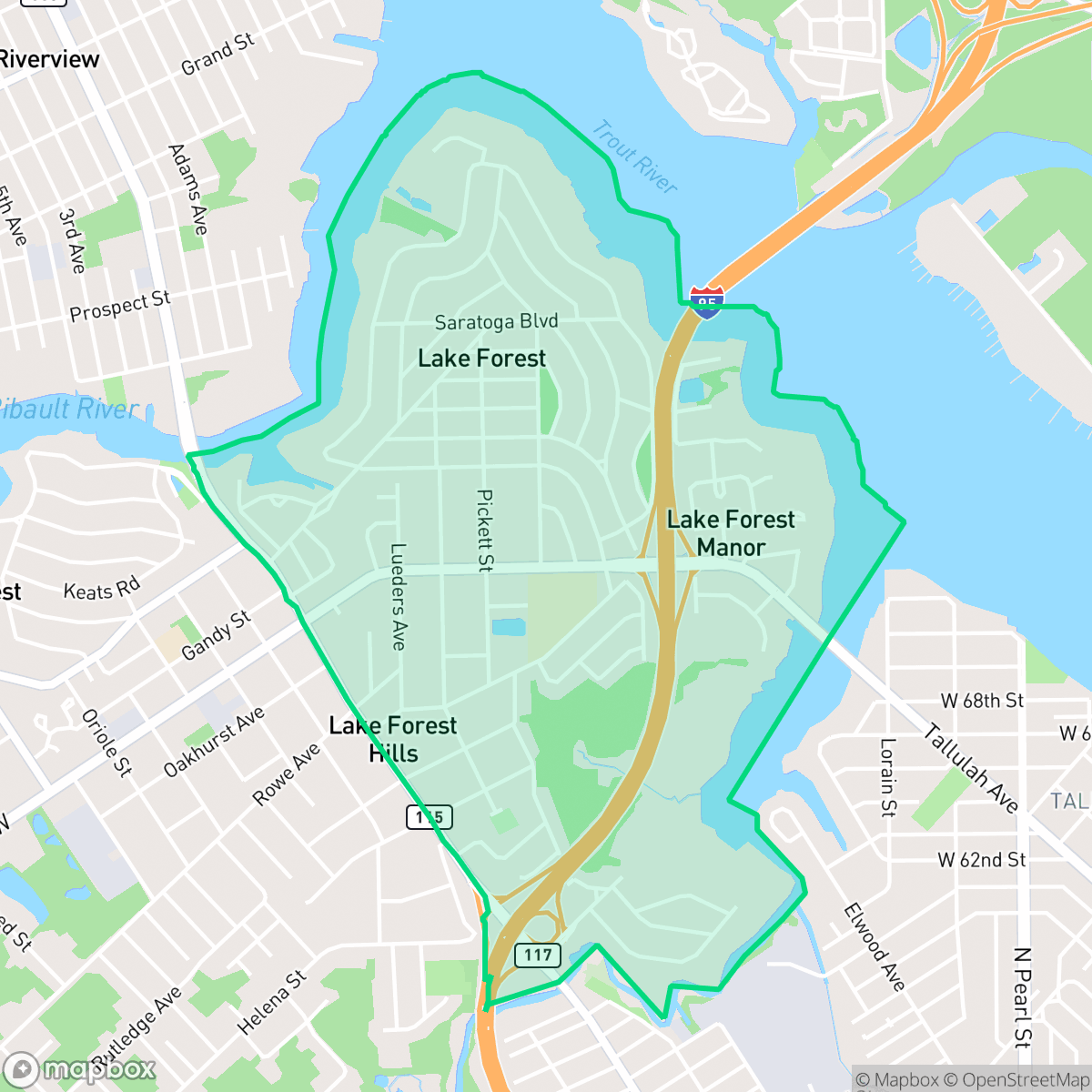
Located five miles northwest of downtown Jacksonville, Lake Forest is a distinctive residential neighborhood defined by its failed 1920s Florida Land Boom origins and subsequent 1940s renaissance. Initially platted in 1926 with a conventional grid, the development stalled before the Great Depression, only to be revived in 1944 with a curvilinear street pattern. The neighborhood is noted for its American Revolutionary War theme, reflected in street names like Concord Boulevard and Bunker Hill Boulevard, as well as its half-oval parks, including Marion Park. Situated on a peninsula bounded by the Ribault River, Trout River, and Moncrief Creek, Lake Forest represents a unique mix of pre- and post-World War II suburban development. By the 1960s, the community became a significant residential destination, further shaped by the construction of Interstate 95.
The area presents a visually appealing landscape defined by spacious driveways and a blend of established suburban density and open, wooded spaces. It maintains a distinct semi-rural character that feels removed from heavy industrial activity, providing a peaceful environment for its diverse population of families, young adults, and seniors. The neighborhood fosters a strong sense of community alignment, reflecting a notably liberal ideological leaning compared to the broader city.
Prospective residents should consider the trade-offs of living in this location, particularly regarding environmental and acoustic factors. While the air quality is generally favorable, the proximity to major transit routes and rail lines results in elevated noise levels. Additionally, the area sits within a designated floodplain, which requires careful attention to insurance planning. Families interested in the local school district will find a system in transition, where access to specialized magnet programs often provides the best educational outcomes within a broader landscape of budget-related consolidation.
Neighborhood Scores Across 15 Qualities
Residential spacing provides more personal buffer than the Jacksonville average. Houses are situated with moderate distances between neighbors, creating a typical established suburban density.
Low traffic volumes and wide roads make streets relatively safe for pedestrians, even though sidewalks are often obscured by trees or absent. According to iHuus data, walkability in this area is notably higher than the Jacksonville average.
Large homes and frequent upscale amenities contribute to a landscape that is significantly more aesthetically pleasing than the Jacksonville average. According to iHuus data, the presence of spacious driveways and well-maintained properties defines much of the area's visual character.
Private fenced yards are common, but the area lacks large public dog parks and features narrow grass verges along many streets. According to iHuus data, this level of accessibility is slightly higher than the Jacksonville average.
Open land and wooded areas are common throughout the area, providing a more semi-rural feel than most parts of Jacksonville. This landscape features scattered homes amid fields alongside denser suburban residential pockets with significant tree canopy.
Activity levels are notably higher than the Jacksonville average, offering a mix of calm residential streets and pockets of local dining. While some areas remain subdued and car-oriented, other sections serve as active hubs with accessible parks and various cafes.
Frequent disturbances from nearby heavy transit corridors and railroad proximity make this area noisier than the Jacksonville average, according to iHuus data.
Air quality levels in Lake Forest fluctuate between acceptable and unhealthy periods. According to iHuus data, the air quality is notably better than the Jacksonville average, though sensitive groups should remain aware of occasional concerns.
Residential tranquility is well-maintained due to an absence of heavy industry, which is significantly lower than the Jacksonville average. Occasional light commercial services and gas stations are present, but they do not introduce major industrial hazards to the area.
Health insurance enrollment levels in Lake Forest are consistent with the average found across Jacksonville. According to iHuus data, a portion of the local population remains uninsured.
Voting patterns and census indicators in Lake Forest reflect a much more liberal leaning than the Jacksonville average, according to iHuus data.
Residents live alongside a broad mix of young adults, families, and seniors. According to iHuus data, this demographic distribution is more varied than the citywide average.
Significant flood risk exists here due to the area's location within a designated floodplain. According to iHuus data, this vulnerability is slightly higher than the Jacksonville average and often necessitates flood insurance.
Address-Level Insights for Lake Forest


iHuus Neighborhood Intelligence Insights
Get address-level neighborhood insights for Lake Forest
- Street-level scores — see how individual blocks compare, not just neighborhood averages
- Micro-zone boundaries — identify quiet pockets, flood boundaries, and walkable clusters before you visit
- 15 dimensions in full — walkability, noise, air quality, school quality, insurance coverage, population age profile, urban/rural index, and more
- Boundary risk alerts — know if your address sits near a block boundary where scores drop, the kind of detail no listing will ever mention
- School insights — individual school ratings and insights, not just district-level data
- Compare before you commit — side-by-side data across neighborhoods, down to block precision
No credit card required
Compare with Any Neighborhood
| Dimension | Lake Forest | 29th and Chase |
|---|---|---|
| 🚶 Walkabilityavg 3.96 | ||
| 🔊 Acoustic Comfortavg 4.37 | ||
| 🤫 Privacy Indexavg 4.3 | ||
| 🎨 Visual Appealavg 4.24 | ||
| 🐕 Dog Friendlinessavg 4.28 | ||
| 🗺️ Urban-Rural Indexavg 5.22 | ||
| ✨ Neighborhood Vibeavg 1.5 | ||
| 🏥 Health Insurance Coverageavg 4.35 | ||
| 🌿 Air Qualityavg 3.84 | ||
| 🏭 Industrial Proximityavg 5.11 | ||
| 🌊 Flood Safetyavg 4.01 | ||
| 🗳️ Ideological Leanavg 2.75 | ||
| 👥 Population Age Profileavg 3.26 | ||
| 🔥 Fire Safety | ||
| 🏫 School Quality |
Lake Forest Rankings
School Districts Serving Lake Forest
School Insights for Lake Forest
Below average outcomes; significant attendance and academic challenges.
School Insights
See what's really behind every school rating near Lake Forest
- Individual school ratings — each school's own score with outcome context, not just a district average
- Enrollment & class size data — student-to-teacher ratio and how it compares to the state average
- Full demographics breakdown — ethnicity and gender composition for every school in the enrollment zone
- Every school in the district — all schools within the enrollment boundary ranked by rating, not just the closest one
- Grade levels & benchmarks — elementary through high school, with below/above state-average flags
No credit card required