Lake Forest Hills, Jacksonville
Updated · 2,693 residents
Lake Forest Hills is a quiet, residential neighborhood defined by its spacious, semi-rural atmosphere and mature tree canopy. It offers a peaceful living environment with minimal industrial activity, making it a desirable choice for those seeking a tranquil retreat within the city.
Key Highlights
About Lake Forest Hills
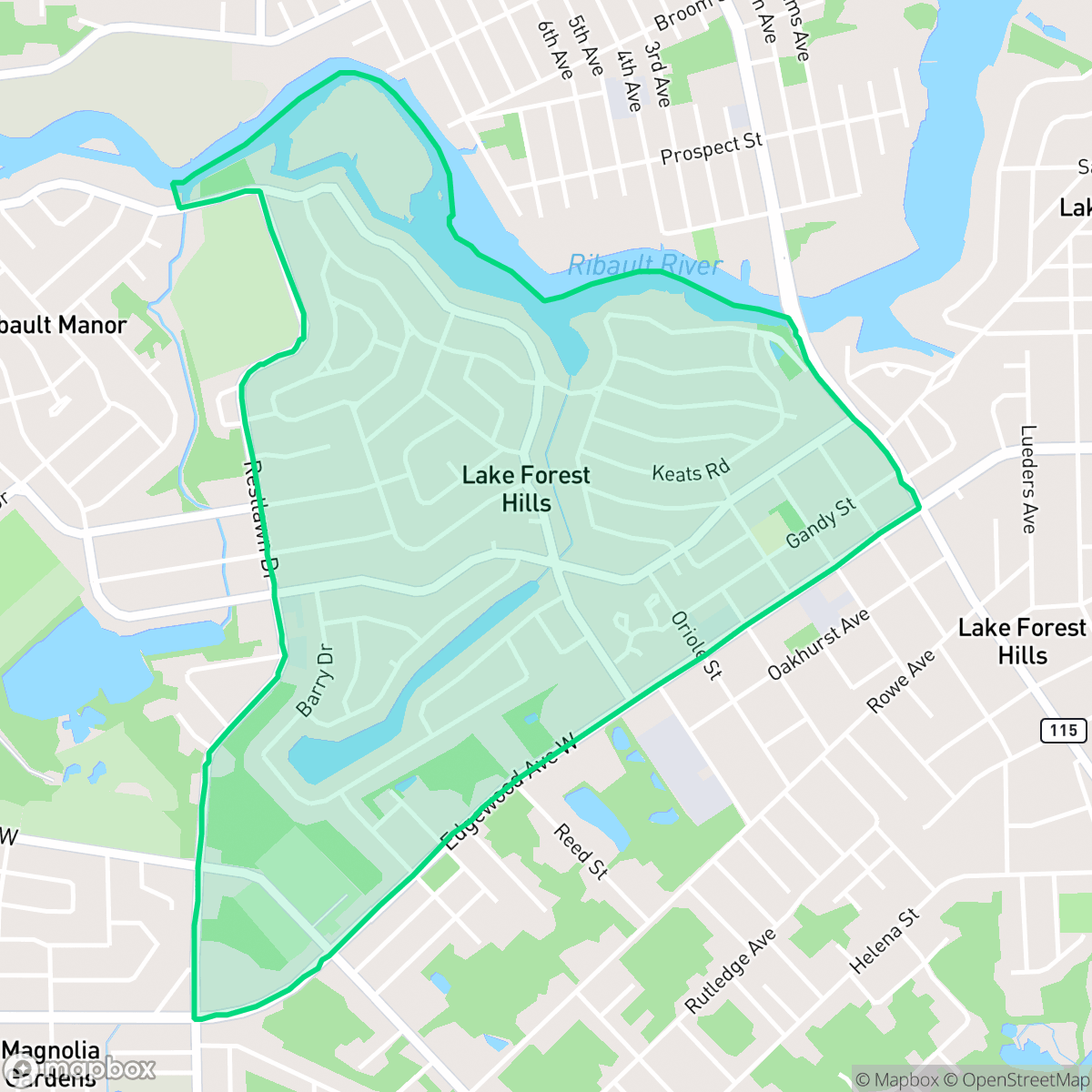
Developed around 1950 by the Charles E. Commander & Company, the Lake Forest Hills subdivision in Jacksonville was built on the site of a former pecan grove plantation. Initially marketed to World War II veterans, the neighborhood became a significant residential area due to its affordable housing and scenic, winding roadways near the Ribault River. The 1957 opening of Jean Ribault High School supported its rapid expansion. During the 1960s, the neighborhood underwent a notable demographic transformation; following the urban renewal and destruction of the Sugar Hill community near downtown, Lake Forest Hills became a prominent destination for Black middle-class professionals, including educators, doctors, and civic leaders, earning it a reputation as a 'new, sweeter Sugar Hill' within the city.
The area is characterized by a modest suburban aesthetic, featuring single-family homes set among woodlands and fields. Because of the limited industrial presence and low traffic density, the acoustic environment is notably quieter than the Jacksonville average. Residents benefit from a consistent, semi-rural feel that provides more space between properties than typical urban settings, contributing to a sense of privacy and calm. According to iHuus data, the neighborhood maintains a visual landscape that is more varied and aesthetically pleasing than many other parts of the city.
For prospective residents, the community supports a diverse age demographic, fostering a stable mix of young adults, families, and older individuals. While formal sidewalks are limited, the quiet streets allow for safe on-road walking, and the abundance of grassy verges provides ample space for pet exercise. Those considering the area should note that while it offers a peaceful residential experience, it is a quiet community with fewer commercial hubs compared to more central districts, making it best suited for those who prioritize a low-key lifestyle over immediate access to high-density retail or nightlife.
Neighborhood Scores Across 15 Qualities
Detached homes feature moderate spacing and are often buffered by mature trees, providing a higher level of privacy than the Jacksonville average.
Low traffic density and quiet residential streets allow for safe walking despite a lack of formal sidewalks. This level of walkability is notably higher than the Jacksonville city average, according to iHuus data.
Standard single-family homes with simple rooflines and tidy, small yards define the area. This visual landscape is more varied and aesthetically pleasing than the typical Jacksonville neighborhood average according to iHuus data.
Continuous grassy verges and nearby wooded patches provide ample space for pet exercise. This level of access to greenery and walking paths is higher than the Jacksonville average, according to iHuus data.
Open land and significant tree canopy provide a more semi-rural atmosphere than the typical Jacksonville landscape. According to iHuus data, the area features scattered homes set among woodlands and fields, offering more space between properties than the city average.
Subdued street life and a lack of major commercial hubs characterize this area, though it offers more local activity than the Jacksonville average. Residents can find a few scattered dining options and local landmarks within a quiet, suburban landscape.
Steady hum from nearby busy streets is present, though the acoustic environment remains significantly quieter than the Jacksonville average according to iHuus data.
Air quality levels in Lake Forest Hills are generally better than the Jacksonville average, though residents may experience occasional days with poor air quality that could affect sensitive groups.
Residential life dominates the area with only scattered light commercial units and local services nearby. According to iHuus data, this lack of heavy manufacturing makes the neighborhood significantly quieter than the Jacksonville average.
Health insurance coverage among residents is notably higher than the Jacksonville average. According to iHuus data, a significant portion of the population maintains coverage, though access remains moderate.
Voting patterns and census indicators show a decidedly liberal leaning, which is significantly more pronounced than the city average according to iHuus data.
Residents live alongside a much wider variety of age demographics than the typical Jacksonville resident. This demographic spread includes a stable mix of young adults, families, and older individuals according to iHuus data.
Flood safety levels in this area are higher than the Jacksonville average, though current FEMA data lacks a detailed study to fully determine long term risk.
Address-Level Insights for Lake Forest Hills


iHuus Neighborhood Intelligence Insights
Get address-level neighborhood insights for Lake Forest Hills
- Street-level scores — see how individual blocks compare, not just neighborhood averages
- Micro-zone boundaries — identify quiet pockets, flood boundaries, and walkable clusters before you visit
- 15 dimensions in full — walkability, noise, air quality, school quality, insurance coverage, population age profile, urban/rural index, and more
- Boundary risk alerts — know if your address sits near a block boundary where scores drop, the kind of detail no listing will ever mention
- School insights — individual school ratings and insights, not just district-level data
- Compare before you commit — side-by-side data across neighborhoods, down to block precision
No credit card required
Compare with Any Neighborhood
| Dimension | Lake Forest Hills | 29th and Chase |
|---|---|---|
| 🚶 Walkabilityavg 3.96 | ||
| 🔊 Acoustic Comfortavg 4.37 | ||
| 🤫 Privacy Indexavg 4.3 | ||
| 🎨 Visual Appealavg 4.24 | ||
| 🐕 Dog Friendlinessavg 4.28 | ||
| 🗺️ Urban-Rural Indexavg 5.22 | ||
| ✨ Neighborhood Vibeavg 1.5 | ||
| 🏥 Health Insurance Coverageavg 4.35 | ||
| 🌿 Air Qualityavg 3.84 | ||
| 🏭 Industrial Proximityavg 5.11 | ||
| 🌊 Flood Safetyavg 4.01 | ||
| 🗳️ Ideological Leanavg 2.75 | ||
| 👥 Population Age Profileavg 3.26 | ||
| 🔥 Fire Safety | ||
| 🏫 School Quality |
Lake Forest Hills Rankings
School Districts Serving Lake Forest Hills
School Insights for Lake Forest Hills
Below average outcomes; significant attendance and academic challenges.
School Insights
See what's really behind every school rating near Lake Forest Hills
- Individual school ratings — each school's own score with outcome context, not just a district average
- Enrollment & class size data — student-to-teacher ratio and how it compares to the state average
- Full demographics breakdown — ethnicity and gender composition for every school in the enrollment zone
- Every school in the district — all schools within the enrollment boundary ranked by rating, not just the closest one
- Grade levels & benchmarks — elementary through high school, with below/above state-average flags
No credit card required