Julington Creek, Jacksonville
Updated · 7,678 residents
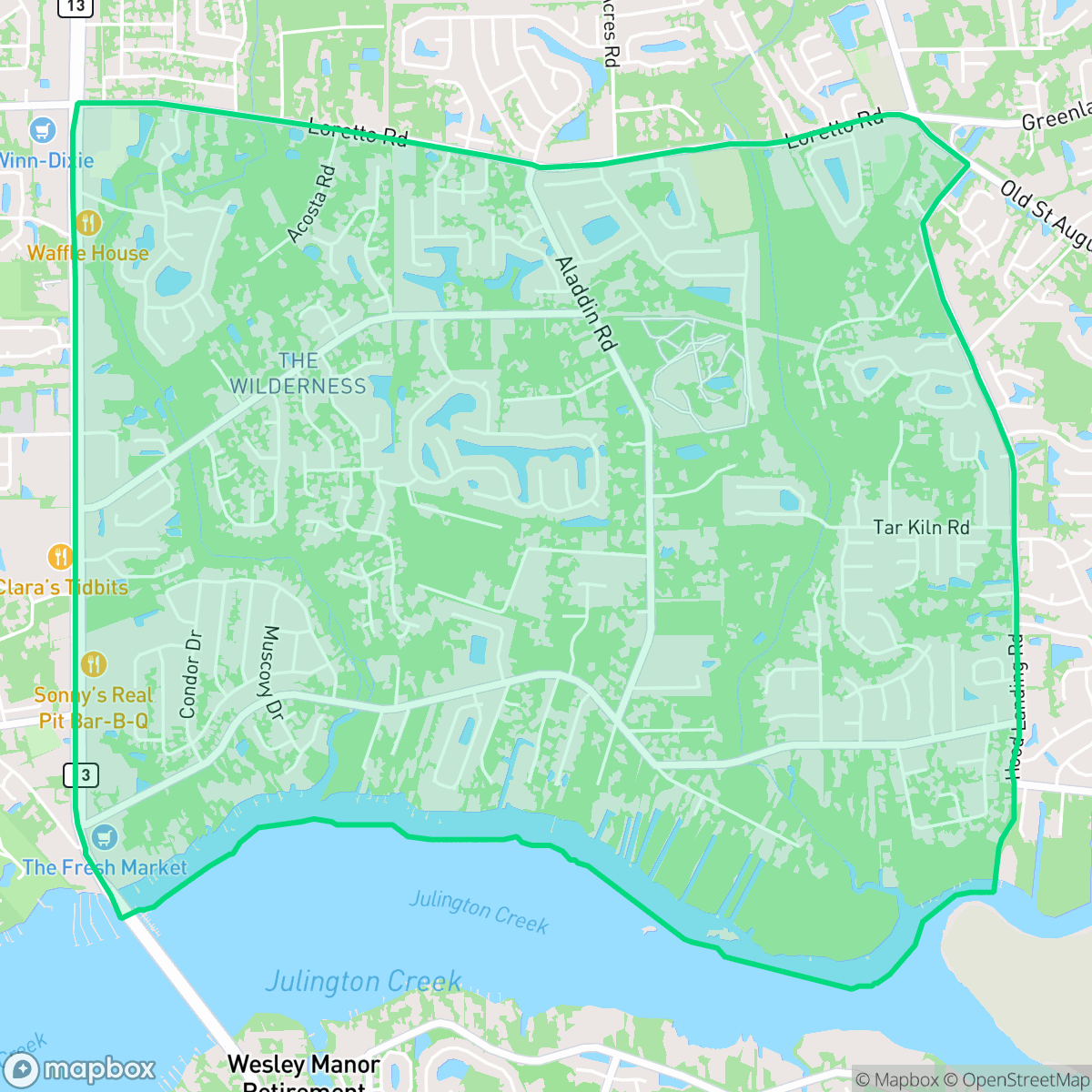
Julington Creek is a quiet, spacious residential community defined by its large, upscale homes and abundant natural scenery. The neighborhood offers a peaceful, suburban environment with clean air and high levels of privacy, making it well-suited for those seeking a tranquil lifestyle away from industrial activity.
Key Highlights
About Julington Creek
The name Julington Creek originates from the 18th-century Julianton Plantation, a 10,000-acre estate established in 1767 by British settler Francis Levett, Sr., and named in honor of his wife, Julia. During the British colonial period, the area served as a site for indigo and rice production, relying on enslaved labor. Historically, the creek was a vital waterway for the Timucua people and later gained literary prominence in Harriet Beecher Stowe’s 1873 book, Palmetto Leaves. While the modern Julington Creek Plantation is a master-planned community established in 1994, the surrounding landscape remains defined by the tidal Julington Creek and the nearby Julington-Durbin Creek Preserve, which protect the area's natural ecological features and historical connection to the St. Johns River watershed.
The area is characterized by its expansive, well-maintained properties and a semi-rural aesthetic that emphasizes greenery and water access. Residents benefit from a complete absence of industrial activity, which contributes to consistently high air quality and a calm atmosphere. The neighborhood layout prioritizes residential space, with homes featuring generous lot sizes and wooded buffers that ensure a degree of seclusion that is rarely found in the denser parts of the city. The visual landscape is polished and consistent, offering a suburban experience that feels both established and open.
While the environment is ideal for those who value quiet and privacy, the area is best suited for families and individuals who prioritize a suburban lifestyle over urban walkability. The community features a diverse age demographic, fostering a stable environment with high rates of health insurance coverage. Although the local school district is currently navigating significant budgetary and structural changes, the neighborhood remains a popular choice for those seeking a spacious, pet-friendly, and quiet place to reside.
Neighborhood Scores Across 15 Qualities
Residential spacing provides a moderate level of separation between homes, offering more distance from neighbors than is typical for the Jacksonville average. According to iHuus data, many properties benefit from wooded buffers and consistent spacing between structures.
Low traffic volumes and quiet residential loops provide safe walking areas, even though sidewalks are intermittent throughout the neighborhood. This level of walkability sits well above the Jacksonville city average.
Large homes with private pools and expansive driveways characterize the area. According to iHuus data, the visual landscape is significantly more polished than the Jacksonville average.
Wide yards and shaded, grassy verges provide ample space for walks. According to iHuus data, the availability of connected green spaces makes this area significantly more dog friendly than the Jacksonville average.
Significant tree cover and open land create a semi-rural feel that is considerably more open than the Jacksonville average. Residents can expect a suburban landscape characterized by single-family homes interspersed with neighborhood lakes and greenery.
Primarily composed of low-key suburban and semi-rural residential blocks, this area offers a peaceful environment with very sparse commercial activity. While certain pockets feature local dining and wellness services, the overall street life is more subdued than the Jacksonville average according to iHuus data.
Steady traffic sounds from nearby thoroughfares are present, though levels remain more tranquil than the Jacksonville average according to iHuus data.
Air quality remains consistently clean with rare instances of elevated readings. This level of air purity is significantly better than the average found throughout Jacksonville, according to iHuus data.
Industrial activity and heavy manufacturing are absent from this area, providing a much cleaner environment than the Jacksonville average. According to iHuus data, the neighborhood consists solely of residential, institutional, and light commercial uses without any detected warehouses or hazard sites.
Health insurance access is exceptionally high among residents, significantly outpacing the Jacksonville city average. Data from iHuus indicates that nearly all members of the community are covered.
Political leanings in this area are more conservative than the Jacksonville average, according to iHuus data.
A balanced mix of young professionals, families, and older residents defines the community. According to iHuus data, this demographic variety is significantly more diverse than the broader Jacksonville area.
Residual flood risk exists within the area, though safety levels remain significantly higher than the Jacksonville average according to iHuus data.
Address-Level Insights for Julington Creek


iHuus Neighborhood Intelligence Insights
Get address-level neighborhood insights for Julington Creek
- Street-level scores — see how individual blocks compare, not just neighborhood averages
- Micro-zone boundaries — identify quiet pockets, flood boundaries, and walkable clusters before you visit
- 15 dimensions in full — walkability, noise, air quality, school quality, insurance coverage, population age profile, urban/rural index, and more
- Boundary risk alerts — know if your address sits near a block boundary where scores drop, the kind of detail no listing will ever mention
- School insights — individual school ratings and insights, not just district-level data
- Compare before you commit — side-by-side data across neighborhoods, down to block precision
No credit card required
Compare with Any Neighborhood
| Dimension | Julington Creek | 29th and Chase |
|---|---|---|
| 🚶 Walkabilityavg 3.96 | ||
| 🔊 Acoustic Comfortavg 4.37 | ||
| 🤫 Privacy Indexavg 4.3 | ||
| 🎨 Visual Appealavg 4.24 | ||
| 🐕 Dog Friendlinessavg 4.28 | ||
| 🗺️ Urban-Rural Indexavg 5.22 | ||
| ✨ Neighborhood Vibeavg 1.5 | ||
| 🏥 Health Insurance Coverageavg 4.35 | ||
| 🌿 Air Qualityavg 3.84 | ||
| 🏭 Industrial Proximityavg 5.11 | ||
| 🌊 Flood Safetyavg 4.01 | ||
| 🗳️ Ideological Leanavg 2.75 | ||
| 👥 Population Age Profileavg 3.26 | ||
| 🔥 Fire Safety | ||
| 🏫 School Quality |
Julington Creek Rankings
School Districts Serving Julington Creek
School Insights for Julington Creek
Below average outcomes; significant attendance and academic challenges.
School Insights
See what's really behind every school rating near Julington Creek
- Individual school ratings — each school's own score with outcome context, not just a district average
- Enrollment & class size data — student-to-teacher ratio and how it compares to the state average
- Full demographics breakdown — ethnicity and gender composition for every school in the enrollment zone
- Every school in the district — all schools within the enrollment boundary ranked by rating, not just the closest one
- Grade levels & benchmarks — elementary through high school, with below/above state-average flags
No credit card required