Jacksonville University, Jacksonville
Updated · 1,795 residents
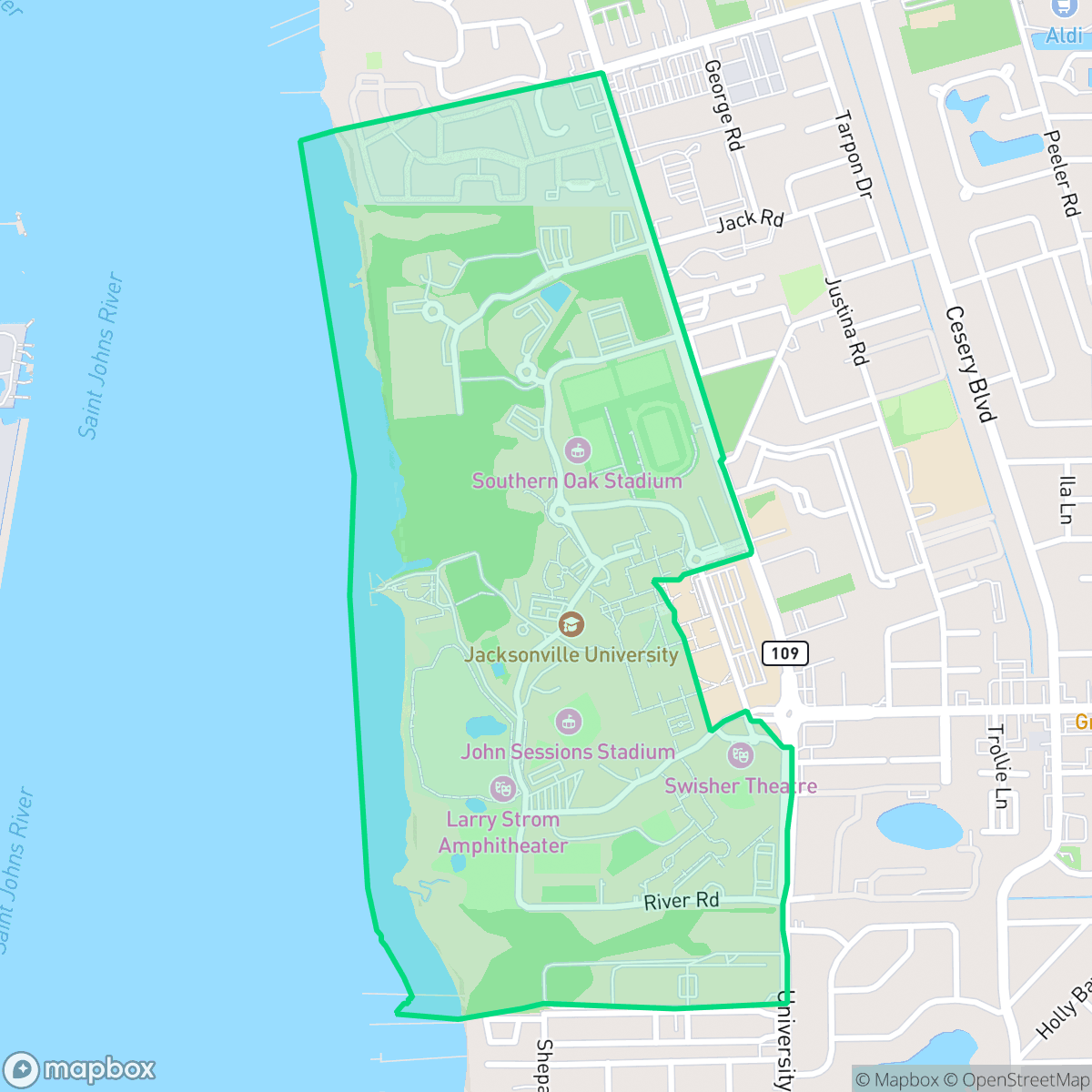
Jacksonville University is defined by its scenic St. Johns River frontage and a youthful energy driven by the presence of its namesake institution. The area offers a quiet, suburban atmosphere with tree-lined streets that provide a welcoming environment for dog owners and pedestrians.
Key Highlights
About Jacksonville University
Jacksonville University serves as the primary anchor for its namesake area within the Arlington district of Jacksonville, Florida. Originally founded in 1934 as a downtown junior college, the institution relocated to its current 240-acre riverside campus in 1950. This move catalyzed the development of the surrounding area, which transitioned from rural riverfront estates into the mid-century suburban expansion that defined post-WWII Arlington. The campus is characterized by its mid-century architectural stock, notably the Swisher Gymnasium and Auditorium, named for local philanthropist Carl S. Swisher, whose contributions were instrumental in the university's early growth. Today, the university remains a defining landmark of the Arlington waterfront, maintaining a distinct cultural and institutional identity rooted in its scenic St. Johns River frontage and its evolution from a regional college into a significant local anchor.
Jacksonville University functions as a balanced suburban landscape where campus life meets residential living. Residents benefit from a tranquil environment with notably lower acoustic levels than the broader city, making it a peaceful retreat. The visual character is diverse, featuring a mix of apartment complexes and private waterfront estates that take advantage of the river views. According to iHuus data, the neighborhood maintains a better air quality profile than the city average, contributing to its appeal as a residential destination.
While the area offers a pleasant, walkable environment under a mature tree canopy, prospective residents should note that sidewalks can be inconsistent on residential roads. The proximity to light commercial services and utility infrastructure is a factor to consider, alongside a moderate flood risk that warrants attention. With a demographic leaning toward young adults, the area provides a lively but subdued atmosphere, supported by the Duval County School District, which offers access to highly regarded magnet and advanced studies programs despite ongoing district-wide consolidations.
Neighborhood Scores Across 15 Qualities
Residential spacing varies between high-density apartment blocks and detached homes with wooded buffers. According to iHuus data, the level of separation between neighbors is slightly higher than the Jacksonville average.
Low-traffic streets and mature tree canopy make for pleasant walking, though sidewalks are frequently obscured or absent on residential roads. This level of walkability is notably higher than the Jacksonville average according to iHuus data.
The area features a varied landscape ranging from dense apartment clusters to affluent waterfront properties with private docks. This visual variety makes the neighborhood significantly more aesthetically pleasing than the Jacksonville average.
Abundant green spaces, wooded areas, and wide grassy verges provide significant opportunities for pet owners. This level of access to natural terrain is notably higher than the Jacksonville average.
A blend of residential single-family homes, apartment complexes, and campus buildings creates a landscape with more urban density than the Jacksonville average. This mix of built environments and significant tree cover provides an even balance between street infrastructure and green space.
Suburban streets offer a subdued atmosphere with pockets of activity centered around local cafes and dining. This area is significantly more lively than the Jacksonville average, providing much more social engagement than typical car-oriented neighborhoods.
Acoustic levels are notably lower than the Jacksonville average, consisting primarily of infrequent distant traffic or passing trains. According to iHuus data, this creates a more tranquil environment compared to much noisier parts of the city.
Air quality levels fluctuate between acceptable and unhealthy, which may cause occasional concern for sensitive groups. This area maintains a better air quality profile than the Jacksonville average, according to iHuus data.
Light commercial activity and service-oriented businesses are present alongside residential areas, marking a higher density of industrial proximity than the Jacksonville average. While much of the area remains residential, nearby utility services and a local Superfund site may impact environmental considerations.
Health insurance coverage among residents is slightly below the Jacksonville average, according to iHuus data. This indicates a notable portion of the local population remains uninsured.
Political perspectives are distributed relatively evenly within this area, representing a more moderate landscape than the more heavily partisan city average.
A high concentration of young adults defines the area, though there remains a modest presence of families and older residents. This demographic profile is slightly more youthful than the Jacksonville average according to iHuus data.
Flood risk in this area is notably higher than the Jacksonville average. According to iHuus data, there is a moderate level of uncertainty regarding flood levels because detailed federal studies for this specific zone are currently incomplete.
Address-Level Insights for Jacksonville University


iHuus Neighborhood Intelligence Insights
Get address-level neighborhood insights for Jacksonville University
- Street-level scores — see how individual blocks compare, not just neighborhood averages
- Micro-zone boundaries — identify quiet pockets, flood boundaries, and walkable clusters before you visit
- 15 dimensions in full — walkability, noise, air quality, school quality, insurance coverage, population age profile, urban/rural index, and more
- Boundary risk alerts — know if your address sits near a block boundary where scores drop, the kind of detail no listing will ever mention
- School insights — individual school ratings and insights, not just district-level data
- Compare before you commit — side-by-side data across neighborhoods, down to block precision
No credit card required
Compare with Any Neighborhood
| Dimension | Jacksonville University | 29th and Chase |
|---|---|---|
| 🚶 Walkabilityavg 3.96 | ||
| 🔊 Acoustic Comfortavg 4.37 | ||
| 🤫 Privacy Indexavg 4.3 | ||
| 🎨 Visual Appealavg 4.24 | ||
| 🐕 Dog Friendlinessavg 4.28 | ||
| 🗺️ Urban-Rural Indexavg 5.22 | ||
| ✨ Neighborhood Vibeavg 1.5 | ||
| 🏥 Health Insurance Coverageavg 4.35 | ||
| 🌿 Air Qualityavg 3.84 | ||
| 🏭 Industrial Proximityavg 5.11 | ||
| 🌊 Flood Safetyavg 4.01 | ||
| 🗳️ Ideological Leanavg 2.75 | ||
| 👥 Population Age Profileavg 3.26 | ||
| 🔥 Fire Safety | ||
| 🏫 School Quality |
Jacksonville University Rankings
School Districts Serving Jacksonville University
School Insights for Jacksonville University
Below average outcomes; significant attendance and academic challenges.
School Insights
See what's really behind every school rating near Jacksonville University
- Individual school ratings — each school's own score with outcome context, not just a district average
- Enrollment & class size data — student-to-teacher ratio and how it compares to the state average
- Full demographics breakdown — ethnicity and gender composition for every school in the enrollment zone
- Every school in the district — all schools within the enrollment boundary ranked by rating, not just the closest one
- Grade levels & benchmarks — elementary through high school, with below/above state-average flags
No credit card required