Jacksonville North Estate, Jacksonville
Updated · 1,878 residents
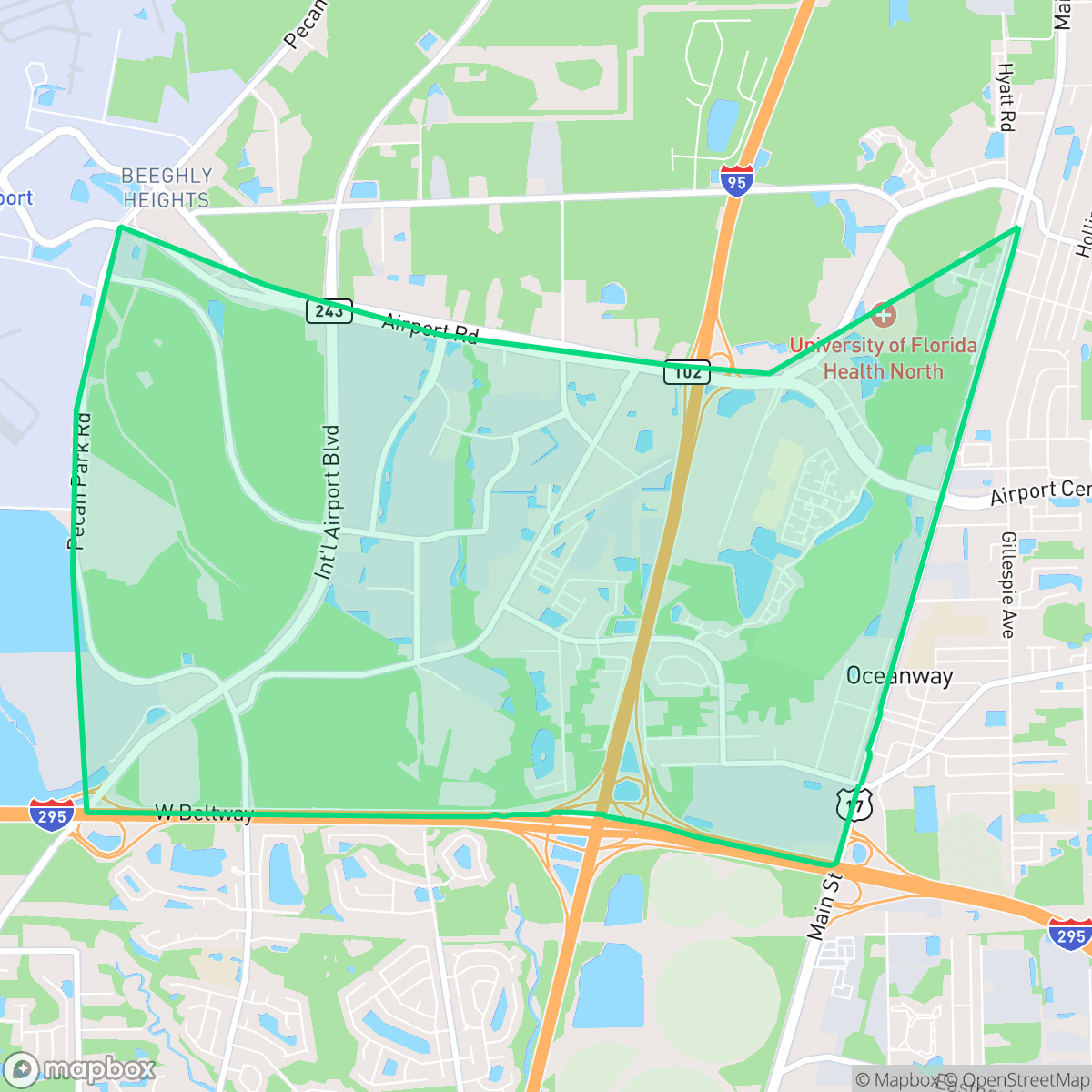
Jacksonville North Estate is a quiet, residential neighborhood primarily serving young adults who prefer a car-dependent suburban lifestyle. The area is defined by its proximity to industrial zones and major transit corridors, which contribute to elevated noise levels and limited pedestrian infrastructure.
Key Highlights
About Jacksonville North Estate
Jacksonville North Estate offers a suburban environment where residential streets and green spaces are distributed in a balanced, low-density layout. The area is notably influenced by its proximity to industrial operations and warehouses, resulting in a landscape shaped by freight traffic and airport activity. While the neighborhood provides a relatively low-key atmosphere, it remains largely car-dependent due to sparse commercial activity and a limited number of local points of interest. Residents often find that the visual environment is straightforward, featuring high-density housing with small private yards and limited greenery.
Prospective residents should note that the area experiences frequent noise from nearby transit corridors and heavy traffic, which can impact acoustic comfort. Pedestrian travel is often difficult due to limited sidewalk availability and busy road patterns. Families should also be aware that the local Duval County School District is currently undergoing significant changes, including school consolidations and budget adjustments, which may affect educational planning. The neighborhood is best suited for individuals who prioritize a quiet, suburban residential setting and are comfortable with the trade-offs of a car-centric, industrial-adjacent location.
Neighborhood Scores Across 15 Qualities
Residential spacing provides some buffer between neighbors, though privacy levels are slightly below the Jacksonville average. According to iHuus data, the neighborhood features a moderate density with mixed distances between adjacent properties.
Limited sidewalk availability and heavy traffic patterns make pedestrian travel uncomfortable; this area falls below the Jacksonville average for walkability.
Residential views consist primarily of high-density housing with limited greenery and small private yards. According to iHuus data, the visual environment is less developed than much of the Jacksonville area.
Sparse greenery and narrow verges make for limited walking opportunities for pets. This area offers fewer open spaces for dogs compared to the Jacksonville average, according to iHuus data.
Residential streets and green spaces are distributed in roughly equal measure. This layout offers a suburban character that is slightly less dense than the Jacksonville average, according to iHuus data.
This area is primarily residential and quiet, offering slightly more activity than the city average through a few local services. Most sections are car-dependent due to sparse commercial activity and very few points of interest.
Persistent noise from nearby transit corridors and heavy traffic is common here. According to iHuus data, acoustic comfort is significantly lower than the Jacksonville average due to proximity to major freeways and rail lines.
Frequent unhealthy air quality levels pose a significant health risk to sensitive groups. This area experiences lower air quality than the Jacksonville average, according to iHuus data.
Varying levels of industrial activity exist within the area, ranging from quiet residential pockets to zones characterized by heavy freight traffic and airport operations. According to iHuus data, the presence of warehouses and loading docks is notably higher than the Jacksonville average.
Health insurance accessibility in this area is slightly below the Jacksonville average, according to iHuus data. Residents may find fewer options for comprehensive coverage compared to other parts of the city.
Political leaning in this area is primarily conservative, representing a slight lean toward conservative values compared to the Jacksonville average.
Young adults make up the majority of the population, with a smaller presence of families and older residents. This demographic profile is slightly lower than the Jacksonville average according to iHuus data.
Flood risk levels in this area are difficult to determine because a detailed federal study has not yet been completed. According to iHuus data, the level of potential exposure is consistent with the average for Jacksonville.
Address-Level Insights for Jacksonville North Estate


iHuus Neighborhood Intelligence Insights
Get address-level neighborhood insights for Jacksonville North Estate
- Street-level scores — see how individual blocks compare, not just neighborhood averages
- Micro-zone boundaries — identify quiet pockets, flood boundaries, and walkable clusters before you visit
- 15 dimensions in full — walkability, noise, air quality, school quality, insurance coverage, population age profile, urban/rural index, and more
- Boundary risk alerts — know if your address sits near a block boundary where scores drop, the kind of detail no listing will ever mention
- School insights — individual school ratings and insights, not just district-level data
- Compare before you commit — side-by-side data across neighborhoods, down to block precision
No credit card required
Compare with Any Neighborhood
| Dimension | Jacksonville North Estate | 29th and Chase |
|---|---|---|
| 🚶 Walkabilityavg 3.96 | ||
| 🔊 Acoustic Comfortavg 4.37 | ||
| 🤫 Privacy Indexavg 4.3 | ||
| 🎨 Visual Appealavg 4.24 | ||
| 🐕 Dog Friendlinessavg 4.28 | ||
| 🗺️ Urban-Rural Indexavg 5.22 | ||
| ✨ Neighborhood Vibeavg 1.5 | ||
| 🏥 Health Insurance Coverageavg 4.35 | ||
| 🌿 Air Qualityavg 3.84 | ||
| 🏭 Industrial Proximityavg 5.11 | ||
| 🌊 Flood Safetyavg 4.01 | ||
| 🗳️ Ideological Leanavg 2.75 | ||
| 👥 Population Age Profileavg 3.26 | ||
| 🔥 Fire Safety | ||
| 🏫 School Quality |
Jacksonville North Estate Rankings
School Districts Serving Jacksonville North Estate
School Insights for Jacksonville North Estate
Below average outcomes; significant attendance and academic challenges.
School Insights
See what's really behind every school rating near Jacksonville North Estate
- Individual school ratings — each school's own score with outcome context, not just a district average
- Enrollment & class size data — student-to-teacher ratio and how it compares to the state average
- Full demographics breakdown — ethnicity and gender composition for every school in the enrollment zone
- Every school in the district — all schools within the enrollment boundary ranked by rating, not just the closest one
- Grade levels & benchmarks — elementary through high school, with below/above state-average flags
No credit card required