Isle of Palms, Jacksonville
Updated · 2,765 residents
Isle of Palms is a scenic waterfront community defined by its network of canals and spacious, private residential lots. While the area offers a quiet, semi-rural atmosphere, residents should be prepared for frequent aircraft noise due to the proximity of flight paths.
Key Highlights
About Isle of Palms
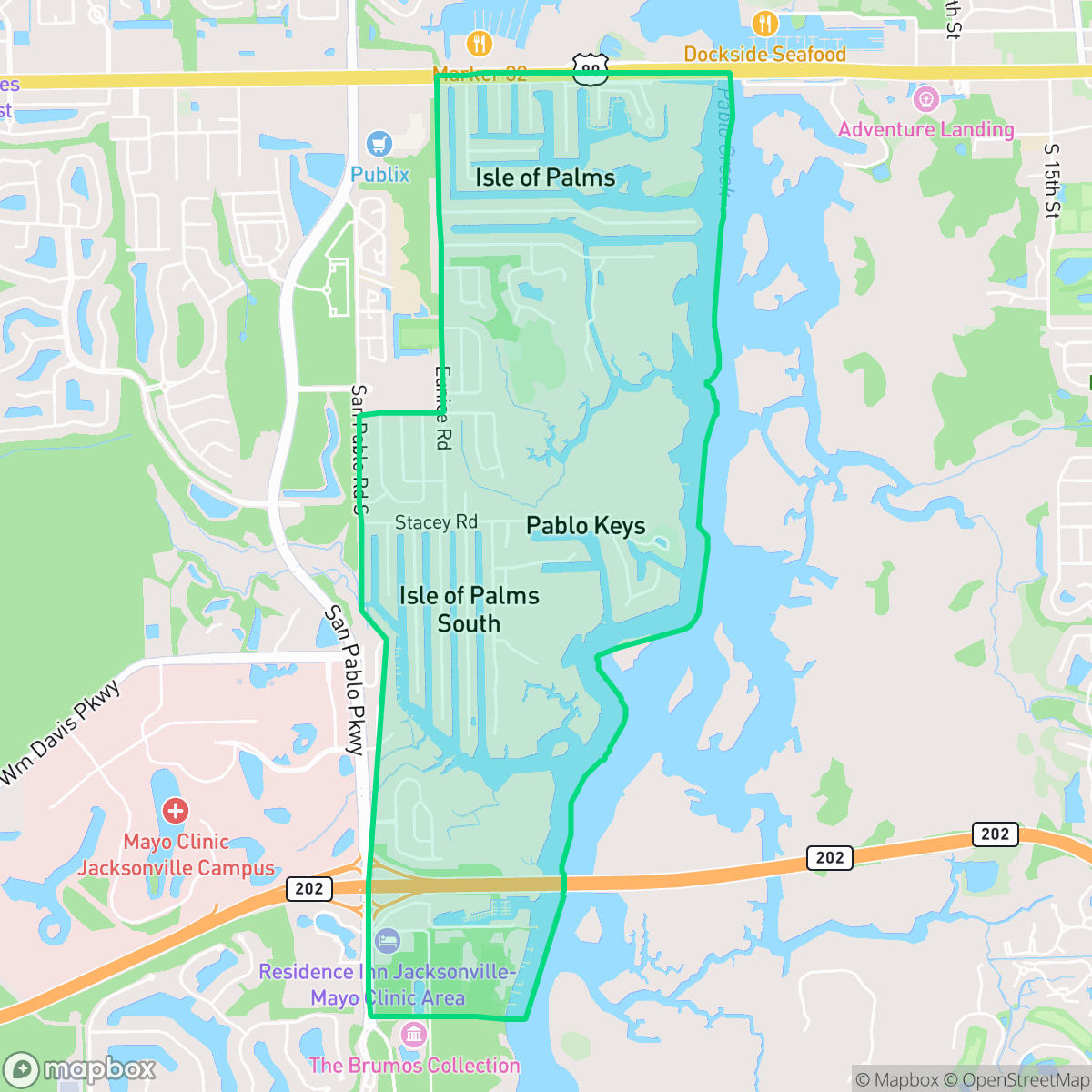
Originally consisting of wild tidal marshland, the Isle of Palms neighborhood in Jacksonville was transformed during the 1950s and 1960s into a planned waterfront community. Developers utilized extensive dredging operations to carve out a network of canals and small lakes, creating the distinctive finger-like peninsulas that define the area's layout today. The neighborhood's name was inspired by the palm trees planted along its main entrance, intended to evoke a tropical, resort-like atmosphere. Situated between San Pablo Road and the Intracoastal Waterway, the community was designed to prioritize water-oriented living, quickly becoming a destination for boating and angling enthusiasts. Over the decades, it evolved from its origins as a collection of modest waterfront ranch-style homes into a sought-after residential enclave known for its canal-front lifestyle and scenic, tree-lined streets.
The neighborhood offers an upscale, water-oriented lifestyle characterized by expansive properties and a semi-rural feel that stands apart from the density of central Jacksonville. Residents enjoy a high level of privacy and minimal industrial presence, creating a tranquil environment for those who prioritize waterfront views and spacious living. The community maintains a balanced demographic mix, fostering a stable residential atmosphere that is well-supported by high rates of health insurance coverage among the local population.
Prospective residents should consider the trade-offs of this location, particularly regarding environmental and acoustic factors. The area experiences frequent aircraft noise, and while the streets are safe for walking, the neighborhood faces moderate flood risks during severe weather. Families with school-aged children will find access to both the highly regarded St. Johns County School District and the diverse offerings of the Duval County system, depending on specific zoning. It is an ideal setting for those who value a quiet, private lifestyle over central urban convenience.
Neighborhood Scores Across 15 Qualities
Residential lots feature significant separation between homes and offer private backyards, providing much more seclusion than the Jacksonville average.
Low traffic volumes and secluded cul-de-sacs provide a safe environment for walking, even though sidewalks are not universally present. This level of walkability is notably higher than the Jacksonville average according to iHuus data.
Large homes featuring private pools and boat docks define the landscape, offering much higher visual appeal than the Jacksonville average. This area provides a scenic environment characterized by spacious properties and canal-side amenities according to iHuus data.
Residential streets feature continuous grassy verges that provide better than average walking opportunities for pets. However, many private properties contain fenced pools which may limit the availability of shared outdoor space.
Open land and nearby natural wetlands provide a more spacious, semi-rural atmosphere compared to the denser urban layout found throughout most of Jacksonville. According to iHuus data, this area features scattered homes and significant greenery that is much less common in the city center.
Low-key residential streets characterize this area, which offers a more active atmosphere than many other parts of Jacksonville. While the neighborhood remains primarily suburban with limited commercial activity, certain pockets near local marinas and transit hubs provide accessible dining and hospitality options.
Frequent aircraft noise from the nearby airport runway makes this area significantly louder than most of Jacksonville. According to iHuus data, acoustic comfort is extremely low due to constant proximity to flight paths.
Air conditions in this area are generally acceptable, though they remain slightly better than the Jacksonville average. Residents may encounter occasional periods of concern during certain weather patterns or seasons.
Heavy industrial activity is largely absent, leaving the area predominantly residential with only scattered light commercial services. This lack of manufacturing and large-scale industry makes the neighborhood significantly quieter than the Jacksonville average, according to iHuus data.
Health insurance accessibility is significantly higher here than the Jacksonville average, according to iHuus data. This indicates a resident population with much greater access to medical coverage compared to the rest of the city.
Voting patterns and census indicators show a significantly more conservative leaning than the Jacksonville average, according to iHuus data.
Residents live alongside a balanced mix of young adults, families, and older populations. This demographic spread is significantly more varied than the average found throughout Jacksonville.
Flood risk in this area is higher than the Jacksonville average, though official FEMA studies for this specific zone remain incomplete. Residents should account for moderate uncertainty regarding potential water levels during extreme weather events.
Address-Level Insights for Isle of Palms


iHuus Neighborhood Intelligence Insights
Get address-level neighborhood insights for Isle of Palms
- Street-level scores — see how individual blocks compare, not just neighborhood averages
- Micro-zone boundaries — identify quiet pockets, flood boundaries, and walkable clusters before you visit
- 15 dimensions in full — walkability, noise, air quality, school quality, insurance coverage, population age profile, urban/rural index, and more
- Boundary risk alerts — know if your address sits near a block boundary where scores drop, the kind of detail no listing will ever mention
- School insights — individual school ratings and insights, not just district-level data
- Compare before you commit — side-by-side data across neighborhoods, down to block precision
No credit card required
Compare with Any Neighborhood
| Dimension | Isle of Palms | 29th and Chase |
|---|---|---|
| 🚶 Walkabilityavg 3.96 | ||
| 🔊 Acoustic Comfortavg 4.37 | ||
| 🤫 Privacy Indexavg 4.3 | ||
| 🎨 Visual Appealavg 4.24 | ||
| 🐕 Dog Friendlinessavg 4.28 | ||
| 🗺️ Urban-Rural Indexavg 5.22 | ||
| ✨ Neighborhood Vibeavg 1.5 | ||
| 🏥 Health Insurance Coverageavg 4.35 | ||
| 🌿 Air Qualityavg 3.84 | ||
| 🏭 Industrial Proximityavg 5.11 | ||
| 🌊 Flood Safetyavg 4.01 | ||
| 🗳️ Ideological Leanavg 2.75 | ||
| 👥 Population Age Profileavg 3.26 | ||
| 🔥 Fire Safety | ||
| 🏫 School Quality |
Isle of Palms Rankings
School Districts Serving Isle of Palms
School Insights for Isle of Palms
Below average outcomes; significant attendance and academic challenges.
School Insights
See what's really behind every school rating near Isle of Palms
- Individual school ratings — each school's own score with outcome context, not just a district average
- Enrollment & class size data — student-to-teacher ratio and how it compares to the state average
- Full demographics breakdown — ethnicity and gender composition for every school in the enrollment zone
- Every school in the district — all schools within the enrollment boundary ranked by rating, not just the closest one
- Grade levels & benchmarks — elementary through high school, with below/above state-average flags
No credit card required