Hogan's Creek, Jacksonville
Updated · 3,430 residents
Hogan's Creek is a highly walkable neighborhood defined by its consistent grid layout and proximity to diverse local dining and commercial hubs. While the area offers a balanced suburban feel with a diverse age demographic, residents should expect significant noise levels from nearby railroad tracks and major highways.
Key Highlights
About Hogan's Creek
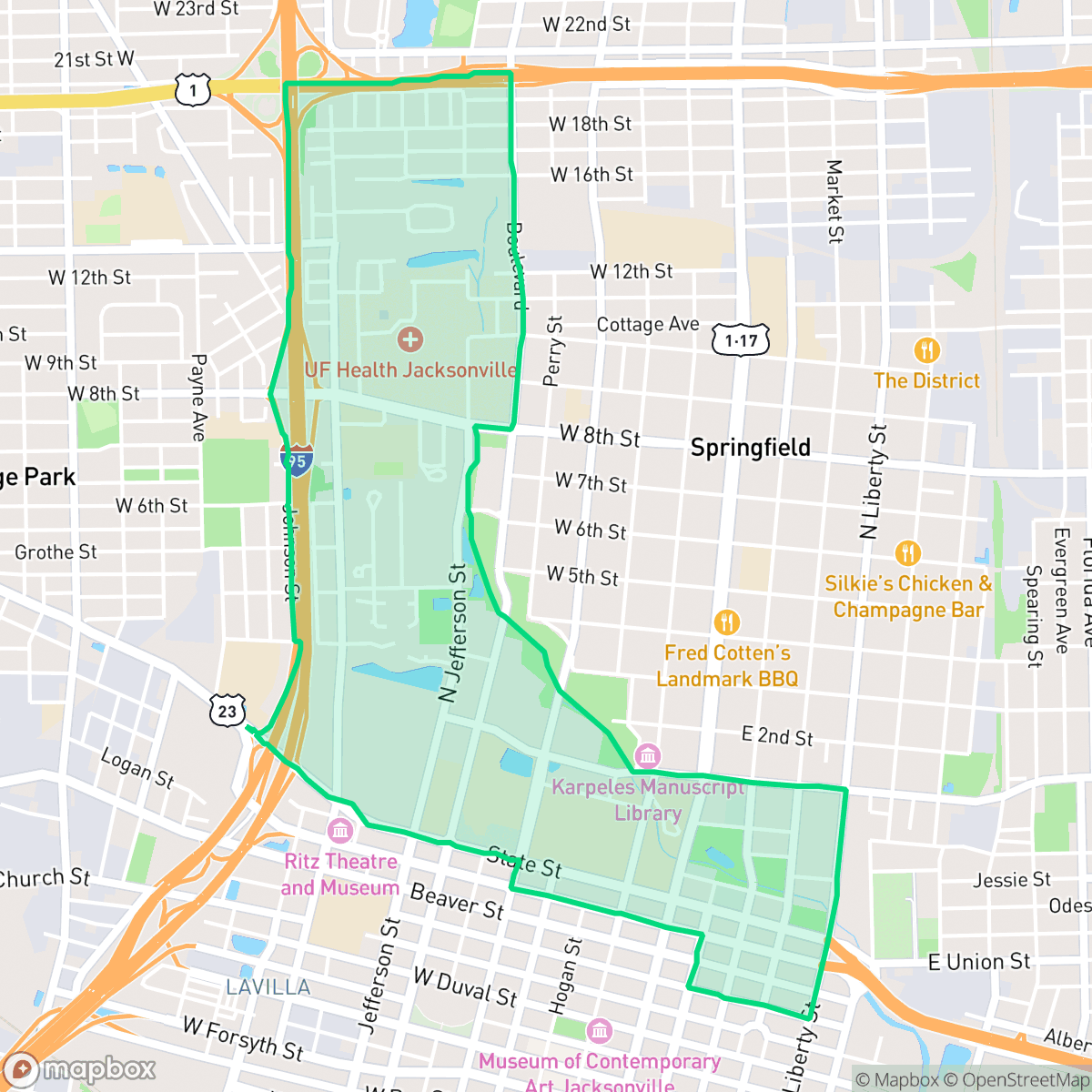
Hogan's Creek, named for early settlers John and David Hogans, historically served as a natural firebreak that spared parts of Jacksonville during the Great Fire of 1901. The area’s character was shaped by the 1929 Hogan's Creek Improvement Project, a scenic transformation led by architect Henry John Klutho and engineer Charles V. Imeson. This project diverted the creek and introduced ornamental bridges, balustrades, and flood-control reservoirs, creating a prominent urban promenade. The creek’s banks have hosted significant landmarks, including the historic Subtropical Exposition grounds, the city’s original Water Works, and Confederate Park, which served as a massive encampment during the 1914 Confederate Veterans Reunion. Once known as Jacksonville's 'Grand Canale,' the creek remains a central feature, separating the historic Springfield neighborhood from downtown and reflecting the city's early 20th-century civic planning efforts.
The neighborhood functions as an active suburban hub, characterized by a mix of modest tract housing and denser apartment clusters. Its layout supports high walkability, allowing residents easy access to a variety of local cafes and restaurants. The population is notably diverse in age, creating a balanced demographic spread that distinguishes it from more uniform residential areas in the city. The area maintains a liberal political climate and offers better than average flood safety compared to the wider Jacksonville region. Prospective residents should weigh the benefits of this central location and pedestrian friendly streets against consistent acoustic disturbances from nearby transit corridors. It is also important to note the presence of a nearby EPA Superfund site that may impact local groundwater and soil quality. Educational needs are served by the Duval County School District, where families often navigate a landscape of specialized magnet programs alongside neighborhood school consolidations and budget adjustments.
Neighborhood Scores Across 15 Qualities
Residential spacing varies between tightly clustered multi-family buildings and detached homes with some separation. According to iHuus data, privacy levels are higher than the Jacksonville average due to more consistent buffering between structures.
Pedestrian navigation is significantly easier here than in much of Jacksonville due to a consistent grid layout and visible sidewalks. While major highway interchanges can create barriers, many residential streets provide safe routes for walking.
Residential landscapes consist primarily of modest tract housing and dense apartment clusters with uniform rooflines. This area offers more visual variety than the Jacksonville average, though it lacks luxury estates or expansive private greenery.
Continuous green verges and access to a large central park provide more opportunities for pet exercise than the Jacksonville average. According to iHuus data, some residential pockets feature narrower sidewalks and limited public greenery.
Residential streets and green spaces are found in equal measure, offering a more suburban feel than the Jacksonville average. The landscape features a diverse blend of single-family homes, apartment complexes, and institutional buildings.
Bustling pockets of activity and a dense variety of local restaurants and cafes provide much more energy than the typical Jacksonville area. This mix of commercial amenities and institutional centers creates a surprisingly lively atmosphere for a suburban setting, according to iHuus data.
Frequent disturbances from nearby railroad tracks and major freeways characterize the area. According to iHuus data, acoustic comfort is notably lower than the Jacksonville average.
Air quality fluctuates between acceptable and unhealthy levels, though conditions generally remain better than the Jacksonville average. Sensitive groups may experience occasional concern during periods of poor air quality according to iHuus data.
Light commercial activity and transit traffic are present near major highway corridors, but heavy industry is notably absent compared to the Jacksonville average. Residents should be aware of a nearby EPA Superfund site that may impact local groundwater and soil quality according to iHuus data.
Health insurance coverage levels in Hogan's Creek are higher than the Jacksonville average. According to iHuus data, a notable portion of the resident population lacks coverage, indicating moderate access to health benefits.
Voting patterns and census indicators in Hogan's Creek reflect a much more liberal political leaning than the Jacksonville average, according to iHuus data.
Residents experience a balanced demographic spread of young adults, families, and older individuals; this age distribution is notably more diverse than the Jacksonville average according to iHuus data.
Residual flood risk exists due to the area's location within a floodplain, though safety levels are notably higher than the Jacksonville average according to iHuus data.
Address-Level Insights for Hogan's Creek


iHuus Neighborhood Intelligence Insights
Get address-level neighborhood insights for Hogan's Creek
- Street-level scores — see how individual blocks compare, not just neighborhood averages
- Micro-zone boundaries — identify quiet pockets, flood boundaries, and walkable clusters before you visit
- 15 dimensions in full — walkability, noise, air quality, school quality, insurance coverage, population age profile, urban/rural index, and more
- Boundary risk alerts — know if your address sits near a block boundary where scores drop, the kind of detail no listing will ever mention
- School insights — individual school ratings and insights, not just district-level data
- Compare before you commit — side-by-side data across neighborhoods, down to block precision
No credit card required
Compare with Any Neighborhood
| Dimension | Hogan's Creek | 29th and Chase |
|---|---|---|
| 🚶 Walkabilityavg 3.96 | ||
| 🔊 Acoustic Comfortavg 4.37 | ||
| 🤫 Privacy Indexavg 4.3 | ||
| 🎨 Visual Appealavg 4.24 | ||
| 🐕 Dog Friendlinessavg 4.28 | ||
| 🗺️ Urban-Rural Indexavg 5.22 | ||
| ✨ Neighborhood Vibeavg 1.5 | ||
| 🏥 Health Insurance Coverageavg 4.35 | ||
| 🌿 Air Qualityavg 3.84 | ||
| 🏭 Industrial Proximityavg 5.11 | ||
| 🌊 Flood Safetyavg 4.01 | ||
| 🗳️ Ideological Leanavg 2.75 | ||
| 👥 Population Age Profileavg 3.26 | ||
| 🔥 Fire Safety | ||
| 🏫 School Quality |
Hogan's Creek Rankings
School Districts Serving Hogan's Creek
School Insights for Hogan's Creek
Below average outcomes; significant attendance and academic challenges.
School Insights
See what's really behind every school rating near Hogan's Creek
- Individual school ratings — each school's own score with outcome context, not just a district average
- Enrollment & class size data — student-to-teacher ratio and how it compares to the state average
- Full demographics breakdown — ethnicity and gender composition for every school in the enrollment zone
- Every school in the district — all schools within the enrollment boundary ranked by rating, not just the closest one
- Grade levels & benchmarks — elementary through high school, with below/above state-average flags
No credit card required