Hidden Hills, Jacksonville
Updated · 2,831 residents
Hidden Hills is a gated community in Arlington centered around a historic golf course, defined by its rolling topography and upscale suburban aesthetic. The area offers a tranquil, semi-rural atmosphere with spacious lots and high privacy, though residents should anticipate noise from nearby transit corridors.
Key Highlights
About Hidden Hills
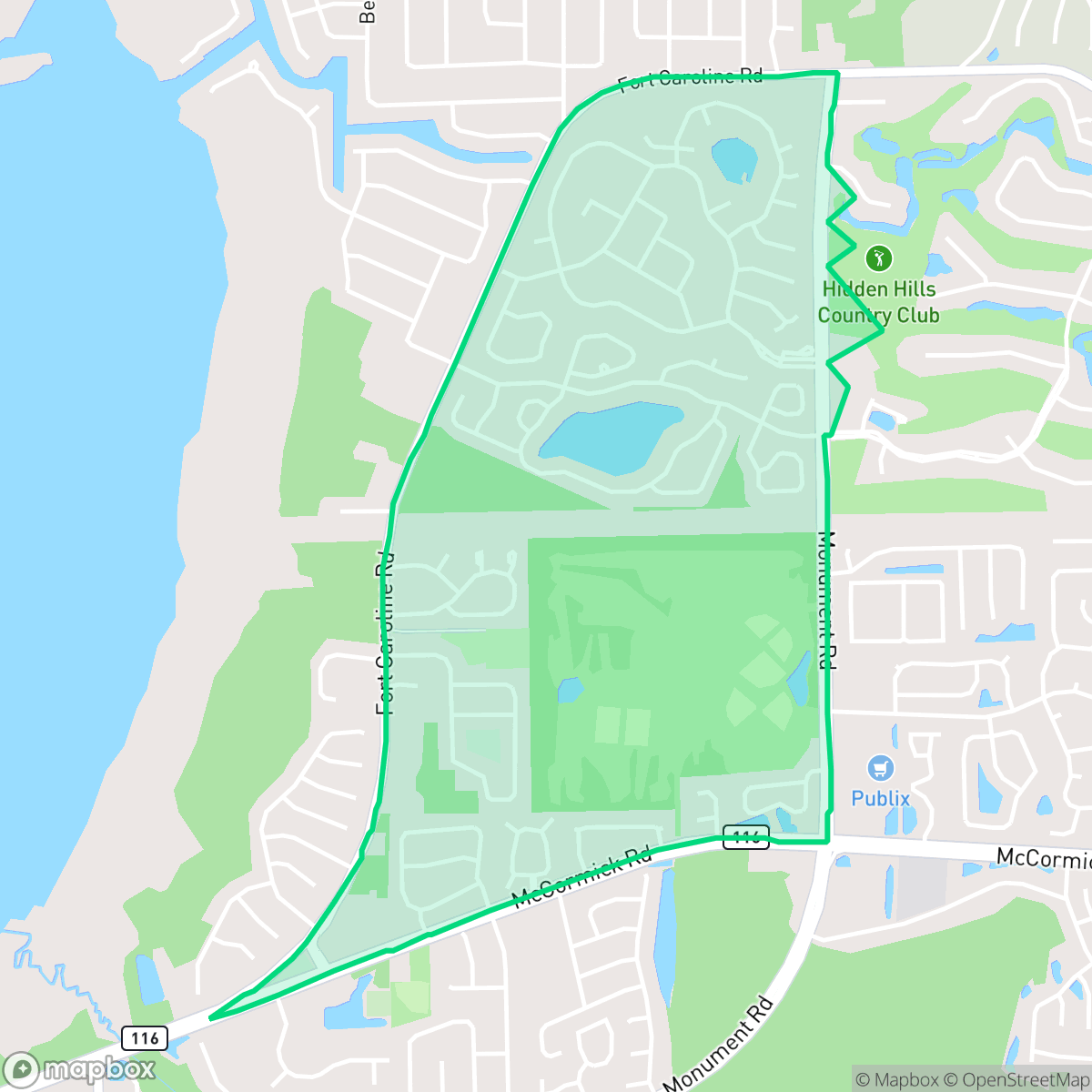
Hidden Hills is a gated residential community in Jacksonville’s Arlington area, centered around the Hidden Hills Country Club. Founded in 1966 as an exclusive, golf-only club, the site gained historical significance by hosting the Greater Jacksonville Open—a precursor to The Players Championship—from 1971 to 1979. Originally designed by Dave Gordon, the course was famously redesigned by Arnold Palmer and Ed Seay in 1986. The neighborhood transitioned into a residential community in the early 1980s, distinguished by its rolling terrain and elevation changes that are rare for the region. Nestled near the historic Fort Caroline area, the community reflects the mid-century suburban expansion of Jacksonville, evolving from a private recreational retreat into a prominent residential enclave defined by its signature golf heritage and undulating landscape.
The neighborhood features a distinct, polished environment characterized by manicured landscapes and large estates that stand out from the typical Jacksonville residential layout. Because of its unique elevation changes and abundance of green space, the area maintains a semi-rural feel despite its proximity to the city. Residents benefit from a quiet, low-density atmosphere with minimal industrial presence, making it a peaceful enclave for those who prioritize visual appeal and a sense of seclusion.
Prospective residents should consider that the community is car-dependent, though it offers better walkability than many surrounding areas. While the neighborhood provides a high level of health insurance coverage and a diverse age demographic, it is situated within a 500-year floodplain, which warrants consideration for flood safety. According to iHuus data, the area is well-suited for families and pet owners who value outdoor space, provided they are comfortable with the noise levels associated with nearby transit routes.
Neighborhood Scores Across 15 Qualities
Residential spacing provides a moderate amount of separation between neighbors, offering more buffer than the Jacksonville average. Mature trees and yard layouts help maintain a sense of distance between homes throughout the area.
Sidewalks are present along many residential blocks and provide pedestrian access to nearby commercial plazas. While the suburban layout remains car-dependent for main roads, walkability is notably higher than the Jacksonville average according to iHuus data.
Manicured landscapes, large estates, and private pools create a highly polished environment that is significantly more visually appealing than the Jacksonville average. According to iHuus data, the presence of well-maintained properties and spacious driveways defines this affluent community.
Abundant greenery, large sports fields, and grassy verges provide ample room for exercise. This area offers significantly more space for pets compared to the Jacksonville average.
Open land and woodland are frequent throughout this area, providing a much more spacious and less dense environment than the Jacksonville average. According to iHuus data, the landscape consists of scattered homes and significant green space.
Life here is notably more tranquil than the Jacksonville average, characterized by a semi-rural atmosphere with very little commercial activity. While most areas are primarily residential and low-key, some pockets offer moderate walkability near local parks and wellness services.
Frequent noise disturbances from nearby transit corridors are common here. According to iHuus data, acoustic comfort in this area is notably lower than the Jacksonville average.
Air quality levels are generally acceptable, though occasional periods of concern may affect sensitive groups. According to iHuus data, the air quality in Hidden Hills is notably better than the Jacksonville city average.
Primarily residential streets and green spaces are free from heavy industry, offering a much lower industrial presence than the Jacksonville average. Local services like small shops and cafes provide convenience without the-encroachment of large scale manufacturing or significant industrial noise.
Health insurance access among residents is significantly higher than the Jacksonville average, according to iHuus data. This high level of coverage suggests greater-than-typical access to medical services within the community.
Conservative political views hold a strong majority within the community, representing a more conservative leaning than the Jacksonville average according to iHuus data.
Residents live alongside a balanced mix of young adults, families, and seniors. This demographic spread is notably more varied than the heavily skewed age distribution found in much of Jacksonville.
Flood risk in this area is notably higher than the Jacksonville average due to its location within a 500-year floodplain. According to iHuus data, some residual flood risk remains despite being outside primary high-risk zones.
Address-Level Insights for Hidden Hills


iHuus Neighborhood Intelligence Insights
Get address-level neighborhood insights for Hidden Hills
- Street-level scores — see how individual blocks compare, not just neighborhood averages
- Micro-zone boundaries — identify quiet pockets, flood boundaries, and walkable clusters before you visit
- 15 dimensions in full — walkability, noise, air quality, school quality, insurance coverage, population age profile, urban/rural index, and more
- Boundary risk alerts — know if your address sits near a block boundary where scores drop, the kind of detail no listing will ever mention
- School insights — individual school ratings and insights, not just district-level data
- Compare before you commit — side-by-side data across neighborhoods, down to block precision
No credit card required
Compare with Any Neighborhood
| Dimension | Hidden Hills | 29th and Chase |
|---|---|---|
| 🚶 Walkabilityavg 3.96 | ||
| 🔊 Acoustic Comfortavg 4.37 | ||
| 🤫 Privacy Indexavg 4.3 | ||
| 🎨 Visual Appealavg 4.24 | ||
| 🐕 Dog Friendlinessavg 4.28 | ||
| 🗺️ Urban-Rural Indexavg 5.22 | ||
| ✨ Neighborhood Vibeavg 1.5 | ||
| 🏥 Health Insurance Coverageavg 4.35 | ||
| 🌿 Air Qualityavg 3.84 | ||
| 🏭 Industrial Proximityavg 5.11 | ||
| 🌊 Flood Safetyavg 4.01 | ||
| 🗳️ Ideological Leanavg 2.75 | ||
| 👥 Population Age Profileavg 3.26 | ||
| 🔥 Fire Safety | ||
| 🏫 School Quality |
Hidden Hills Rankings
School Districts Serving Hidden Hills
School Insights for Hidden Hills
Below average outcomes; significant attendance and academic challenges.
School Insights
See what's really behind every school rating near Hidden Hills
- Individual school ratings — each school's own score with outcome context, not just a district average
- Enrollment & class size data — student-to-teacher ratio and how it compares to the state average
- Full demographics breakdown — ethnicity and gender composition for every school in the enrollment zone
- Every school in the district — all schools within the enrollment boundary ranked by rating, not just the closest one
- Grade levels & benchmarks — elementary through high school, with below/above state-average flags
No credit card required