Greenland, Jacksonville
Updated · 10,994 residents
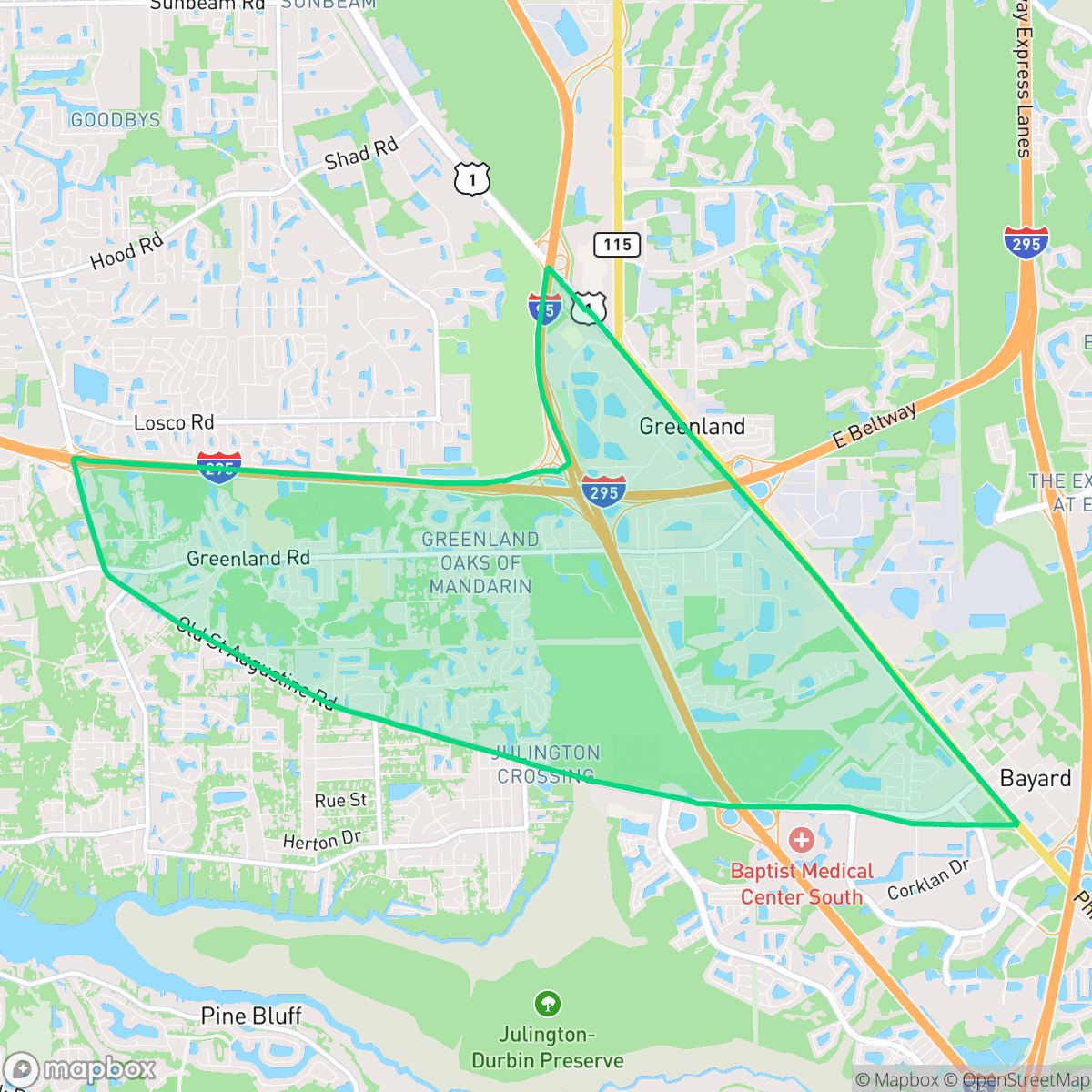
Greenland is a historic, semi-rural community in southern Duval County characterized by large homes and wooded landscapes. While the area offers a quiet, upscale residential atmosphere, residents should be aware of frequent noise from nearby railroad tracks and major highway traffic.
Key Highlights
About Greenland
Greenland, a historic community in southern Duval County, was established after the Civil War along the Old King’s Road. It emerged in the late 19th century as a settlement along the Florida East Coast (FEC) railroad corridor. The neighborhood’s identity was deeply rooted in the naval stores industry, with residents working in the surrounding pine forests to produce turpentine and resin. A significant cultural landmark is the Mount Zion Missionary Baptist Church, which was founded by freedmen in 1867 and remains in operation today. While much of the surrounding area has been transformed by modern suburban sprawl, the original Greenland community persists as a quiet, wooded enclave, with street names like Cedar, Pine, and Magnolia serving as remnants of its timber-industry heritage.
The neighborhood maintains a spacious, semi-rural feel with scattered homes situated among open land and trees. It features an upscale aesthetic, with many properties boasting private pools and well-maintained grounds. Although it lacks dense commercial activity, the area provides a peaceful environment that feels distinct from the surrounding urban sprawl. According to iHuus data, the community benefits from better-than-average air quality and a higher level of flood safety compared to the broader Jacksonville region.
Prospective residents should weigh the benefits of this private, lower-density setting against the reality of higher noise levels caused by proximity to transit corridors. While internal streets are quiet and suitable for walking, access to external amenities typically requires driving. Families considering the area will navigate the broader Duval County Public Schools system, which offers specialized magnet programs alongside ongoing district-wide adjustments to manage enrollment and budget requirements.
Neighborhood Scores Across 15 Qualities
Residents experience a moderate level of privacy with varied distances between homes. This level of spacing and density provides more separation between neighbors than the average area in Jacksonville.
Low-traffic internal streets offer a peaceful environment for walking, though connectivity to external commercial areas is limited. According to iHuus data, the neighborhood remains more walkable than much of Jacksonville despite the lack of continuous sidewalk networks.
Large homes with private pools and well-maintained driveways characterize much of this area. According to iHuus data, the visual landscape is significantly more polished than the Jacksonville average.
Sidewalk verges and retention ponds offer opportunities for exercise, though public park access is limited. According to iHuus data, the availability of walking areas is higher than the Jacksonville average.
Open land and woodland areas are frequent throughout the neighborhood, providing a much more spacious and less dense environment than the Jacksonville average. Residents will find scattered homes situated among fields rather than typical dense suburban sprawl.
A peaceful, suburban atmosphere prevails here with very little commercial activity or street life. While the area lacks a dense collection of amenities, it remains more active than many other parts of Jacksonville.
Frequent disturbances from nearby railroad tracks and heavy freeway traffic characterize this area. According to iHuus data, acoustic comfort in Greenland is significantly lower than the Jacksonville average.
Air quality levels fluctuate between acceptable and unhealthy, particularly for sensitive groups. According to iHuus data, the air quality in Greenland is notably better than the Jacksonville average.
Minimal heavy industry defines this area, which remains mostly residential with only scattered light commercial activity. This level of industrial separation is significantly higher than the Jacksonville average, though residents near major highway borders may encounter occasional transit noise.
Health insurance coverage levels in Greenland are notably higher than the Jacksonville average. According to iHuus data, a significant portion of the population maintains coverage, though gaps in access still exist among some residents.
Political preferences in Greenland align closely with the broader Jacksonville area, characterized by a conservative majority and a small presence of opposing viewpoints.
Residents experience a more balanced mix of young adults, families, and seniors than typical for Jacksonville. This demographic variety is reflected in the local population profile according to iHuus data.
Residual flood risks exist within this area as it sits inside a 500-year floodplain. According to iHuus data, the safety level in Greenland is notably higher than the Jacksonville city average.
Address-Level Insights for Greenland


iHuus Neighborhood Intelligence Insights
Get address-level neighborhood insights for Greenland
- Street-level scores — see how individual blocks compare, not just neighborhood averages
- Micro-zone boundaries — identify quiet pockets, flood boundaries, and walkable clusters before you visit
- 15 dimensions in full — walkability, noise, air quality, school quality, insurance coverage, population age profile, urban/rural index, and more
- Boundary risk alerts — know if your address sits near a block boundary where scores drop, the kind of detail no listing will ever mention
- School insights — individual school ratings and insights, not just district-level data
- Compare before you commit — side-by-side data across neighborhoods, down to block precision
No credit card required
Compare with Any Neighborhood
| Dimension | Greenland | 29th and Chase |
|---|---|---|
| 🚶 Walkabilityavg 3.96 | ||
| 🔊 Acoustic Comfortavg 4.37 | ||
| 🤫 Privacy Indexavg 4.3 | ||
| 🎨 Visual Appealavg 4.24 | ||
| 🐕 Dog Friendlinessavg 4.28 | ||
| 🗺️ Urban-Rural Indexavg 5.22 | ||
| ✨ Neighborhood Vibeavg 1.5 | ||
| 🏥 Health Insurance Coverageavg 4.35 | ||
| 🌿 Air Qualityavg 3.84 | ||
| 🏭 Industrial Proximityavg 5.11 | ||
| 🌊 Flood Safetyavg 4.01 | ||
| 🗳️ Ideological Leanavg 2.75 | ||
| 👥 Population Age Profileavg 3.26 | ||
| 🔥 Fire Safety | ||
| 🏫 School Quality |
Greenland Rankings
School Districts Serving Greenland
School Insights for Greenland
Below average outcomes; significant attendance and academic challenges.
School Insights
See what's really behind every school rating near Greenland
- Individual school ratings — each school's own score with outcome context, not just a district average
- Enrollment & class size data — student-to-teacher ratio and how it compares to the state average
- Full demographics breakdown — ethnicity and gender composition for every school in the enrollment zone
- Every school in the district — all schools within the enrollment boundary ranked by rating, not just the closest one
- Grade levels & benchmarks — elementary through high school, with below/above state-average flags
No credit card required