Grand Park, Jacksonville
Updated · 4,223 residents
Grand Park is a quiet, residential neighborhood in Jacksonville defined by its mid-century housing and proximity to logistics corridors. While it offers a semi-rural feel with diverse age demographics, residents should expect limited sidewalk connectivity and noticeable traffic noise from nearby industrial areas.
Key Highlights
About Grand Park
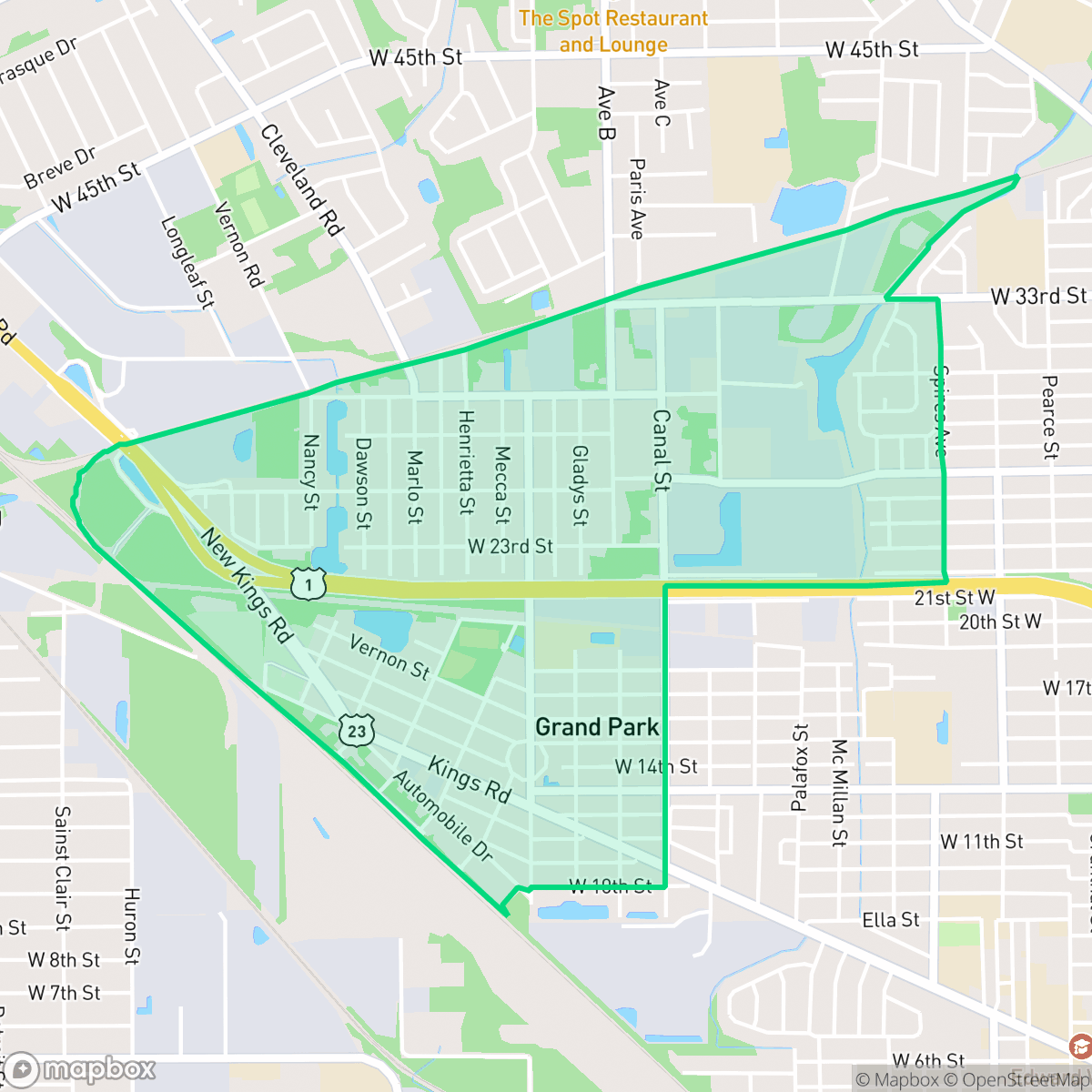
Platted in 1906 by the Jacksonville Development Company, Grand Park originated as a railroad suburb for workers at the nearby Grand Crossing rail yards. Annexed into Jacksonville in 1925, the neighborhood transitioned into a post-World War II industrial hub, defined by a mix of mid-century brick ranch-style homes and rail-served industrial facilities. Historically low-lying, the area suffered from chronic flooding until major infrastructure projects in the 1990s and 2000s modernized its drainage systems. Notable landmarks include the 1914 Public School No. 14, now the Grand Park Educational Center, and Johnnie Walker Park, which replaced the original circular park centered on the now-vanished Lake Juanita. The neighborhood’s physical character was significantly reshaped in the 1960s by the construction of the 20th Street Expressway, now known as the Martin Luther King, Jr. Parkway.
The neighborhood maintains a low-key atmosphere characterized by established housing blocks and a functional aesthetic. According to iHuus data, the area features a significantly progressive ideological lean and high rates of health insurance coverage among its residents. The landscape is a blend of residential streets and open woodland, providing a sense of seclusion that is more pronounced than in many other parts of the city. While the area is primarily residential, the northern boundary is influenced by logistics warehouses and rail lines, which contribute to a steady presence of industrial activity and associated traffic sounds.
Living in this area involves specific trade-offs, particularly regarding infrastructure and environmental factors. Pedestrian movement is hindered by a lack of continuous sidewalks, making it less convenient for dog walking or casual strolls compared to more urbanized districts. While major infrastructure projects have improved drainage in recent decades, the area retains a moderate level of flood risk, and residents should remain aware of the ongoing uncertainty regarding local flood mapping. The neighborhood is best suited for those who prioritize a quiet, established environment and value the balance of a semi-rural character over high-density commercial convenience.
Neighborhood Scores Across 15 Qualities
Residential spacing provides a moderate buffer between neighbors, offering more seclusion than the Jacksonville average. While single-family homes feature typical suburban separation, some denser apartment clusters within the area have less private yard space.
Pedestrian movement is possible due to wide, low-traffic residential streets; however, the lack of continuous sidewalks makes walking less consistent than the Jacksonville average. According to iHuus data, some areas are further hindered by proximity to major highways and industrial zones.
Standard tract housing and high-density apartment complexes define the landscape, featuring simple rooflines and small yards. This area presents a functional aesthetic that is slightly above the Jacksonville average for visual variety.
Residential streets feature narrow verges and limited greenery, as most vegetation is contained within private yards. While a large nearby park provides sports fields, the lack of wide public pathways makes walking dogs along neighborhood streets less convenient than the city average.
Open land and woodland are more prevalent here than in the typical Jacksonville area. The landscape features a mix of low-density residential housing alongside significant light industrial and logistics corridors.
Primarily composed of established housing blocks and light industrial zones, this area offers a low-key atmosphere with very little commercial activity. Residents may find the neighborhood more subdued than the Jacksonville average due to a lack of significant points of interest or dense street life.
Steady traffic sounds from nearby busy streets are common in this area. This level of acoustic activity is slightly higher than the Jacksonville average, according to iHuus data.
Air quality fluctuates between acceptable and unhealthy levels, though it remains notably better than the Jacksonville average. Sensitive groups should monitor local conditions during periods of occasional concern.
Logistics warehouses and rail lines introduce significant semi-truck traffic and noise to the northern boundary. This level of industrial proximity is roughly in line with the Jacksonville average, featuring a blend of commercial activity and residential life.
Health insurance access among Grand Park residents is significantly higher than the Jacksonville average. According to iHuus data, a large majority of the population maintains coverage.
Voting patterns and census indicators in Grand Park show a much more progressive lean than the Jacksonville average, according to iHuus data.
Residents live alongside a wide variety of age demographics, including young professionals and families. This distribution represents a more balanced age spread than the city average, according to iHuus data.
Flood risk in this area is higher than the Jacksonville average, though a lack of detailed FEMA studies makes the precise level of uncertainty moderate. Residents should remain aware that more comprehensive flood mapping for this specific zone has not yet been finalized.
Address-Level Insights for Grand Park


iHuus Neighborhood Intelligence Insights
Get address-level neighborhood insights for Grand Park
- Street-level scores — see how individual blocks compare, not just neighborhood averages
- Micro-zone boundaries — identify quiet pockets, flood boundaries, and walkable clusters before you visit
- 15 dimensions in full — walkability, noise, air quality, school quality, insurance coverage, population age profile, urban/rural index, and more
- Boundary risk alerts — know if your address sits near a block boundary where scores drop, the kind of detail no listing will ever mention
- School insights — individual school ratings and insights, not just district-level data
- Compare before you commit — side-by-side data across neighborhoods, down to block precision
No credit card required
Compare with Any Neighborhood
| Dimension | Grand Park | 29th and Chase |
|---|---|---|
| 🚶 Walkabilityavg 3.96 | ||
| 🔊 Acoustic Comfortavg 4.37 | ||
| 🤫 Privacy Indexavg 4.3 | ||
| 🎨 Visual Appealavg 4.24 | ||
| 🐕 Dog Friendlinessavg 4.28 | ||
| 🗺️ Urban-Rural Indexavg 5.22 | ||
| ✨ Neighborhood Vibeavg 1.5 | ||
| 🏥 Health Insurance Coverageavg 4.35 | ||
| 🌿 Air Qualityavg 3.84 | ||
| 🏭 Industrial Proximityavg 5.11 | ||
| 🌊 Flood Safetyavg 4.01 | ||
| 🗳️ Ideological Leanavg 2.75 | ||
| 👥 Population Age Profileavg 3.26 | ||
| 🔥 Fire Safety | ||
| 🏫 School Quality |
Grand Park Rankings
School Districts Serving Grand Park
School Insights for Grand Park
Below average outcomes; significant attendance and academic challenges.
School Insights
See what's really behind every school rating near Grand Park
- Individual school ratings — each school's own score with outcome context, not just a district average
- Enrollment & class size data — student-to-teacher ratio and how it compares to the state average
- Full demographics breakdown — ethnicity and gender composition for every school in the enrollment zone
- Every school in the district — all schools within the enrollment boundary ranked by rating, not just the closest one
- Grade levels & benchmarks — elementary through high school, with below/above state-average flags
No credit card required