Gilmore, Jacksonville
Updated · 779 residents
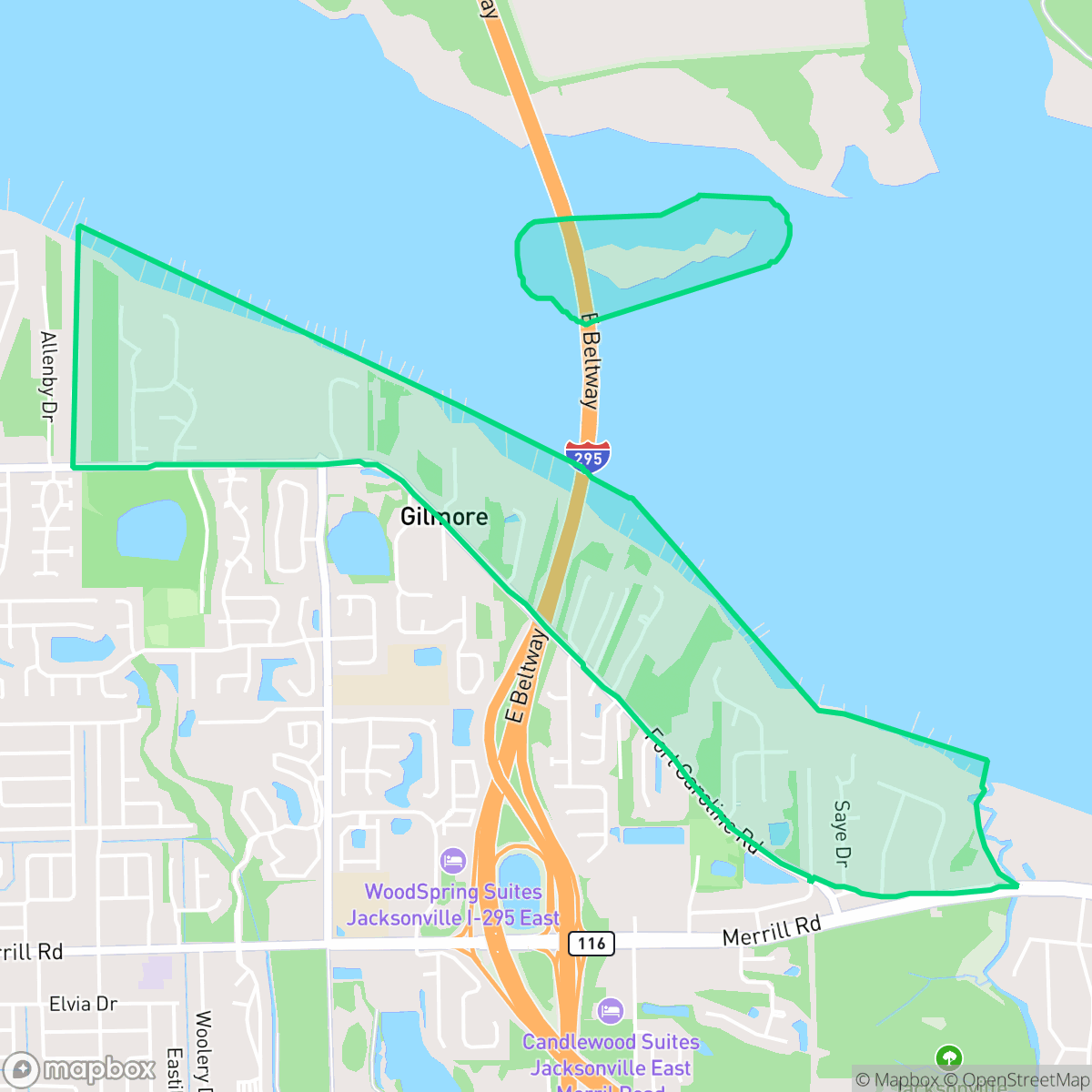
Gilmore is a quiet, residential community in Arlington that offers a peaceful, low-density environment near the St. Johns River. While the area provides a suburban feel with abundant greenery, residents should be aware of occasional noise from nearby transit routes and railroad tracks.
Key Highlights
About Gilmore
The historic Gilmore community, located in the Arlington area of Jacksonville, overlooks Mill Cove along the St. Johns River. The area’s history is rooted in prehistoric Native American settlements, evidenced by local mounds. In 1885, Irish immigrant Archibald Gilmore homesteaded 80 acres of land south of Merrill Road, establishing a community that became known for its riverfront fish camps. The Gilmore family significantly shaped the area by platting subdivisions in 1914 and 1925, and donating land for the Gilmore Methodist Episcopal Church, which was organized in 1922. The community is also home to the Gilmore-Cameron Cemetery, the final resting place for many early settlers. Today, the area is recognized by a historical marker that commemorates its evolution from a pioneer homestead and fishing village into a residential community.
The area is defined by its subdued atmosphere and residential focus, characterized by a mix of single-family homes and wooded buffers. It maintains a balanced suburban layout that integrates natural forest cover with established housing clusters, offering a visual character that varies from standard suburban streets to more private, manicured properties. The environment is generally quiet, though proximity to major transit corridors and rail lines introduces periodic noise that can impact acoustic comfort.
For those considering this location, the neighborhood is well-suited for residents who prioritize a secluded, nature-oriented setting over high-density commercial activity. While the area provides ample space for outdoor activities like dog walking, it lacks significant local commercial destinations. Families will navigate the Duval County School District, which offers a diverse range of educational options, including competitive magnet programs, though the district is currently undergoing significant administrative and structural changes to address budget and enrollment shifts.
Neighborhood Scores Across 15 Qualities
Housing layouts vary between clustered townhomes and single-family homes with wooded buffers, matching the typical density seen across Jacksonville. According to iHuus data, residents can expect a mix of closely spaced structures and properties with moderate spacing between neighbors.
Low traffic volumes and residential cul-de-sacs provide a safe environment for walking, though the lack of continuous sidewalks is consistent with the city average. Some paths may be partially obscured by dense tree canopy according to iHuus data.
Residential views range from standard suburban housing to more affluent pockets with manicured properties and private pools. This variety of streetscapes offers a higher level of visual interest than the Jacksonville average.
Abundant wooded buffers and large sports fields provide ample exercise space for pets. This area offers slightly more greenery and grass verges for dog walking than the Jacksonville average.
Residential layouts feature a consistent balance of single-family homes and green spaces, matching the broader Jacksonville urban-rural profile. According to iHuus data, the landscape includes dense forest cover and retention ponds interspersed with established housing clusters.
Primarily composed of single-family homes and dense forest cover, this area offers a very subdued atmosphere with minimal commercial activity. According to iHuus data, the neighborhood lacks significant local destinations and sits slightly below the city average for liveliness.
Frequent sounds from nearby railroad tracks and major transit routes make this area noisier than the Jacksonville average. According to iHuus data, residents may experience consistent acoustic disturbances from heavy traffic and rail activity.
Air quality levels fluctuate between acceptable and unhealthy, presenting occasional concerns for sensitive groups. This area maintains a slightly better air quality profile than the Jacksonville average, according to iHuus data.
Industrial activity is significantly lower than the Jacksonville average, with most of the area consisting of residential and recreational land use. While heavy industry is absent, some residents near storage facilities may experience increased freight traffic and loading dock noise.
Health insurance access among residents is slightly above the Jacksonville average, according to iHuus data. This indicates a moderate level of coverage for those living in the area.
Conservative viewpoints represent the majority of the community, though there is a modest presence of opposing perspectives. This political lean is slightly higher than the Jacksonville average according to iHuus data.
Young adults comprise the majority of the population, though there is a modest presence of families and older residents. This age profile leans slightly more towards a younger demographic than the Jacksonville average, according to iHuus data.
Flood safety levels in Gilmore are slightly higher than the Jacksonville average, though precise risk assessments remain undetermined due to a lack of detailed federal studies. Residents should account for potential water concerns when considering long term property stability according to iHuus data.
Address-Level Insights for Gilmore


iHuus Neighborhood Intelligence Insights
Get address-level neighborhood insights for Gilmore
- Street-level scores — see how individual blocks compare, not just neighborhood averages
- Micro-zone boundaries — identify quiet pockets, flood boundaries, and walkable clusters before you visit
- 15 dimensions in full — walkability, noise, air quality, school quality, insurance coverage, population age profile, urban/rural index, and more
- Boundary risk alerts — know if your address sits near a block boundary where scores drop, the kind of detail no listing will ever mention
- School insights — individual school ratings and insights, not just district-level data
- Compare before you commit — side-by-side data across neighborhoods, down to block precision
No credit card required
Compare with Any Neighborhood
| Dimension | Gilmore | 29th and Chase |
|---|---|---|
| 🚶 Walkabilityavg 3.96 | ||
| 🔊 Acoustic Comfortavg 4.37 | ||
| 🤫 Privacy Indexavg 4.3 | ||
| 🎨 Visual Appealavg 4.24 | ||
| 🐕 Dog Friendlinessavg 4.28 | ||
| 🗺️ Urban-Rural Indexavg 5.22 | ||
| ✨ Neighborhood Vibeavg 1.5 | ||
| 🏥 Health Insurance Coverageavg 4.35 | ||
| 🌿 Air Qualityavg 3.84 | ||
| 🏭 Industrial Proximityavg 5.11 | ||
| 🌊 Flood Safetyavg 4.01 | ||
| 🗳️ Ideological Leanavg 2.75 | ||
| 👥 Population Age Profileavg 3.26 | ||
| 🔥 Fire Safety | ||
| 🏫 School Quality |
Gilmore Rankings
School Districts Serving Gilmore
School Insights for Gilmore
Below average outcomes; significant attendance and academic challenges.
School Insights
See what's really behind every school rating near Gilmore
- Individual school ratings — each school's own score with outcome context, not just a district average
- Enrollment & class size data — student-to-teacher ratio and how it compares to the state average
- Full demographics breakdown — ethnicity and gender composition for every school in the enrollment zone
- Every school in the district — all schools within the enrollment boundary ranked by rating, not just the closest one
- Grade levels & benchmarks — elementary through high school, with below/above state-average flags
No credit card required