Garden City, Jacksonville
Updated · 2,111 residents
Garden City is a quiet, semi-rural neighborhood in northwest Jacksonville that offers a calm, low-key atmosphere for its residents. The area features modest single-family homes on spacious lots, providing a sense of privacy that is often unavailable in more urbanized parts of the city.
Key Highlights
About Garden City
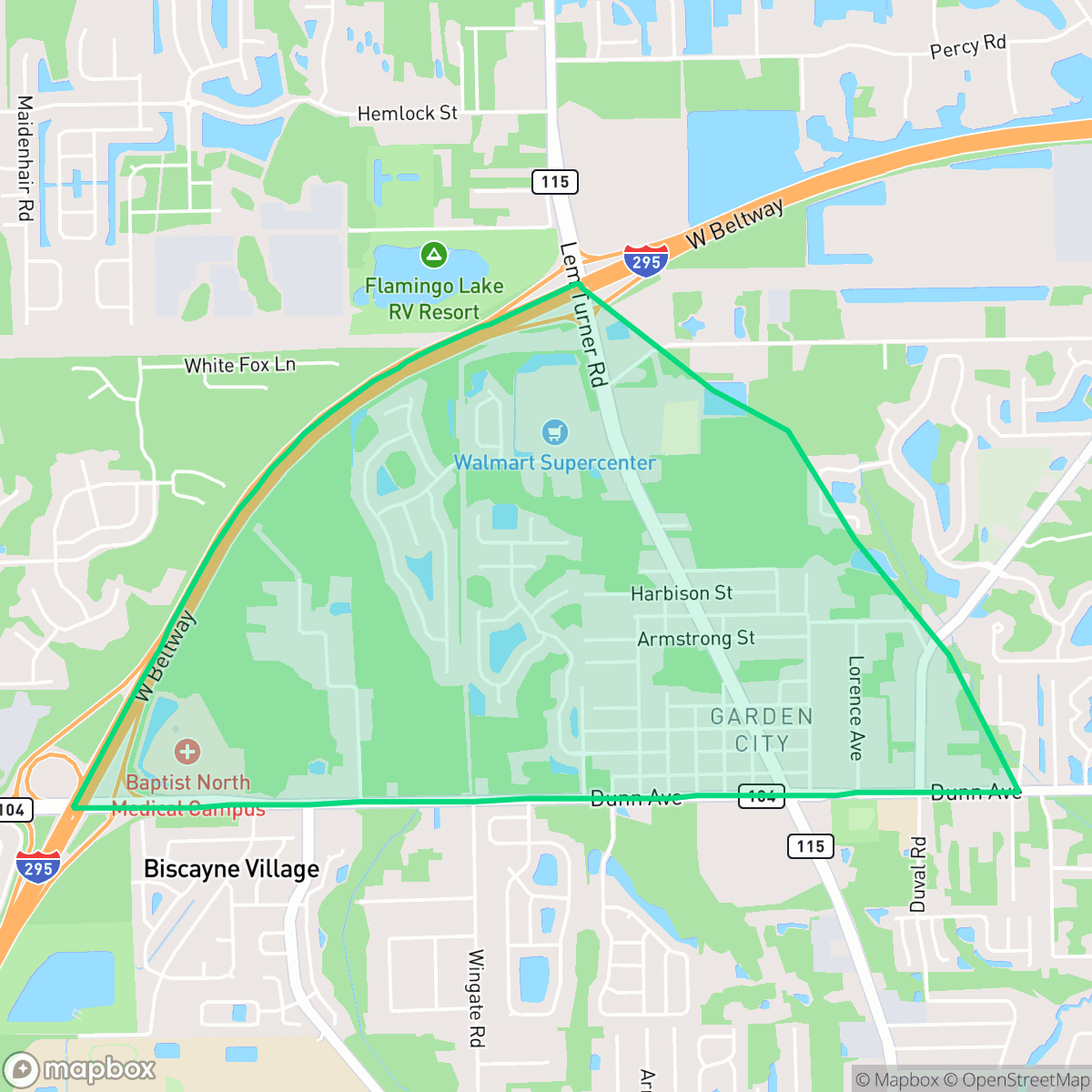
Located in northwest Jacksonville, the Garden City neighborhood is situated near the intersection of Lem Turner Road and Dunn Avenue. The area is named for the road established by Lemuel Turner, who historically operated a ferry across the nearby Trout River. A focal point of the community's history was the Garden City Park site, which was deeded to Duval County by the Garden City Community Club in 1936. This location previously housed the neighborhood’s first official post office and a long-standing community center that served as a local landmark until its demolition in 2002. While the neighborhood retains a sparse suburban character, its residential development primarily occurred during the second half of the 20th century, reflecting the broader growth trends of the Northside region.
The neighborhood is defined by its open, semi-rural character and modest residential streetscapes. It provides a peaceful environment with minimal industrial interference, allowing for a more secluded living experience than many other Jacksonville communities. Residents benefit from high levels of health insurance coverage and a balanced demographic profile that includes a diverse mix of young adults, families, and seniors. According to iHuus data, the area maintains a neat appearance with tidy yards and simple architecture, contributing to a stable and structured local environment.
While the area offers a quiet, walkable environment with low traffic volumes, prospective residents should note the lack of dedicated sidewalks and the presence of noise from nearby railroad tracks and major freeways. The neighborhood is well-suited for those who prioritize privacy and a relaxed pace of life over proximity to dense commercial hubs. Families should consider the broader context of the Duval County School District, which provides a range of specialized magnet programs alongside the challenges of ongoing district-wide school consolidations.
Neighborhood Scores Across 15 Qualities
Residential plots feature moderate spacing and wooded buffers that offer more seclusion than the Jacksonville average. According to iHuus data, houses are typically separated by a notable distance from one another.
Low traffic volumes and proximity to commercial hubs make much of the area accessible on foot, despite a lack of sidewalks. This level of walkability sits well above the Jacksonville average.
Standard single-family homes with tidy yards and simple architecture define the local scenery, which appears more visually structured than much of Jacksonville. According to iHuus data, the area lacks significant greenery or large private amenities but maintains a neat appearance.
Low-traffic residential streets and wooded buffers provide ample space for exercise, making this area more dog-friendly than the Jacksonville average. While dedicated public parks are limited, the quiet nature of the neighborhood supports easy walking routes.
Low density living with frequent open land and wooded patches defines this area. According to iHuus data, the landscape is significantly more open and less urbanized than the Jacksonville average.
Residential streets offer a calm, low-key atmosphere with significantly more activity than the Jacksonville average. While commercial options are sparse, certain pockets feature local dining and wellness services within a moderately walkable setting.
Frequent disturbances from nearby railroad tracks and major freeway traffic characterize this area. According to iHuus data, the acoustic environment is notably more disruptive than the Jacksonville average.
Air quality in Garden City fluctuates between acceptable and unhealthy levels, though it remains slightly better than the Jacksonville average. Residents sensitive to pollutants may notice occasional periods of concern according to iHuus data.
Residential life remains largely undisturbed by heavy industry, as the area features only scattered light commercial services and utility infrastructure. According to iHuus data, this lack of industrial density is significantly lower than the Jacksonville average.
Health insurance access is significantly higher in Garden City than the Jacksonville average. According to iHuus data, a substantial majority of residents are covered by health insurance plans.
Voting patterns and census indicators reflect a predominantly liberal political leaning, which is notably higher than the Jacksonville average.
Residents live alongside a more varied mix of young adults, families, and seniors than is typical for the broader Jacksonville area. According to iHuus data, this provides a balanced demographic landscape without the concentration seen in other parts of the city.
Residual flood risks exist within the area, though safety levels remain notably higher than the Jacksonville average according to iHuus data.
Address-Level Insights for Garden City


iHuus Neighborhood Intelligence Insights
Get address-level neighborhood insights for Garden City
- Street-level scores — see how individual blocks compare, not just neighborhood averages
- Micro-zone boundaries — identify quiet pockets, flood boundaries, and walkable clusters before you visit
- 15 dimensions in full — walkability, noise, air quality, school quality, insurance coverage, population age profile, urban/rural index, and more
- Boundary risk alerts — know if your address sits near a block boundary where scores drop, the kind of detail no listing will ever mention
- School insights — individual school ratings and insights, not just district-level data
- Compare before you commit — side-by-side data across neighborhoods, down to block precision
No credit card required
Compare with Any Neighborhood
| Dimension | Garden City | 29th and Chase |
|---|---|---|
| 🚶 Walkabilityavg 3.96 | ||
| 🔊 Acoustic Comfortavg 4.37 | ||
| 🤫 Privacy Indexavg 4.3 | ||
| 🎨 Visual Appealavg 4.24 | ||
| 🐕 Dog Friendlinessavg 4.28 | ||
| 🗺️ Urban-Rural Indexavg 5.22 | ||
| ✨ Neighborhood Vibeavg 1.5 | ||
| 🏥 Health Insurance Coverageavg 4.35 | ||
| 🌿 Air Qualityavg 3.84 | ||
| 🏭 Industrial Proximityavg 5.11 | ||
| 🌊 Flood Safetyavg 4.01 | ||
| 🗳️ Ideological Leanavg 2.75 | ||
| 👥 Population Age Profileavg 3.26 | ||
| 🔥 Fire Safety | ||
| 🏫 School Quality |
Garden City Rankings
School Districts Serving Garden City
School Insights for Garden City
Below average outcomes; significant attendance and academic challenges.
School Insights
See what's really behind every school rating near Garden City
- Individual school ratings — each school's own score with outcome context, not just a district average
- Enrollment & class size data — student-to-teacher ratio and how it compares to the state average
- Full demographics breakdown — ethnicity and gender composition for every school in the enrollment zone
- Every school in the district — all schools within the enrollment boundary ranked by rating, not just the closest one
- Grade levels & benchmarks — elementary through high school, with below/above state-average flags
No credit card required