Fort George Island, Jacksonville
Updated · 304 residents
Fort George Island is a tranquil, semi-rural community defined by its protected natural landscapes and deep historical roots. While the area offers a quiet, secluded residential environment, it remains challenging for pedestrians and requires residents to rely on vehicles for daily errands.
Key Highlights
About Fort George Island
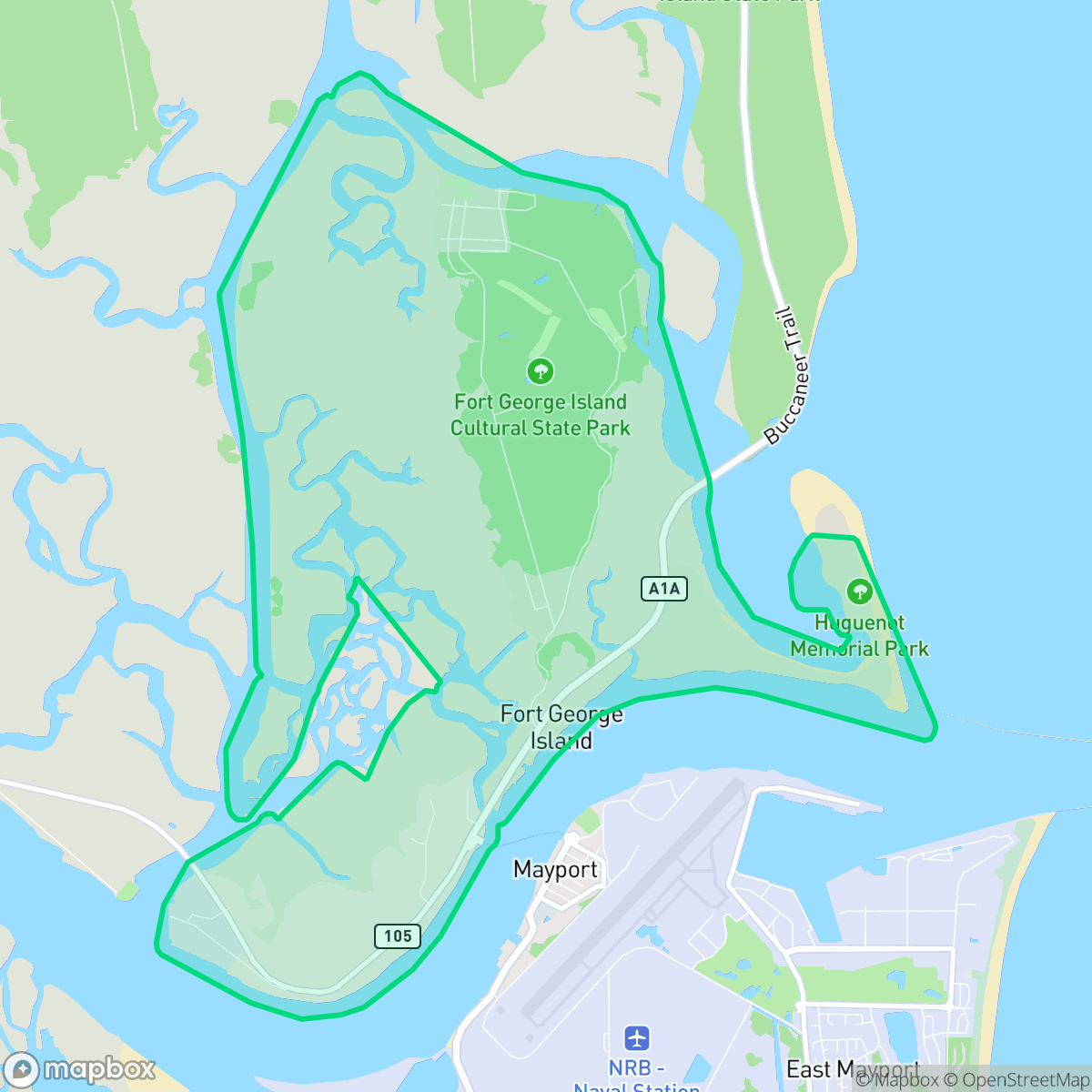
Originally known as Alicamani, Fort George Island served as a major center for the Timucua people, evidenced by significant shell middens. By the late 16th century, the Spanish established the Mission of San Juan del Puerto on the site. Following British control in the 18th century, James Oglethorpe constructed Fort St. George to defend the Georgia colony. The island later became a hub for plantation-era agriculture, most notably under Zephaniah Kingsley, whose namesake plantation remains a historic landmark. In the early 20th century, the island transitioned into a leisure destination, marked by the 1928 construction of the Colonial Revival-style Ribault Club. Today, much of the island is preserved within the Fort George Island Cultural State Park and the Timucuan Ecological and Historic Preserve, protecting its diverse layers of Native American, colonial, and plantation history.
The neighborhood functions as a quiet, residential enclave that maintains a suburban balance between developed streets and expansive green spaces. The atmosphere is notably subdued, with minimal commercial activity or bustling street life. Residents here enjoy a sense of privacy that exceeds typical urban environments, benefiting from a setting that is largely removed from heavy industrial presence, according to iHuus data.
Living in the area involves navigating specific environmental and logistical considerations, including a higher susceptibility to flooding that necessitates appropriate insurance coverage. The population consists primarily of young adults, and while it offers a peaceful lifestyle, those seeking walkability or extensive local pet amenities may find the infrastructure limited. Families should note that school options fall under the Duval County district, which provides access to specialized magnet programs alongside broader challenges related to district-wide budget and enrollment management.
Neighborhood Scores Across 15 Qualities
Residential spacing provides a reasonable buffer between neighbors, offering slightly more seclusion than the typical Jacksonville neighborhood according to iHuus data.
Limited sidewalk availability and vehicle traffic make pedestrian travel uncomfortable. Walking accessibility is slightly lower than the Jacksonville average, according to iHuus data.
Standard tract housing with tidy but small yards defines the local landscape. This area offers slightly more visual variety than the average Jacksonville neighborhood according to iHuus data.
Access to public parks and wide green verges for walking pets is below the Jacksonville average, according to iHuus data. Residents may find fewer specialized dog-friendly spaces within this immediate area.
Residential streets and green spaces are distributed in relatively equal measure, providing a more suburban feel than the Jacksonville average according to iHuus data.
Very little commercial activity or street life exists here, creating a tranquil atmosphere that is slightly more subdued than the Jacksonville average. Residents will find a primarily residential and semi-rural landscape with few local amenities or bustling shopping districts.
Local traffic from nearby busy streets creates a steady hum throughout the area. This level of acoustic activity is roughly consistent with the average found across Jacksonville.
Air quality levels fluctuate between acceptable and unhealthy for sensitive groups. According to iHuus data, conditions in this area are slightly better than the Jacksonville city average.
Residential life remains largely separated from heavy industry, though some light commercial units and local services are present. This level of industrial activity is slightly below the Jacksonville average, according to iHuus data.
Health insurance coverage levels in this area are roughly comparable to the Jacksonville average. According to iHuus data, a significant portion of the resident population remains uninsured.
Voting patterns and census indicators reflect a predominantly conservative political leaning, which is more pronounced than the average found across Jacksonville.
A significant portion of the population consists of young adults, with a slightly lower presence of families and seniors compared to the Jacksonville average. According to iHuus data, the demographic profile skews younger than much of the surrounding city.
Properties are located within a designated floodplain, which means flood insurance is typically required. This level of vulnerability to rising waters is higher than the Jacksonville average, according to iHuus data.
Address-Level Insights for Fort George Island


iHuus Neighborhood Intelligence Insights
Get address-level neighborhood insights for Fort George Island
- Street-level scores — see how individual blocks compare, not just neighborhood averages
- Micro-zone boundaries — identify quiet pockets, flood boundaries, and walkable clusters before you visit
- 15 dimensions in full — walkability, noise, air quality, school quality, insurance coverage, population age profile, urban/rural index, and more
- Boundary risk alerts — know if your address sits near a block boundary where scores drop, the kind of detail no listing will ever mention
- School insights — individual school ratings and insights, not just district-level data
- Compare before you commit — side-by-side data across neighborhoods, down to block precision
No credit card required
Compare with Any Neighborhood
| Dimension | Fort George Island | 29th and Chase |
|---|---|---|
| 🚶 Walkabilityavg 3.96 | ||
| 🔊 Acoustic Comfortavg 4.37 | ||
| 🤫 Privacy Indexavg 4.3 | ||
| 🎨 Visual Appealavg 4.24 | ||
| 🐕 Dog Friendlinessavg 4.28 | ||
| 🗺️ Urban-Rural Indexavg 5.22 | ||
| ✨ Neighborhood Vibeavg 1.5 | ||
| 🏥 Health Insurance Coverageavg 4.35 | ||
| 🌿 Air Qualityavg 3.84 | ||
| 🏭 Industrial Proximityavg 5.11 | ||
| 🌊 Flood Safetyavg 4.01 | ||
| 🗳️ Ideological Leanavg 2.75 | ||
| 👥 Population Age Profileavg 3.26 | ||
| 🔥 Fire Safety | ||
| 🏫 School Quality |
Fort George Island Rankings
School Districts Serving Fort George Island
School Insights for Fort George Island
Below average outcomes; significant attendance and academic challenges.
School Insights
See what's really behind every school rating near Fort George Island
- Individual school ratings — each school's own score with outcome context, not just a district average
- Enrollment & class size data — student-to-teacher ratio and how it compares to the state average
- Full demographics breakdown — ethnicity and gender composition for every school in the enrollment zone
- Every school in the district — all schools within the enrollment boundary ranked by rating, not just the closest one
- Grade levels & benchmarks — elementary through high school, with below/above state-average flags
No credit card required