Fort Caroline Shores, Jacksonville
Updated · 3,547 residents
Fort Caroline Shores is a distinctive residential enclave defined by its hilly topography and lush, wooded landscapes along the St. Johns River. The area offers a quiet, semi-rural atmosphere with upscale homes and well-maintained properties, providing a serene retreat from the typical Jacksonville urban environment.
Key Highlights
About Fort Caroline Shores
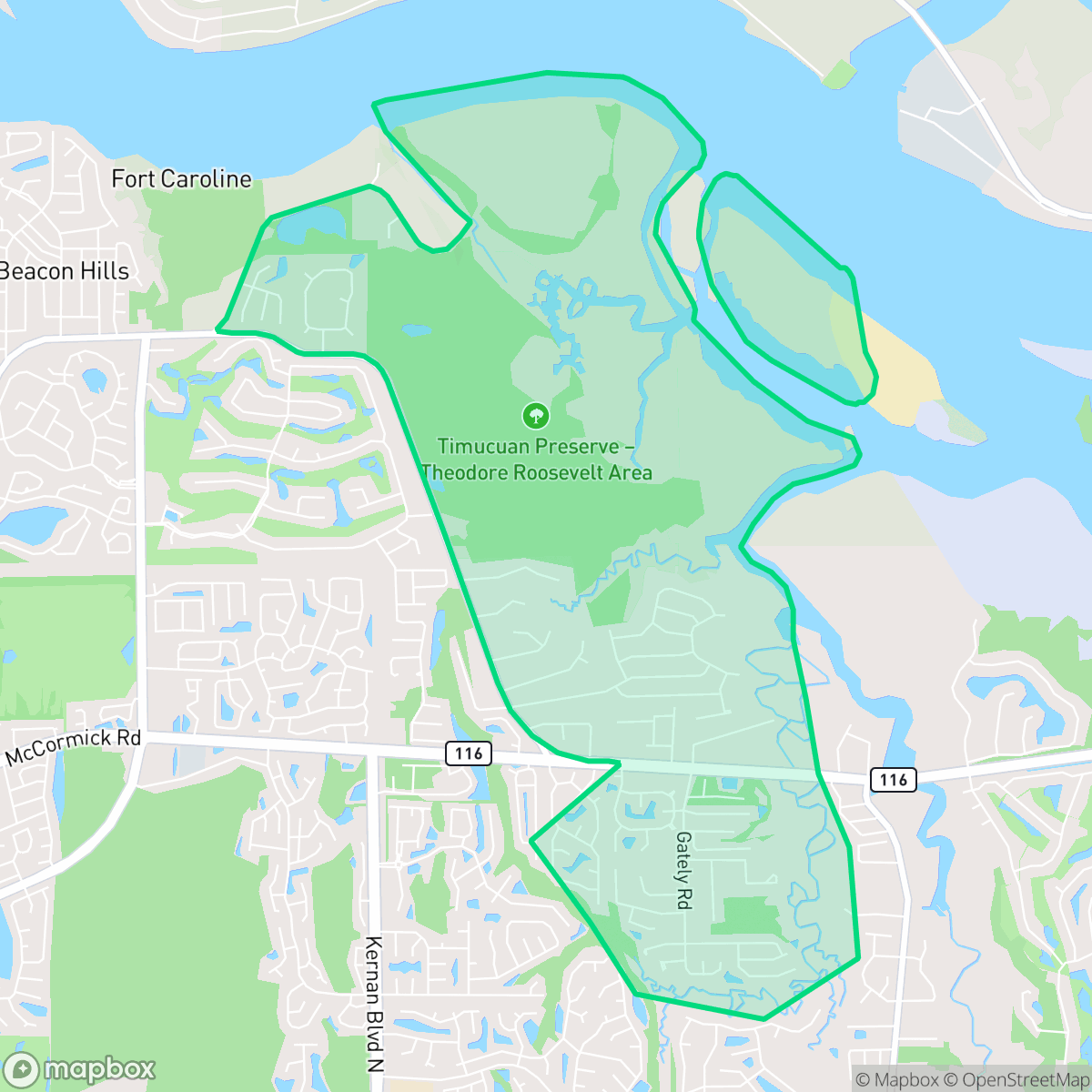
Fort Caroline Shores is a residential neighborhood in Jacksonville, Florida, situated along the St. Johns River. Its name and character are deeply tied to the historical legacy of the 1564 French Huguenot settlement of Fort Caroline, which was established nearby. While the original fort was destroyed by Spanish forces in 1565, the area remains culturally defined by its proximity to the Fort Caroline National Memorial and the broader Timucuan Ecological and Historic Preserve. Unlike much of Jacksonville's relatively flat landscape, the neighborhood is noted for its distinctive, hilly topography and microclimate. Developed as a residential community in the 20th century, it is recognized for its preserved natural greenery and its location within a region historically significant as one of the earliest European colonial sites in the present-day United States.
The neighborhood is characterized by its significant tree canopy and expansive open spaces, which contribute to a semi-rural aesthetic rarely found in the city. Residents benefit from high levels of privacy and minimal industrial presence, creating a peaceful living environment. The visual appeal is consistently high, marked by large, architecturally diverse homes and manicured landscaping that take advantage of the area's unique, elevated terrain.
While the area provides an excellent setting for dog walking and outdoor recreation, it is primarily a residential community with limited commercial activity or local destinations. Prospective residents should note that while traffic noise is generally moderate, the area is best suited for those seeking a quiet, low-key lifestyle rather than proximity to urban amenities. Families should consider the broader Duval County School District landscape, which offers a variety of magnet programs alongside ongoing district-wide efforts to manage enrollment and budget challenges.
Neighborhood Scores Across 15 Qualities
Residential spacing provides a moderate level of seclusion, sitting above the Jacksonville average. Homes feature varying setbacks where some structures are situated near wooded buffers and ponds while others sit closer to neighbors.
Low traffic volumes and accessible sidewalks in residential clusters provide better pedestrian conditions than the Jacksonville average. Many streets feature continuous sidewalk networks that facilitate safe movement throughout the area.
Manicured landscaping, large homes with complex rooflines, and frequent private pools create a highly aesthetic environment. According to iHuus data, the visual quality of this area is significantly higher than the Jacksonville average.
Wide green verges, wooded buffers, and numerous ponds provide excellent environments for walking pets. According to iHuus data, these features make the area more dog friendly than much of Jacksonville.
Expansive open land and significant tree canopy provide a more rural atmosphere than the typical Jacksonville urban landscape. Residential areas feature scattered homes amidst woodland and fields, according to iHuus data.
Minimal commercial activity and a lack of local destinations result in a very low-key atmosphere that is slightly below the city average for liveliness. This area consists primarily of quiet, residential streets with very few nearby amenities or points of interest.
A steady hum of local traffic from nearby busy streets is common here. According to iHuus data, acoustic comfort levels are higher than the Jacksonville average.
Air quality in this area fluctuates between acceptable and unhealthy levels, though it remains better than the average for Jacksonville. Residents sensitive to pollutants should monitor local conditions during periods of occasional concern.
Residential tranquility is high here due to a lack of heavy industrial activity, significantly lower than the Jacksonville average. While an electrical substation exists in the northwest quadrant, the area remains primarily composed of quiet streets and green spaces.
Health insurance access among residents is notably higher than the Jacksonville average, according to iHuus data.
Voting patterns and census indicators show a significantly more conservative leaning than the Jacksonville average, according to iHuus data.
Residents of various life stages, including young adults and seniors, live alongside families here. This demographic spread is more varied than the typical age distribution found across Jacksonville.
Flood safety levels in this area are higher than the Jacksonville average, though official FEMA studies for this specific location remain incomplete. Residents should remain aware of moderate uncertainty regarding long term flood patterns.
Address-Level Insights for Fort Caroline Shores


iHuus Neighborhood Intelligence Insights
Get address-level neighborhood insights for Fort Caroline Shores
- Street-level scores — see how individual blocks compare, not just neighborhood averages
- Micro-zone boundaries — identify quiet pockets, flood boundaries, and walkable clusters before you visit
- 15 dimensions in full — walkability, noise, air quality, school quality, insurance coverage, population age profile, urban/rural index, and more
- Boundary risk alerts — know if your address sits near a block boundary where scores drop, the kind of detail no listing will ever mention
- School insights — individual school ratings and insights, not just district-level data
- Compare before you commit — side-by-side data across neighborhoods, down to block precision
No credit card required
Compare with Any Neighborhood
| Dimension | Fort Caroline Shores | 29th and Chase |
|---|---|---|
| 🚶 Walkabilityavg 3.96 | ||
| 🔊 Acoustic Comfortavg 4.37 | ||
| 🤫 Privacy Indexavg 4.3 | ||
| 🎨 Visual Appealavg 4.24 | ||
| 🐕 Dog Friendlinessavg 4.28 | ||
| 🗺️ Urban-Rural Indexavg 5.22 | ||
| ✨ Neighborhood Vibeavg 1.5 | ||
| 🏥 Health Insurance Coverageavg 4.35 | ||
| 🌿 Air Qualityavg 3.84 | ||
| 🏭 Industrial Proximityavg 5.11 | ||
| 🌊 Flood Safetyavg 4.01 | ||
| 🗳️ Ideological Leanavg 2.75 | ||
| 👥 Population Age Profileavg 3.26 | ||
| 🔥 Fire Safety | ||
| 🏫 School Quality |
Fort Caroline Shores Rankings
School Districts Serving Fort Caroline Shores
School Insights for Fort Caroline Shores
Below average outcomes; significant attendance and academic challenges.
School Insights
See what's really behind every school rating near Fort Caroline Shores
- Individual school ratings — each school's own score with outcome context, not just a district average
- Enrollment & class size data — student-to-teacher ratio and how it compares to the state average
- Full demographics breakdown — ethnicity and gender composition for every school in the enrollment zone
- Every school in the district — all schools within the enrollment boundary ranked by rating, not just the closest one
- Grade levels & benchmarks — elementary through high school, with below/above state-average flags
No credit card required