Fairways Forest, Jacksonville
Updated · 3,471 residents
Fairways Forest is a quiet, established community in Arlington defined by its signature brick and Mediterranean-style architecture. The area offers a highly walkable environment with mature tree canopies and a peaceful, suburban atmosphere.
Key Highlights
About Fairways Forest
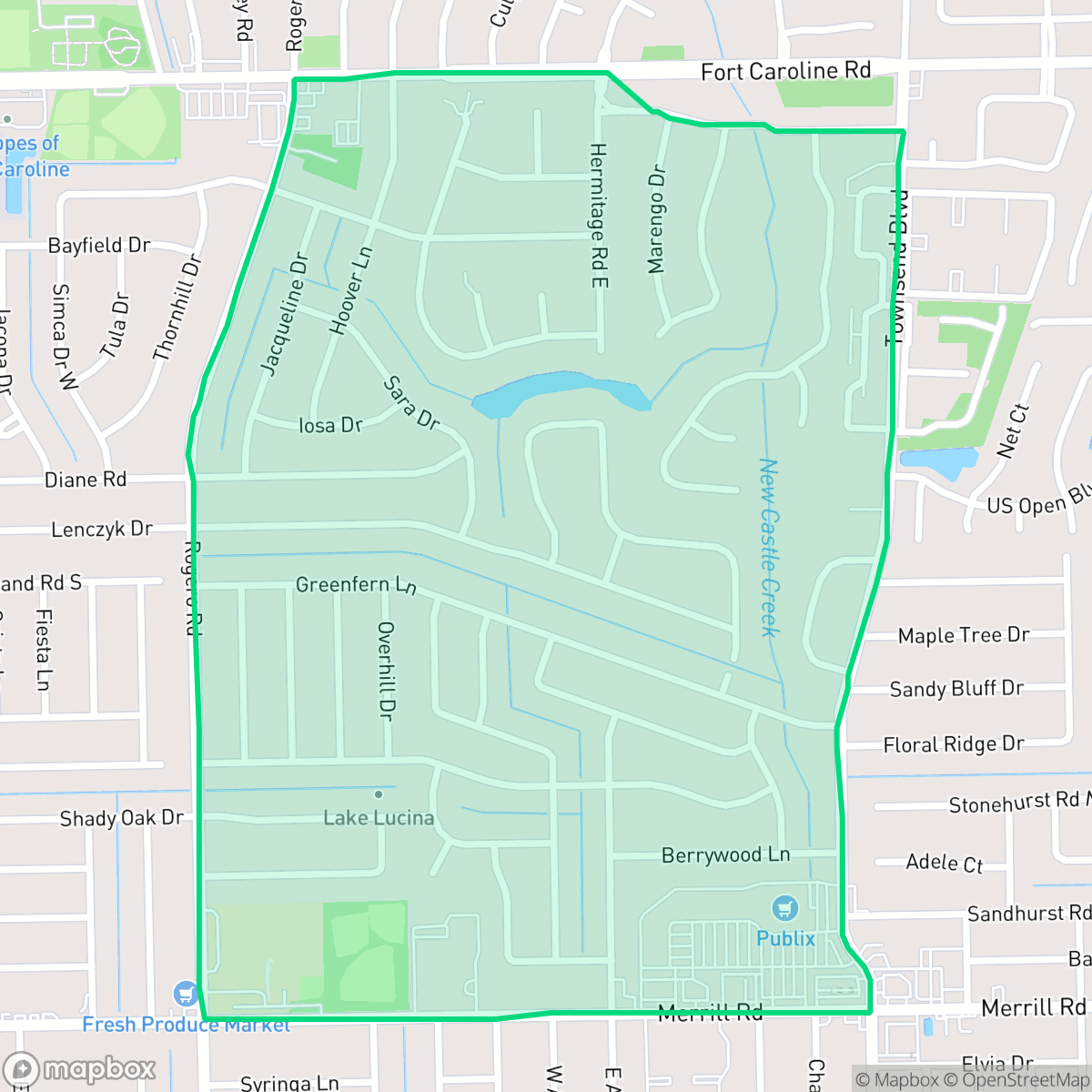
Fairways Forest is an established neighborhood in the Arlington area of Jacksonville, Florida, developed in the early 1970s by local attorney and developer Lonnie Wurn. Comprising 253 brick and Mediterranean-style homes, the community was initially populated largely by military personnel and corporate transplants drawn to the city’s growing economy. Characterized by its flag-flying spirit and signature lampposts, the neighborhood maintains a distinct suburban identity supported by the Fairways Forest Civic Association. In 2001, residents funded the construction of a brick wall along the community's northern boundary to harmonize with the existing architecture. The neighborhood remains known for its long-term residency and active civic engagement.
The neighborhood benefits from a semi-rural suburban landscape where open land and woodland areas are more common than in many other parts of Jacksonville. Residents enjoy a visually polished environment featuring spacious lots and private amenities, supported by a minimal industrial presence that keeps the surroundings focused on residential life. The area maintains a deliberate separation between properties, contributing to a sense of privacy that exceeds the city average.
While the environment is generally calm, those living here may notice steady traffic sounds from nearby arterial roads. The demographic profile is notably diverse, accommodating a mix of young adults, families, and seniors. Families should consider that while the local school district provides access to specialized magnet programs, it is currently navigating significant budgetary and consolidation challenges. Overall, the area is well-suited for those seeking an established, walkable community with high levels of health insurance coverage and a stable, neighborhood-focused identity.
Neighborhood Scores Across 15 Qualities
Residential spacing offers a moderate level of separation between neighbors, providing more buffer than the Jacksonville average. Homes typically feature suburban lot sizes with some natural screening from trees and private yards.
Low-traffic residential streets and established sidewalks make walking throughout the area much more accessible than the Jacksonville average. While some arterial crossings require extra caution, many neighborhood loops and cul-de-sacs provide safe routes for pedestrians.
Large-scale homes and frequent private amenities like backyard pools create a visual environment significantly more polished than the Jacksonville average. According to iHuus data, the area is characterized by spacious lots and prominent residential footprints.
Access to local parks and grassy verges provides more space for pets than the Jacksonville average. While some streets feature narrow sidewalks, many areas offer consistent green buffers between the road and pavement.
Open land and woodland are more prevalent here than in the typical Jacksonville neighborhood. Residents will find a landscape of scattered homes and mature tree canopies interspersed with suburban residential pockets, according to iHuus data.
Primarily residential and low-key, this area offers more activity than most of Jacksonville but lacks a dense commercial core. Residents can find occasional dining and local parks, though the neighborhood remains much quieter than the city average.
Steady traffic sounds from nearby busy streets are present. This level of acoustic activity is slightly higher than the average found throughout Jacksonville.
Air quality levels are generally acceptable but include occasional periods of concern for sensitive groups. According to iHuus data, these conditions are notably better than the Jacksonville city average.
Residential and institutional uses dominate the area, with significantly less industrial activity than the Jacksonville average. While some light commercial retail and large parking lots are present near main roads, there are no visible heavy industries or hazardous facilities.
Health insurance access among residents is significantly higher than the Jacksonville average, according to iHuus data.
Political leanings in this area are more evenly distributed than the city average, reflecting a diverse range of views among residents according to iHuus data.
Residents live alongside a varied mix of young adults, families, and seniors. This demographic distribution is more balanced than the typical age profile found across Jacksonville.
Flood risk in this area is significantly lower than the Jacksonville average, though some residual risk remains within a 500-year floodplain according to iHuus data.
Address-Level Insights for Fairways Forest


iHuus Neighborhood Intelligence Insights
Get address-level neighborhood insights for Fairways Forest
- Street-level scores — see how individual blocks compare, not just neighborhood averages
- Micro-zone boundaries — identify quiet pockets, flood boundaries, and walkable clusters before you visit
- 15 dimensions in full — walkability, noise, air quality, school quality, insurance coverage, population age profile, urban/rural index, and more
- Boundary risk alerts — know if your address sits near a block boundary where scores drop, the kind of detail no listing will ever mention
- School insights — individual school ratings and insights, not just district-level data
- Compare before you commit — side-by-side data across neighborhoods, down to block precision
No credit card required
Compare with Any Neighborhood
| Dimension | Fairways Forest | 29th and Chase |
|---|---|---|
| 🚶 Walkabilityavg 3.96 | ||
| 🔊 Acoustic Comfortavg 4.37 | ||
| 🤫 Privacy Indexavg 4.3 | ||
| 🎨 Visual Appealavg 4.24 | ||
| 🐕 Dog Friendlinessavg 4.28 | ||
| 🗺️ Urban-Rural Indexavg 5.22 | ||
| ✨ Neighborhood Vibeavg 1.5 | ||
| 🏥 Health Insurance Coverageavg 4.35 | ||
| 🌿 Air Qualityavg 3.84 | ||
| 🏭 Industrial Proximityavg 5.11 | ||
| 🌊 Flood Safetyavg 4.01 | ||
| 🗳️ Ideological Leanavg 2.75 | ||
| 👥 Population Age Profileavg 3.26 | ||
| 🔥 Fire Safety | ||
| 🏫 School Quality |
Fairways Forest Rankings
School Districts Serving Fairways Forest
School Insights for Fairways Forest
Below average outcomes; significant attendance and academic challenges.
School Insights
See what's really behind every school rating near Fairways Forest
- Individual school ratings — each school's own score with outcome context, not just a district average
- Enrollment & class size data — student-to-teacher ratio and how it compares to the state average
- Full demographics breakdown — ethnicity and gender composition for every school in the enrollment zone
- Every school in the district — all schools within the enrollment boundary ranked by rating, not just the closest one
- Grade levels & benchmarks — elementary through high school, with below/above state-average flags
No credit card required