Fairfield, Jacksonville
Updated · 1,246 residents
Fairfield is a historic Jacksonville neighborhood defined by its industrial heritage and transition into a quiet, mixed-use area. While it offers a diverse age range of residents, the neighborhood faces challenges with high flood risk, limited walkability, and proximity to heavy industrial infrastructure.
Key Highlights
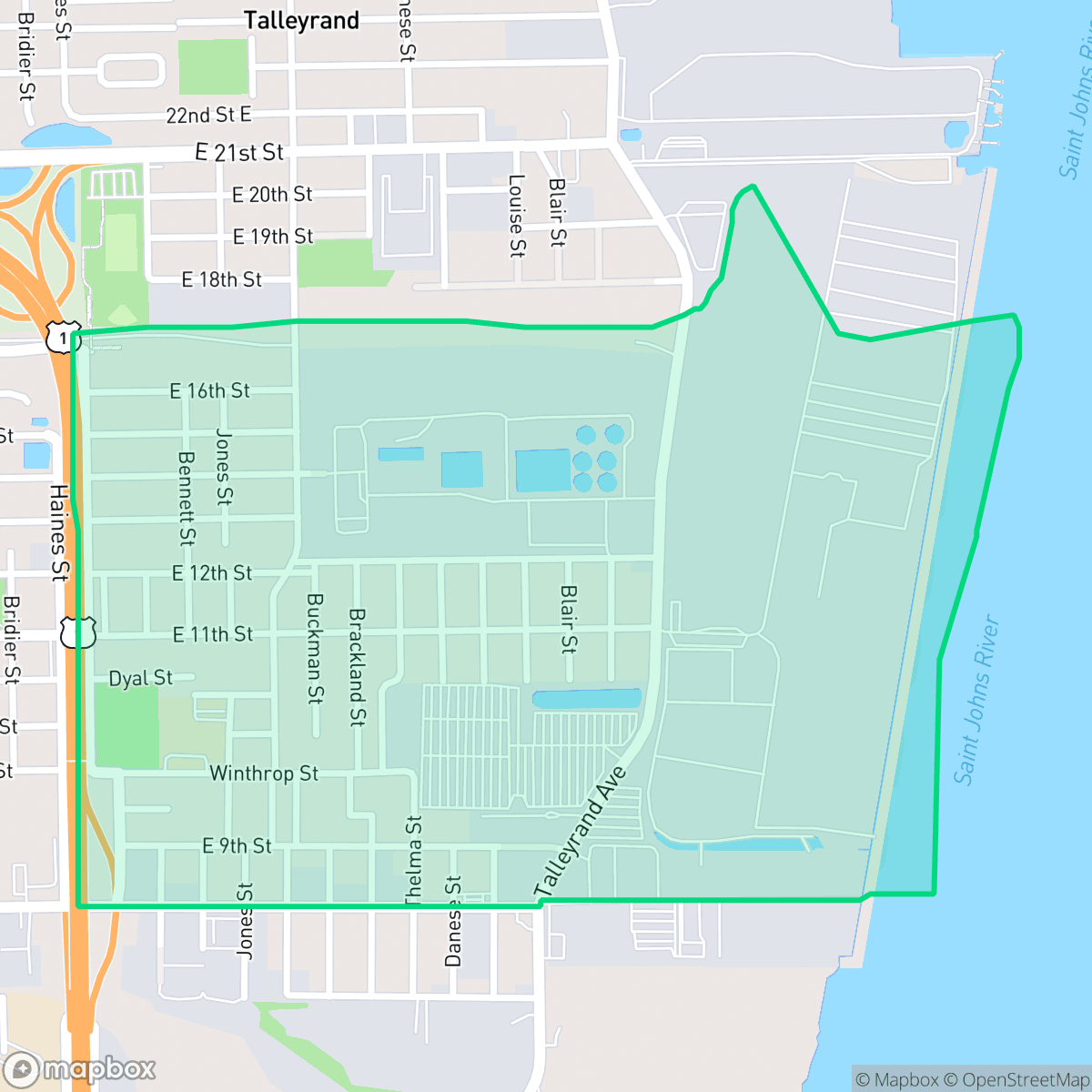
About Fairfield
Established in the late 1860s by New Yorker Jacob S. Parker, Fairfield emerged as one of Jacksonville's earliest suburbs. Named for the Florida state fairgrounds established on Parker’s property in 1876, the area became a prominent sports and entertainment district featuring horse racing. Incorporated as a town in 1880, it was annexed by Jacksonville in 1887. Following the Great Fire of 1901, Fairfield transitioned into a significant industrial hub, hosting railroad lumber terminals, World War I-era concrete shipbuilding, and a Ford Motor Company assembly plant. Key landmarks included the 1910 Fairfield Public School and the historic East End Shell Road. Over time, the neighborhood’s residential character was largely transformed by mid-20th-century infrastructure projects, most notably the construction of the Mathews Bridge and the expansion of the city's sports complex.
This area maintains a unique identity shaped by its evolution from a 19th-century suburb to a modern industrial hub. Residents live among a blend of residential blocks and large-scale warehouses, resulting in a landscape that balances quiet suburban streets with active freight corridors. The neighborhood is characterized by its politically diverse population and a varied age demographic, creating a social environment that reflects a broad mix of backgrounds and life stages.
Prospective residents should weigh the trade-offs of living in a zone with significant industrial proximity and limited pedestrian infrastructure. The area presents notable environmental considerations, including a high vulnerability to flooding and moderate air quality fluctuations. Those considering the neighborhood will find it best suited for individuals who prioritize affordability and a central location over proximity to extensive parks or high-end retail amenities. Families should be aware that their educational experience within the Duval County School District will rely heavily on navigating the district's specialized magnet programs and ongoing consolidation efforts.
Neighborhood Scores Across 15 Qualities
Residential spacing varies throughout the area, with some homes situated closely together near industrial zones while others sit further apart near wooded patches. This level of density is roughly in line with the Jacksonville average, according to iHuus data.
Limited sidewalk connectivity and proximity to high-traffic industrial zones make pedestrian travel uncomfortable. According to iHuus data, the area is less walkable than the Jacksonville average due to significant barriers created by highways and large industrial blocks.
Visual scenery is characterized by modest housing footprints, dirt lots, and proximity to heavy rail and industrial yards. This landscape offers less greenery and fewer amenities than the Jacksonville average, according to iHuus data.
Public green spaces and wide walking verges are scarce, making outdoor exercise difficult for pet owners. According to iHuus data, the lack of accessible parks in this area is below the Jacksonville average.
Residential blocks and single-family homes exist alongside significant industrial infrastructure and rail lines. This area presents a more balanced mix of developed space and greenery than the Jacksonville average, according to iHuus data.
Local activity levels are higher than the Jacksonville average, though much of the area remains subdued with a mix of residential blocks, industrial zones, and occasional lifestyle retail. While some pockets offer dining and wellness services, other sections are car-dependent and lack significant street life.
Consistent noise levels from nearby busy streets are present; this level of acoustic activity is roughly equivalent to the Jacksonville average.
Air quality in Fairfield fluctuates between acceptable and unhealthy levels, though it remains better than the Jacksonville average. Sensitive individuals should monitor local conditions for occasional periods of concern.
Proximity to large-scale warehouses, freight corridors, and a nearby EPA Superfund site contributes to significantly higher levels of industrial activity than the Jacksonville average. Residents may experience frequent heavy vehicle traffic, loading dock noise, and potential environmental concerns regarding soil and groundwater contamination.
Health insurance accessibility in this area is lower than the Jacksonville average. According to iHuus data, a small portion of the local population maintains active health coverage.
Political leanings in this area are split nearly evenly between conservative and liberal perspectives. This represents a much more politically diverse landscape than the typical Jacksonville average, according to iHuus data.
A varied mix of young adults, families, and older residents characterizes this area. According to iHuus data, the population age distribution is more diverse than the Jacksonville average.
Significant flood vulnerability exists within this area as much of the neighborhood sits inside a designated 100-year floodplain. According to iHuus data, this risk is substantially higher than the Jacksonville average and typically necessitates flood insurance for properties.
Address-Level Insights for Fairfield


iHuus Neighborhood Intelligence Insights
Get address-level neighborhood insights for Fairfield
- Street-level scores — see how individual blocks compare, not just neighborhood averages
- Micro-zone boundaries — identify quiet pockets, flood boundaries, and walkable clusters before you visit
- 15 dimensions in full — walkability, noise, air quality, school quality, insurance coverage, population age profile, urban/rural index, and more
- Boundary risk alerts — know if your address sits near a block boundary where scores drop, the kind of detail no listing will ever mention
- School insights — individual school ratings and insights, not just district-level data
- Compare before you commit — side-by-side data across neighborhoods, down to block precision
No credit card required
Compare with Any Neighborhood
| Dimension | Fairfield | 29th and Chase |
|---|---|---|
| 🚶 Walkabilityavg 3.96 | ||
| 🔊 Acoustic Comfortavg 4.37 | ||
| 🤫 Privacy Indexavg 4.3 | ||
| 🎨 Visual Appealavg 4.24 | ||
| 🐕 Dog Friendlinessavg 4.28 | ||
| 🗺️ Urban-Rural Indexavg 5.22 | ||
| ✨ Neighborhood Vibeavg 1.5 | ||
| 🏥 Health Insurance Coverageavg 4.35 | ||
| 🌿 Air Qualityavg 3.84 | ||
| 🏭 Industrial Proximityavg 5.11 | ||
| 🌊 Flood Safetyavg 4.01 | ||
| 🗳️ Ideological Leanavg 2.75 | ||
| 👥 Population Age Profileavg 3.26 | ||
| 🔥 Fire Safety | ||
| 🏫 School Quality |
Fairfield Rankings
School Districts Serving Fairfield
School Insights for Fairfield
Below average outcomes; significant attendance and academic challenges.
School Insights
See what's really behind every school rating near Fairfield
- Individual school ratings — each school's own score with outcome context, not just a district average
- Enrollment & class size data — student-to-teacher ratio and how it compares to the state average
- Full demographics breakdown — ethnicity and gender composition for every school in the enrollment zone
- Every school in the district — all schools within the enrollment boundary ranked by rating, not just the closest one
- Grade levels & benchmarks — elementary through high school, with below/above state-average flags
No credit card required