Edgewood, Jacksonville
Updated · 1,643 residents
Edgewood is a quiet, historically rooted community defined by its early 20th-century commercial architecture along the Edgewood Avenue corridor. While it offers a balanced suburban atmosphere with a diverse population, residents face challenges regarding pedestrian accessibility and limited public green spaces.
Key Highlights
About Edgewood
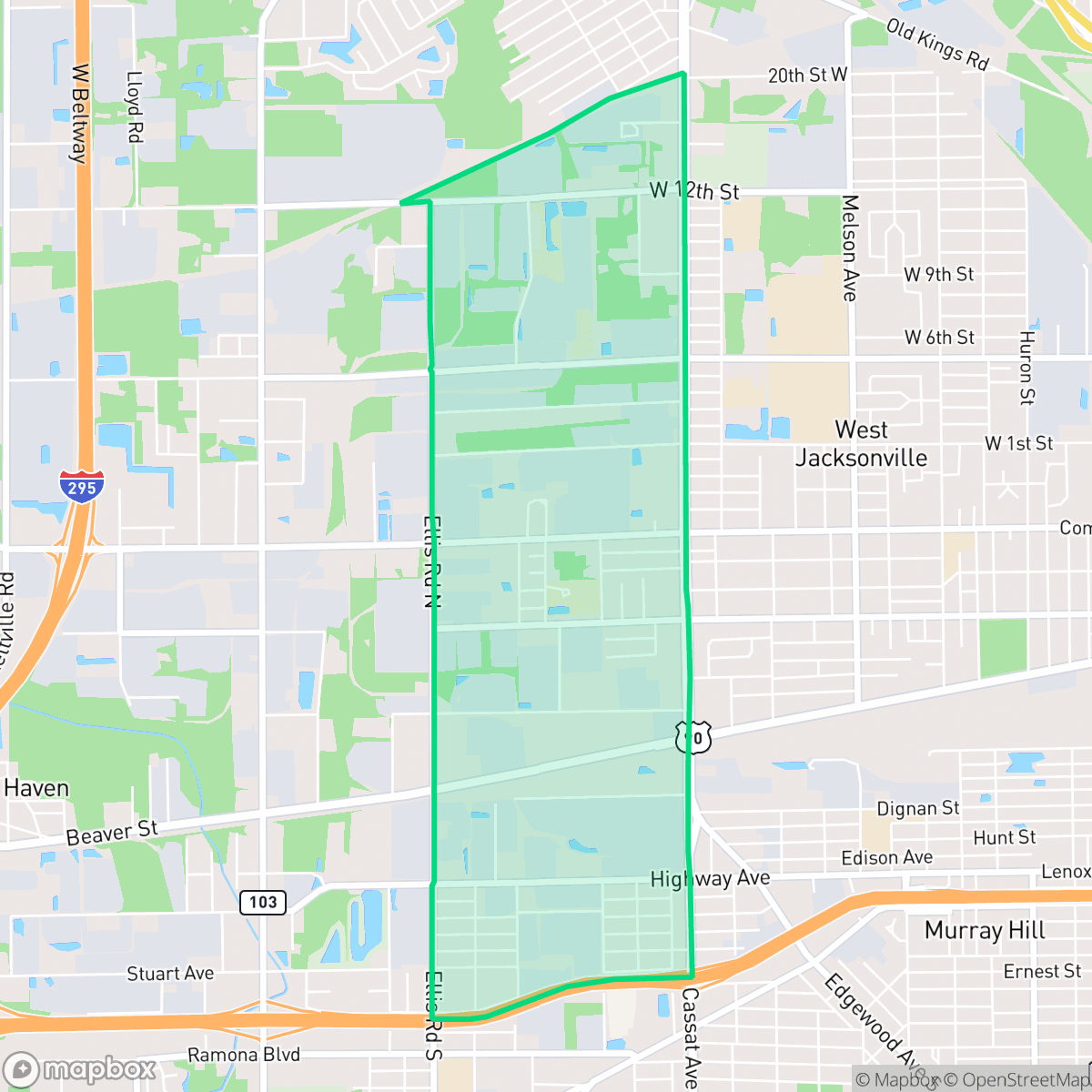
The Edgewood neighborhood in Jacksonville traces its origins to the Edgewood subdivision, which was platted in the 1880s. While significant portions of the original tract were later replatted as Murray Hill, the area remains historically defined by the Edgewood Avenue corridor. Once promoted as the 'Avenue of Progress,' this street evolved into a vital commercial hub following the 1914 extension of streetcar service, which linked the community to the Florida Military Academy. The corridor retains early 20th-century commercial architecture, with some structures dating back to 1915. Although the name 'Edgewood' is also historically linked to the failed 19th-century development that preceded the Avondale neighborhood, the Edgewood Avenue district continues to serve as a distinct, walkable landmark that anchors the character of the surrounding community.
The area maintains a distinct character through its vintage commercial buildings and a suburban density that feels slightly more compact than other parts of Jacksonville. It serves as a quiet residential enclave where the demographic makeup is notably balanced, attracting a mix of young adults, families, and long-term residents. While the neighborhood lacks extensive ornamental greenery, it provides a sense of privacy that is slightly above the city average, allowing for more separation between homes than is typical for the region. Air quality remains better than the Jacksonville average, providing a relatively stable environment for residents.
Living here requires navigating certain trade-offs, particularly regarding daily mobility and infrastructure. Pedestrian travel is often difficult due to limited sidewalk availability and significant traffic volumes on major thoroughfares. Prospective residents should also be prepared for occasional light industrial activity and ambient traffic noise. Families considering the area will find themselves within the Duval County School District, where access to specialized magnet programs can provide significant educational benefits despite the broader challenges of district-wide consolidation and budget management.
Neighborhood Scores Across 15 Qualities
Housing layouts provide a moderate level of separation between neighbors, offering slightly more buffer than the typical Jacksonville area. According to iHuus data, residential spacing remains mixed throughout the neighborhood.
Limited sidewalk availability and high traffic volumes make pedestrian travel uncomfortable. According to iHuus data, walkability in this area is lower than the Jacksonville average.
Dense housing layouts and small yards characterize the area, which offers less visual variety than much of Jacksonville. According to iHuus data, the landscape lacks significant ornamental greenery or extensive public amenities.
Sparse greenery and narrow street verges make for limited off-leash opportunities. According to iHuus data, the amount of accessible open space for dogs is below the Jacksonville average.
Residential streets and green spaces are distributed in nearly equal measure, providing a suburban density that sits slightly higher than the Jacksonville average according to iHuus data.
Low-key residential streets and sparse commercial activity define this area, though it offers a higher level of local liveliness than the Jacksonville average. While many sections are car-dependent, certain pockets near transit hubs provide a notable collection of dining and retail options.
Steady traffic sounds from nearby busy streets are present; this level of acoustic activity is slightly higher than the Jacksonville average according to iHuus data.
Air quality levels fluctuate between acceptable and unhealthy for sensitive groups. According to iHuus data, conditions in Edgewood are better than the average seen throughout Jacksonville.
Light industrial and commercial activities, such as printing services and storage facilities, introduce occasional utility odors and intermittent heavy vehicle traffic. This level of industrial proximity is slightly lower than the Jacksonville average, reflecting a landscape where residential life blends with active daytime commerce.
Health insurance accessibility in Edgewood is slightly lower than the Jacksonville average. Residents may encounter more challenges accessing employer-sponsored plans compared to other parts of the city, according to iHuus data.
Political perspectives are evenly split within the area, representing a much more balanced ideological landscape than the broader Jacksonville average.
A varied mix of young adults, families, and older residents characterizes the area. According to iHuus data, this demographic distribution is more balanced than the average seen across Jacksonville.
Flood risk levels in this area are comparable to the Jacksonville average, though current FEMA studies for the neighborhood remain incomplete. Residents should exercise caution as specific flood hazard details are not yet fully determined.
Address-Level Insights for Edgewood


iHuus Neighborhood Intelligence Insights
Get address-level neighborhood insights for Edgewood
- Street-level scores — see how individual blocks compare, not just neighborhood averages
- Micro-zone boundaries — identify quiet pockets, flood boundaries, and walkable clusters before you visit
- 15 dimensions in full — walkability, noise, air quality, school quality, insurance coverage, population age profile, urban/rural index, and more
- Boundary risk alerts — know if your address sits near a block boundary where scores drop, the kind of detail no listing will ever mention
- School insights — individual school ratings and insights, not just district-level data
- Compare before you commit — side-by-side data across neighborhoods, down to block precision
No credit card required
Compare with Any Neighborhood
| Dimension | Edgewood | 29th and Chase |
|---|---|---|
| 🚶 Walkabilityavg 3.96 | ||
| 🔊 Acoustic Comfortavg 4.37 | ||
| 🤫 Privacy Indexavg 4.3 | ||
| 🎨 Visual Appealavg 4.24 | ||
| 🐕 Dog Friendlinessavg 4.28 | ||
| 🗺️ Urban-Rural Indexavg 5.22 | ||
| ✨ Neighborhood Vibeavg 1.5 | ||
| 🏥 Health Insurance Coverageavg 4.35 | ||
| 🌿 Air Qualityavg 3.84 | ||
| 🏭 Industrial Proximityavg 5.11 | ||
| 🌊 Flood Safetyavg 4.01 | ||
| 🗳️ Ideological Leanavg 2.75 | ||
| 👥 Population Age Profileavg 3.26 | ||
| 🔥 Fire Safety | ||
| 🏫 School Quality |
Edgewood Rankings
School Districts Serving Edgewood
School Insights for Edgewood
Below average outcomes; significant attendance and academic challenges.
School Insights
See what's really behind every school rating near Edgewood
- Individual school ratings — each school's own score with outcome context, not just a district average
- Enrollment & class size data — student-to-teacher ratio and how it compares to the state average
- Full demographics breakdown — ethnicity and gender composition for every school in the enrollment zone
- Every school in the district — all schools within the enrollment boundary ranked by rating, not just the closest one
- Grade levels & benchmarks — elementary through high school, with below/above state-average flags
No credit card required