East Jacksonville, Jacksonville
Updated · 2,936 residents
East Jacksonville is a historically significant community defined by its 19th-century architecture and deep cultural roots. While it offers a diverse age demographic and a central location, residents face challenges regarding industrial proximity, limited walkability, and sparse green space.
Key Highlights
About East Jacksonville
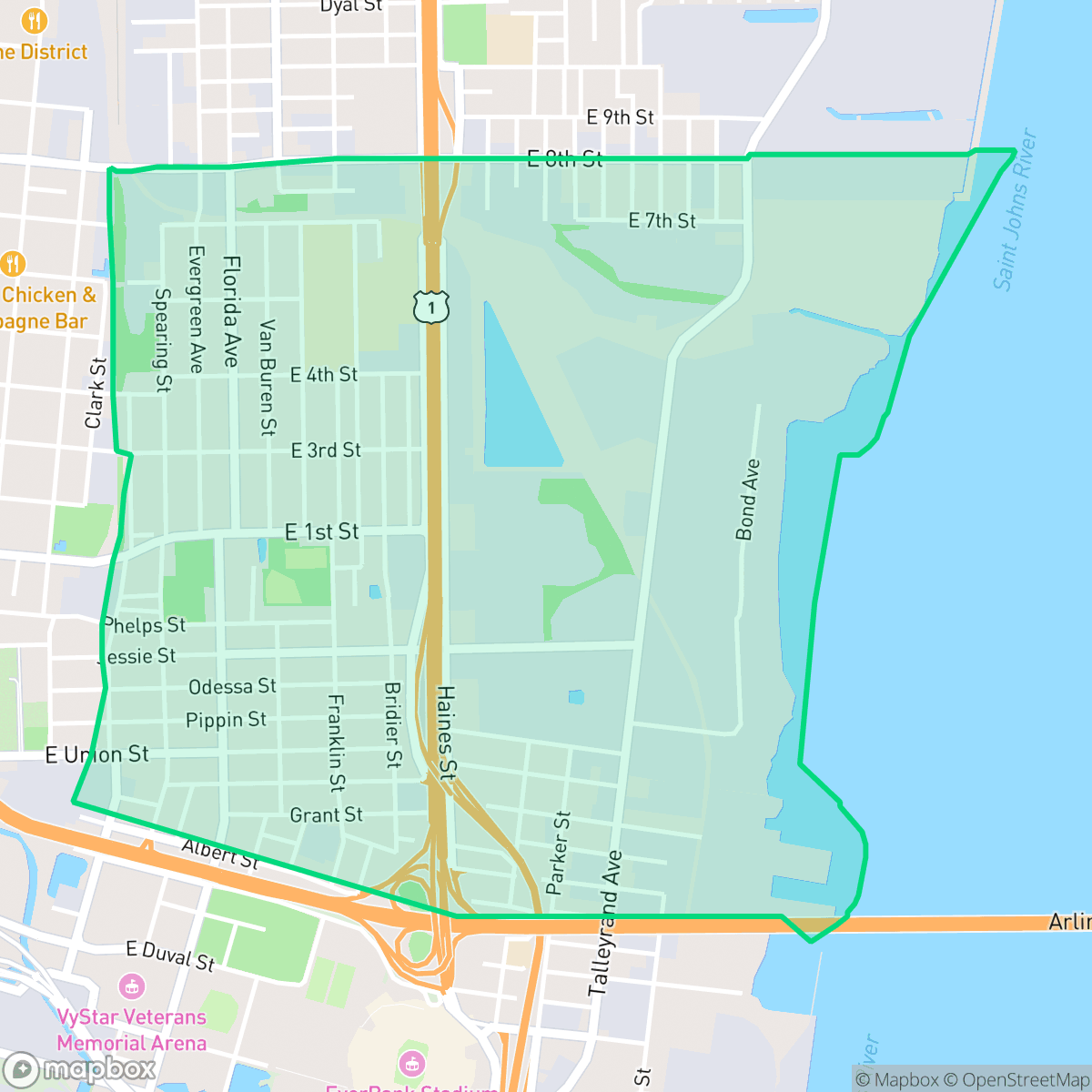
Originally an independent suburb settled after the Civil War, East Jacksonville was annexed by the city in 1887 and later became part of the broader 'Historic Eastside.' Historically a working-class community for sawmill and port laborers, it stands as one of Jacksonville’s last cohesive 19th-century Black neighborhoods. The area served as a vital cultural and commercial hub during segregation, anchored by 'The Avenue' (Florida Avenue) and institutions like the Mother Midway A.M.E. Church, Florida’s oldest A.M.E. congregation. The neighborhood is noted for its frame vernacular and bungalow architecture and its deep ties to Gullah Geechee heritage. It was home to influential figures including A. Philip Randolph, James Weldon Johnson, and humanitarian Eartha M.M. White, who helped establish the city’s first playground for African American children within the community.
The area functions as a dense, urban-suburban mix where residential pockets sit directly alongside industrial infrastructure and freight corridors. The landscape is characterized by modest housing and a lack of public greenery, with many streets featuring fragmented sidewalks that make pedestrian travel difficult. Despite the industrial presence and associated noise from nearby traffic, the neighborhood maintains a distinct identity as a liberal-leaning community with a varied population of young adults, families, and seniors. According to iHuus data, the air quality in this area remains better than the Jacksonville average, even as industrial activity contributes to a more utilitarian visual environment.
Potential residents should be aware of the limited access to employer-sponsored health insurance and the presence of a nearby EPA Superfund site that may affect environmental conditions. While the area provides a central base for those navigating the city, the combination of heavy industrial activity and limited public park space makes it better suited for those who prioritize proximity to transit hubs over a quiet, suburban aesthetic. Families should consider that local school options within the Duval County Public School district are currently undergoing significant consolidation and budget adjustments, making access to specific magnet programs a key factor for educational planning.
Neighborhood Scores Across 15 Qualities
Housing arrangements vary between closely packed homes and larger open parcels, providing slightly more separation than the Jacksonville average. According to iHuus data, residential lots feature inconsistent spacing with some areas situated near industrial zones and others near wooded gaps.
Fragmented sidewalks and proximity to high-traffic highways create significant barriers to safe pedestrian movement. This lack of continuous infrastructure makes navigating the area on foot more challenging than in many other parts of Jacksonville.
Visual surroundings are characterized by dense, modest housing and significant industrial presence. According to iHuus data, the area lacks green amenities and features more visible dirt lots and rail interfaces than the Jacksonville average.
Green spaces are primarily fragmented into private yards or narrow sidewalk verges, making the area less dog-friendly than much of Jacksonville. While a local park with a baseball field offers some walking opportunities, public greenery is generally sparse throughout the neighborhood.
Residential pockets and small businesses sit alongside significant industrial infrastructure and rail lines. This area presents a suburban density slightly higher than the Jacksonville average, according to iHuus data.
Activity levels are notably higher than the city average, offering a mix of suburban amenities, local dining, and cultural venues. While some pockets remain quiet and car-dependent, many areas provide steady movement around transit hubs, colleges, and retail strips.
Local traffic from nearby busy streets creates a consistent hum. This level of acoustic activity is roughly comparable to the city average.
Air quality levels fluctuate between acceptable and unhealthy, particularly for sensitive groups. According to iHuus data, the air quality in this area is notably better than the Jacksonville average.
Significant industrial activity, including freight corridors and large-scale warehouses, creates more heavy traffic and operational noise than the Jacksonville average. Residents should also be aware of a nearby EPA Superfund site that may impact soil and groundwater quality according to iHuus data.
Health insurance access is notably lower in this area than the Jacksonville average. Residents may face greater challenges accessing employer-sponsored or private medical plans according to iHuus data.
Political leanings in this area are significantly more liberal than the Jacksonville average, featuring a liberal majority alongside a modest conservative presence.
Residents will find a varied demographic of young adults, families, and seniors; this age distribution is more diverse than the average found across Jacksonville.
Flood safety levels in this area are slightly above the city average, though detailed studies for this specific location remain incomplete.
Address-Level Insights for East Jacksonville


iHuus Neighborhood Intelligence Insights
Get address-level neighborhood insights for East Jacksonville
- Street-level scores — see how individual blocks compare, not just neighborhood averages
- Micro-zone boundaries — identify quiet pockets, flood boundaries, and walkable clusters before you visit
- 15 dimensions in full — walkability, noise, air quality, school quality, insurance coverage, population age profile, urban/rural index, and more
- Boundary risk alerts — know if your address sits near a block boundary where scores drop, the kind of detail no listing will ever mention
- School insights — individual school ratings and insights, not just district-level data
- Compare before you commit — side-by-side data across neighborhoods, down to block precision
No credit card required
Compare with Any Neighborhood
| Dimension | East Jacksonville | 29th and Chase |
|---|---|---|
| 🚶 Walkabilityavg 3.96 | ||
| 🔊 Acoustic Comfortavg 4.37 | ||
| 🤫 Privacy Indexavg 4.3 | ||
| 🎨 Visual Appealavg 4.24 | ||
| 🐕 Dog Friendlinessavg 4.28 | ||
| 🗺️ Urban-Rural Indexavg 5.22 | ||
| ✨ Neighborhood Vibeavg 1.5 | ||
| 🏥 Health Insurance Coverageavg 4.35 | ||
| 🌿 Air Qualityavg 3.84 | ||
| 🏭 Industrial Proximityavg 5.11 | ||
| 🌊 Flood Safetyavg 4.01 | ||
| 🗳️ Ideological Leanavg 2.75 | ||
| 👥 Population Age Profileavg 3.26 | ||
| 🔥 Fire Safety | ||
| 🏫 School Quality |
East Jacksonville Rankings
School Districts Serving East Jacksonville
School Insights for East Jacksonville
Below average outcomes; significant attendance and academic challenges.
School Insights
See what's really behind every school rating near East Jacksonville
- Individual school ratings — each school's own score with outcome context, not just a district average
- Enrollment & class size data — student-to-teacher ratio and how it compares to the state average
- Full demographics breakdown — ethnicity and gender composition for every school in the enrollment zone
- Every school in the district — all schools within the enrollment boundary ranked by rating, not just the closest one
- Grade levels & benchmarks — elementary through high school, with below/above state-average flags
No credit card required