East Arlington, Jacksonville
Updated · 20,431 residents
East Arlington is an established suburban neighborhood defined by its upscale, manicured aesthetic and spacious residential lots. Residents enjoy a quiet, pedestrian-friendly environment with access to significant green buffers, though the area experiences notable noise from nearby transit corridors.
Key Highlights
About East Arlington
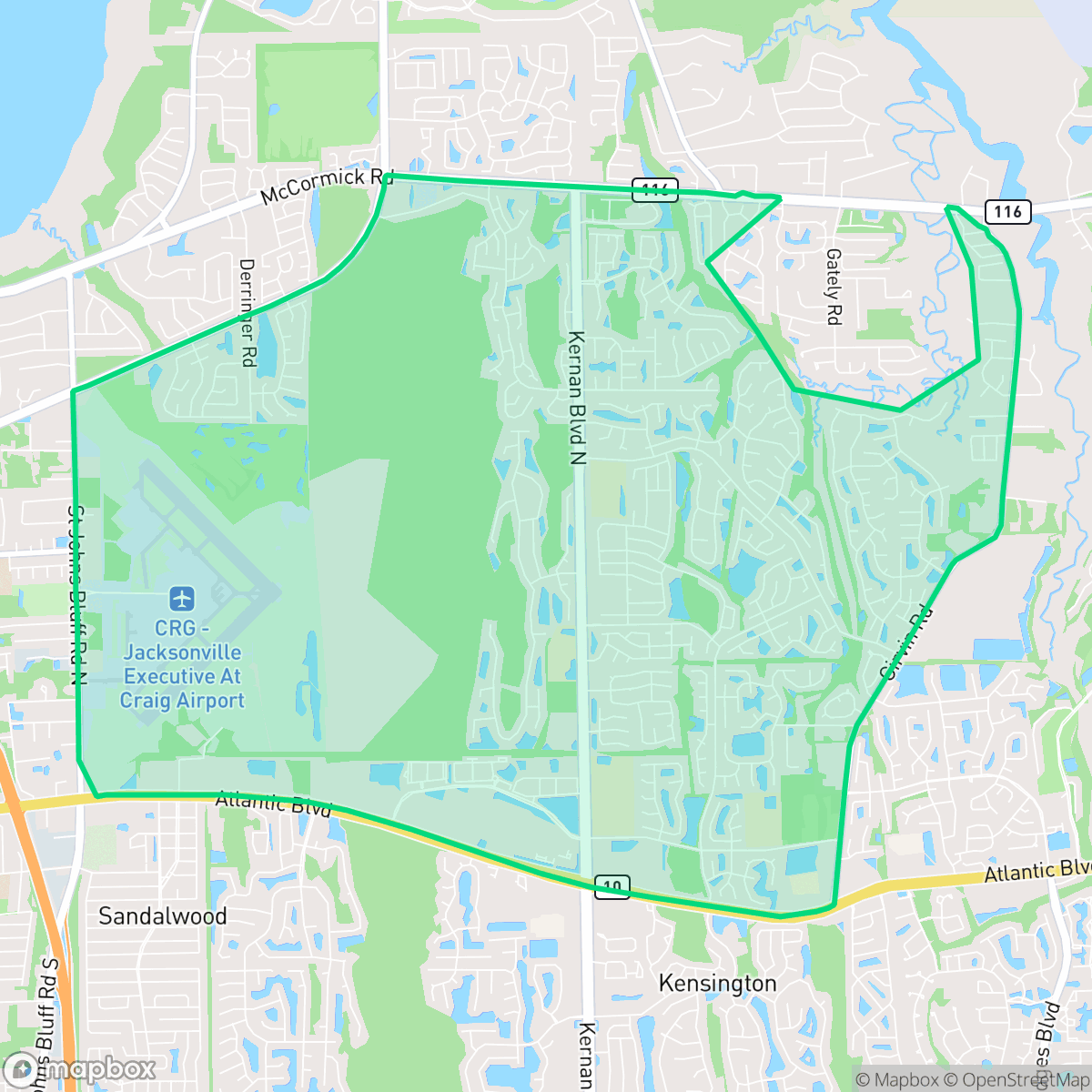
East Arlington is a modern suburban neighborhood in Jacksonville, Florida, that primarily developed from the 1970s onward as the city expanded eastward toward the Intracoastal Waterway. Unlike the historic core of Arlington, which features 16th-century colonial sites and mid-century modern architecture, East Arlington is characterized by its later residential growth, consisting largely of established subdivisions, gated enclaves, and newer construction. The area serves as an eastern counterpart to older Arlington neighborhoods, providing a suburban residential environment with proximity to the University of North Florida and the Intracoastal Waterway. It lacks the distinct, long-standing historical landmarks found in the broader Arlington region, reflecting instead the rapid suburbanization of Jacksonville during the late 20th century.
The area features a collection of well-maintained subdivisions and gated enclaves that prioritize privacy through thoughtful landscaping and tree-lined streets. With a diverse age demographic, the neighborhood offers a spacious feel that contrasts with the denser urban core of Jacksonville. Residents benefit from high levels of health insurance coverage and a low industrial presence, which contributes to a tranquil, suburban atmosphere that remains distinct from the city's more commercialized districts.
While the neighborhood provides a peaceful lifestyle, it is characterized by higher noise levels due to its proximity to major freeways and railroad tracks. The local walkability is excellent within residential clusters, though some arterial roads lack continuous infrastructure. Families should note that while the neighborhood falls under the Duval County School District, educational experiences vary significantly based on access to specialized magnet programs versus local campus zoning. According to iHuus data, the area maintains a moderate flood risk profile, making it important for prospective residents to review local drainage patterns.
Neighborhood Scores Across 15 Qualities
Houses feature moderate spacing with private backyards and natural buffers, offering more separation between neighbors than the Jacksonville average. According to iHuus data, many lots utilize fences and tree lines to maintain a sense of seclusion within a suburban layout.
Low-traffic residential loops and cul-de-sacs provide safe environments for pedestrians, making walkability notably higher than the Jacksonville average. While some arterial roads lack visible paths, many residential clusters feature continuous sidewalk networks.
Large homes with manicured landscaping and private pools characterize much of the area. This level of visual amenity is significantly higher than the Jacksonville average, according to iHuus data.
Wide grassy verges and perimeter paths around local retention ponds offer more space for walking pets than the Jacksonville average. According to iHuus data, many residential streets feature significant green buffers between sidewalks and roads that facilitate easy strolls with dogs.
Residential layouts feature low-density housing and significant tree canopy, offering a more open environment than the typical Jacksonville urban core. According to iHuus data, this area provides more frequent access to woodlands and managed green spaces compared to the city average.
Low levels of commercial activity and street life create a peaceful atmosphere, though the area lacks the social energy found in more active parts of Jacksonville. Most residents will find a subdued environment characterized by established housing blocks rather than bustling local hubs.
Frequent sounds from nearby freeways and railroad tracks contribute to higher levels of acoustic disturbance than the Jacksonville average, according to iHuus data.
Air conditions fluctuate between acceptable and unhealthy levels, though quality remains notably better than the Jacksonville average according to iHuus data. Sensitive groups may experience occasional concern during certain periods.
Industrial activity is notably lower than the Jacksonville average, with most areas consisting of residential streets and light commercial services. While a few utility corridors and storage facilities exist, residents will find very little heavy manufacturing or large-scale industrial noise.
Health insurance access among residents is significantly higher than the Jacksonville average, according to iHuus data. This indicates a well-covered population with greater access to medical services.
Conservative-leaning voters form a majority within the community, representing a slightly more conservative tilt than the Jacksonville average according to iHuus data.
Residents live alongside a broad range of age groups, including young adults, families, and seniors. This demographic spread is notably more varied than the average seen across Jacksonville, according to iHuus data.
Flood safety levels in this area are higher than the Jacksonville average, though a lack of detailed FEMA studies means certain risks remain undetermined. Residents should stay informed about local drainage and seasonal water patterns according to iHuus data.
Address-Level Insights for East Arlington


iHuus Neighborhood Intelligence Insights
Get address-level neighborhood insights for East Arlington
- Street-level scores — see how individual blocks compare, not just neighborhood averages
- Micro-zone boundaries — identify quiet pockets, flood boundaries, and walkable clusters before you visit
- 15 dimensions in full — walkability, noise, air quality, school quality, insurance coverage, population age profile, urban/rural index, and more
- Boundary risk alerts — know if your address sits near a block boundary where scores drop, the kind of detail no listing will ever mention
- School insights — individual school ratings and insights, not just district-level data
- Compare before you commit — side-by-side data across neighborhoods, down to block precision
No credit card required
Compare with Any Neighborhood
| Dimension | East Arlington | 29th and Chase |
|---|---|---|
| 🚶 Walkabilityavg 3.96 | ||
| 🔊 Acoustic Comfortavg 4.37 | ||
| 🤫 Privacy Indexavg 4.3 | ||
| 🎨 Visual Appealavg 4.24 | ||
| 🐕 Dog Friendlinessavg 4.28 | ||
| 🗺️ Urban-Rural Indexavg 5.22 | ||
| ✨ Neighborhood Vibeavg 1.5 | ||
| 🏥 Health Insurance Coverageavg 4.35 | ||
| 🌿 Air Qualityavg 3.84 | ||
| 🏭 Industrial Proximityavg 5.11 | ||
| 🌊 Flood Safetyavg 4.01 | ||
| 🗳️ Ideological Leanavg 2.75 | ||
| 👥 Population Age Profileavg 3.26 | ||
| 🔥 Fire Safety | ||
| 🏫 School Quality |
East Arlington Rankings
School Districts Serving East Arlington
School Insights for East Arlington
Below average outcomes; significant attendance and academic challenges.
School Insights
See what's really behind every school rating near East Arlington
- Individual school ratings — each school's own score with outcome context, not just a district average
- Enrollment & class size data — student-to-teacher ratio and how it compares to the state average
- Full demographics breakdown — ethnicity and gender composition for every school in the enrollment zone
- Every school in the district — all schools within the enrollment boundary ranked by rating, not just the closest one
- Grade levels & benchmarks — elementary through high school, with below/above state-average flags
No credit card required