Downtown Jacksonville, Jacksonville
Updated · 5,031 residents
Downtown Jacksonville serves as a vibrant urban hub defined by its high walkability and dense concentration of dining and entertainment venues. While the neighborhood offers a diverse community and rich architectural variety, residents should expect significant noise from transit corridors and a compact living environment with limited private outdoor space.
Key Highlights
About Downtown Jacksonville
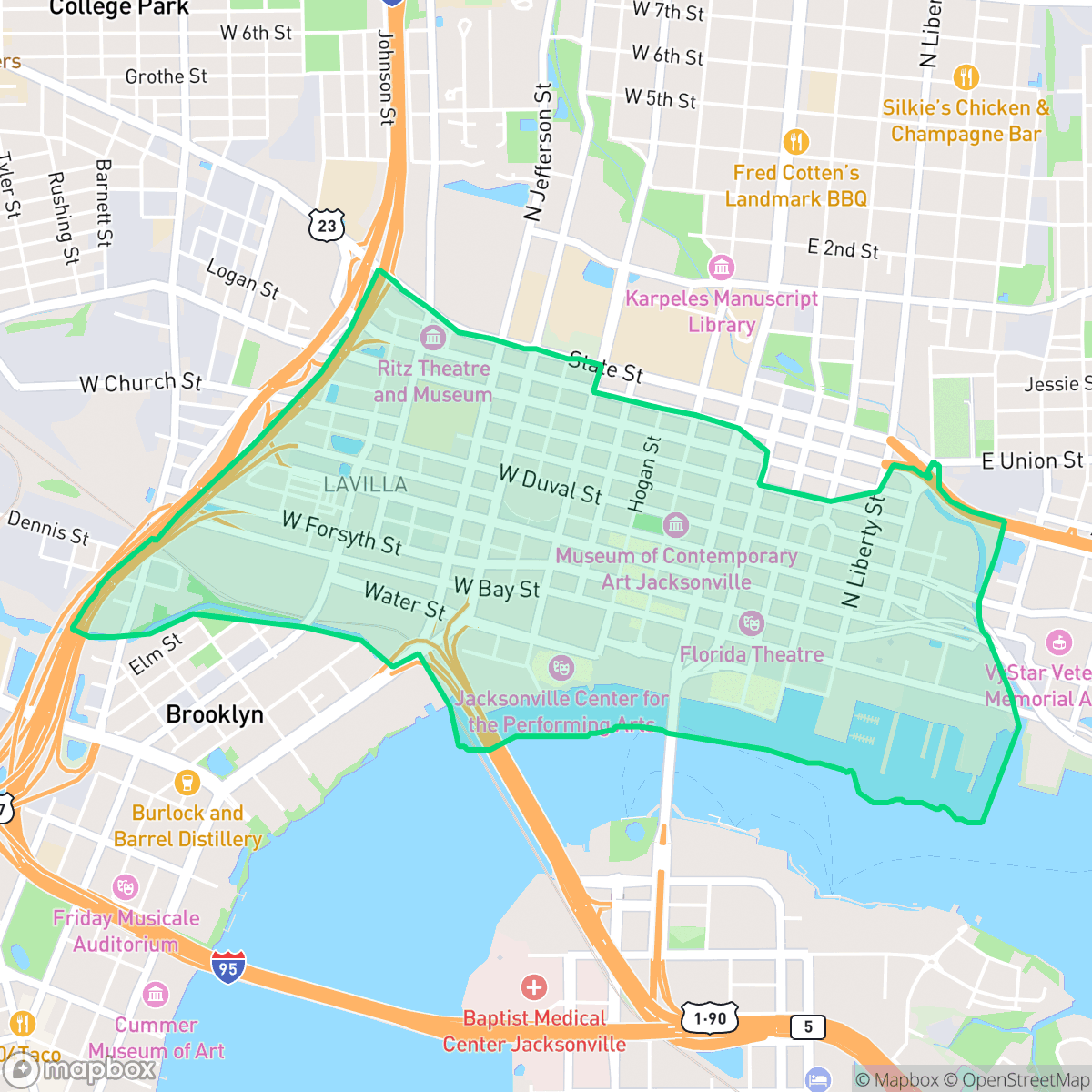
Downtown Jacksonville, founded in 1822 by Isaiah D. Hart, serves as the city's historic core. The neighborhood was fundamentally transformed by the Great Fire of 1901, which razed the central business district and prompted a rapid, stylish architectural revival. This reconstruction introduced a significant collection of Prairie School and Art Deco structures, including the iconic Florida Theatre and the St. James Building, which now serves as City Hall. Defined by its grid-based street layout along the St. Johns River, the area features James Weldon Johnson Park, the city's oldest public space. Historically a center for banking and shipping, Downtown Jacksonville remains a cultural anchor, characterized by its resilient 20th-century architectural heritage and its evolution from a frontier crossing known as 'Cowford' into a modern urban center.
The area functions as a dense urban core characterized by a grid layout that connects corporate towers, mid-range residential units, and riverfront access. As a major social center, it provides a lively atmosphere with frequent activity near key landmarks and transit hubs, making it a primary destination for those who prioritize proximity to culture and nightlife over suburban quiet. The visual landscape is functional, blending modern infrastructure with historic structures to create a unique, if highly built-up, environment that remains more accessible on foot than most parts of the city.
Living in the neighborhood involves specific trade-offs, particularly regarding acoustic comfort and privacy. Due to frequent rail traffic and heavy vehicle volume on major thoroughfares, the area is notably louder than the city average, and the prevalence of multi-unit complexes results in limited personal space. Prospective residents should also be aware of the local landscape regarding health insurance coverage and the presence of light industrial activity, including a nearby environmental site. Families navigating the educational landscape will find a district currently undergoing significant consolidation, where success often depends on securing placement in specialized magnet programs rather than relying solely on neighborhood school zoning.
Neighborhood Scores Across 15 Qualities
Dense urban structures and shared walls create a high-density environment with minimal separation between neighbors. This level of privacy is slightly lower than the Jacksonville city average due to the close proximity of multi-unit complexes.
Pedestrian infrastructure in the urban core, including continuous sidewalks and riverwalks, is significantly more developed than the Jacksonville average. While some arterial roads present challenges due to heavy traffic, many areas feature a consistent grid layout that facilitates easy movement on foot.
The visual landscape consists of a mix of corporate towers, parking lots, and mid-range residential units. This environment offers more architectural variety than the city average, though it lacks lush greenery or high-end estates.
Paved surfaces and dense urban structures dominate the landscape, though some street-side verges and scattered patches of grass provide areas for walking. This level of accessibility is slightly higher than the city average according to iHuus data.
High-rise commercial buildings, parking structures, and major highway interchanges create a dense urban environment that is more built-up than the Jacksonville average. According to iHuus data, this area lacks the suburban balance of green space and residential streets found elsewhere in the city.
Highly active streets and a dense concentration of dining, nightlife, and entertainment venues make this area significantly more lively than the Jacksonville average. According to iHuus data, the neighborhood serves as a major social center with frequent activity near key landmarks and transit hubs.
Frequent sounds from nearby railroad tracks and heavy traffic on major thoroughfares make this area louder than the Jacksonville average. Residents can expect significant acoustic disturbances due to the proximity of transit corridors and highway infrastructure.
Air quality levels fluctuate between acceptable and unhealthy, posing occasional concerns for sensitive groups. According to iHuus data, the atmosphere in this area remains significantly cleaner than the Jacksonville city average.
Occasional light commercial activities and storage facilities introduce some heavy freight traffic and transit-related odors. While industrial proximity is higher than the city average, the area remains primarily composed of mixed-use and residential spaces; however, residents should be aware of a nearby EPA Superfund site with potential environmental implications.
Health insurance access for residents is significantly below the Jacksonville average, according to iHuus data. This disparity reflects a higher rate of uninsured individuals compared to most other parts of the city.
Political leaning in this area is significantly more liberal than the Jacksonville average, according to iHuus data.
A balanced mix of young professionals, families, and older residents characterizes this area. According to iHuus data, the age distribution is more varied than the city average.
Residual flood risks exist as parts of the area fall within the 500 year floodplain, though safety levels remain notably higher than the Jacksonville average according to iHuus data.
Address-Level Insights for Downtown Jacksonville


iHuus Neighborhood Intelligence Insights
Get address-level neighborhood insights for Downtown Jacksonville
- Street-level scores — see how individual blocks compare, not just neighborhood averages
- Micro-zone boundaries — identify quiet pockets, flood boundaries, and walkable clusters before you visit
- 15 dimensions in full — walkability, noise, air quality, school quality, insurance coverage, population age profile, urban/rural index, and more
- Boundary risk alerts — know if your address sits near a block boundary where scores drop, the kind of detail no listing will ever mention
- School insights — individual school ratings and insights, not just district-level data
- Compare before you commit — side-by-side data across neighborhoods, down to block precision
No credit card required
Compare with Any Neighborhood
| Dimension | Downtown Jacksonville | 29th and Chase |
|---|---|---|
| 🚶 Walkabilityavg 3.96 | ||
| 🔊 Acoustic Comfortavg 4.37 | ||
| 🤫 Privacy Indexavg 4.3 | ||
| 🎨 Visual Appealavg 4.24 | ||
| 🐕 Dog Friendlinessavg 4.28 | ||
| 🗺️ Urban-Rural Indexavg 5.22 | ||
| ✨ Neighborhood Vibeavg 1.5 | ||
| 🏥 Health Insurance Coverageavg 4.35 | ||
| 🌿 Air Qualityavg 3.84 | ||
| 🏭 Industrial Proximityavg 5.11 | ||
| 🌊 Flood Safetyavg 4.01 | ||
| 🗳️ Ideological Leanavg 2.75 | ||
| 👥 Population Age Profileavg 3.26 | ||
| 🔥 Fire Safety | ||
| 🏫 School Quality |
Downtown Jacksonville Rankings
School Districts Serving Downtown Jacksonville
School Insights for Downtown Jacksonville
Below average outcomes; significant attendance and academic challenges.
School Insights
See what's really behind every school rating near Downtown Jacksonville
- Individual school ratings — each school's own score with outcome context, not just a district average
- Enrollment & class size data — student-to-teacher ratio and how it compares to the state average
- Full demographics breakdown — ethnicity and gender composition for every school in the enrollment zone
- Every school in the district — all schools within the enrollment boundary ranked by rating, not just the closest one
- Grade levels & benchmarks — elementary through high school, with below/above state-average flags
No credit card required