Dinsmore, Jacksonville
Updated · 3,071 residents
Dinsmore is a quiet, semi-rural community in Northwest Jacksonville defined by its spacious lots and peaceful atmosphere. Residents enjoy a high level of privacy and a pet-friendly environment, though the area remains limited in terms of commercial activity and pedestrian infrastructure.
Key Highlights
About Dinsmore
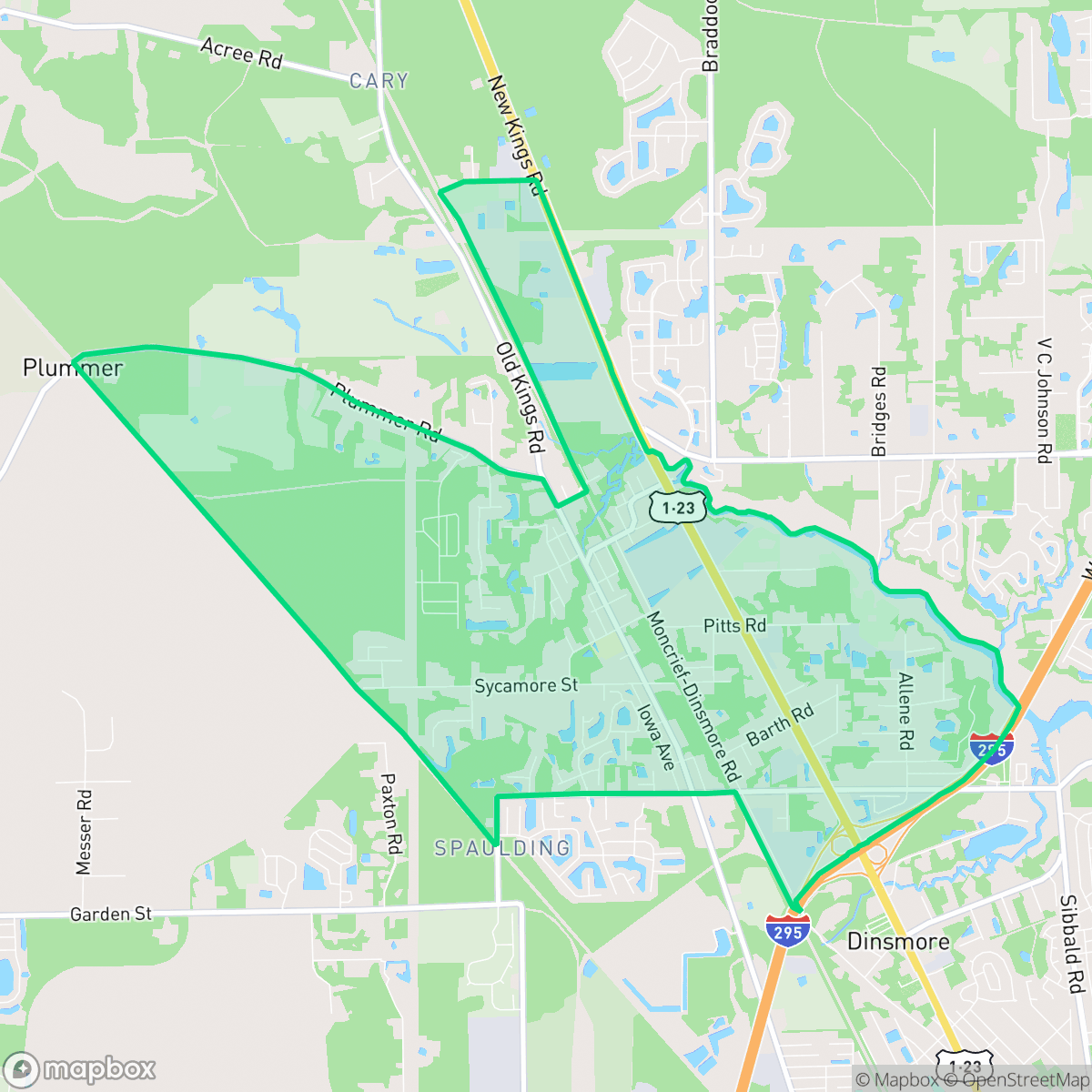
Dinsmore is a historic rural community in Northwest Jacksonville, established in the late 19th century and named after a Northern real estate developer. Originally defined by plantations and turpentine production, the area evolved into a significant industrial hub centered on sawmills, most notably those operated by Captain C.W. Hilliard. The arrival of the Savannah, Florida & Western Railroad in 1881 facilitated growth, eventually shifting the local economy toward dairy farming, with the Dinsmore Dairy Company becoming a prominent regional producer. The dairy gained historical significance for its owners' vocal support of the civil rights movement, which led to its forced retail closure by the Ku Klux Klan in 1959. Today, the neighborhood retains its character through landmarks like the historic Dinsmore Cemetery, Old Kings Road, and long-standing community buildings.
The area offers a distinct semi-rural setting characterized by open land and woodland, providing a sense of seclusion that is uncommon in the broader Jacksonville region. While the landscape is primarily composed of standard tract housing, the generous spacing between homes ensures a high degree of personal privacy. The atmosphere is notably quiet, with minimal commercial development or high-traffic destinations, making it an ideal environment for those who prefer a low-activity lifestyle over the bustle of the city core.
Living here requires an adjustment to limited pedestrian infrastructure, as the lack of sidewalks means residents often share roadways with vehicles. While the neighborhood provides a peaceful retreat, the local air quality and flood risk are moderate, requiring residents to stay informed on environmental conditions. According to iHuus data, the area benefits from high health insurance coverage and a diverse age demographic, making it a stable choice for families and retirees alike. Educational needs are served by the Duval County School District, where families can access specialized magnet programs despite the broader challenges of district-wide consolidation.
Neighborhood Scores Across 15 Qualities
Spacious lots with significant separation between homes provide a greater sense of seclusion than is typical for Jacksonville. According to iHuus data, residents can expect much more personal space compared to the city average.
Low-traffic streets provide a calm environment for walking, although the lack of sidewalks means pedestrians must share the road with vehicles. This level of walkability is slightly higher than the average for Jacksonville.
Standard tract housing defines the area, featuring tidy but small yards and simple rooflines. According to iHuus data, the visual landscape is slightly more varied than the Jacksonville average.
Accessible green spaces and wide, low-traffic paths make this area notably more suitable for dog owners than the Jacksonville average. According to iHuus data, the neighborhood provides safer environments for walking pets compared to most other parts of the city.
Frequent open land and scattered homes amidst woodland characterize this area, offering a more rural feel than much of Jacksonville. According to iHuus data, the landscape features significantly more open space and natural vegetation compared to the city average.
Minimal commercial activity and very few local destinations define this area, which remains more tranquil than the Jacksonville average. According to iHuus data, residents can expect a peaceful, low-activity environment with limited access to nearby shops or dining hubs.
Local traffic from nearby busy streets creates a consistent level of ambient noise. According to iHuus data, acoustic comfort in this area is slightly higher than the Jacksonville average.
Air quality levels fluctuate between acceptable and unhealthy ranges, presenting occasional concerns for sensitive groups. According to iHuus data, the air quality in Dinsmore is better than the Jacksonville average.
Residential streets remain largely free of heavy industry, though some areas near storage facilities experience increased freight traffic and loading activity. This neighborhood maintains a lower industrial density than the Jacksonville average according to iHuus data.
Health insurance accessibility among residents is notably higher than the Jacksonville average, according to iHuus data.
Political leanings in this area trend significantly more liberal than the Jacksonville average. According to iHuus data, the neighborhood maintains a liberal majority with a modest opposing presence.
A varied demographic of young adults, families, and seniors resides here, representing a more balanced age distribution than the Jacksonville average according to iHuus data.
Flood risk in this area is slightly higher than the Jacksonville average, though official assessments from FEMA remain incomplete for this specific location. According to iHuus data, residents should maintain awareness of local drainage and seasonal water levels.
Address-Level Insights for Dinsmore


iHuus Neighborhood Intelligence Insights
Get address-level neighborhood insights for Dinsmore
- Street-level scores — see how individual blocks compare, not just neighborhood averages
- Micro-zone boundaries — identify quiet pockets, flood boundaries, and walkable clusters before you visit
- 15 dimensions in full — walkability, noise, air quality, school quality, insurance coverage, population age profile, urban/rural index, and more
- Boundary risk alerts — know if your address sits near a block boundary where scores drop, the kind of detail no listing will ever mention
- School insights — individual school ratings and insights, not just district-level data
- Compare before you commit — side-by-side data across neighborhoods, down to block precision
No credit card required
Compare with Any Neighborhood
| Dimension | Dinsmore | 29th and Chase |
|---|---|---|
| 🚶 Walkabilityavg 3.96 | ||
| 🔊 Acoustic Comfortavg 4.37 | ||
| 🤫 Privacy Indexavg 4.3 | ||
| 🎨 Visual Appealavg 4.24 | ||
| 🐕 Dog Friendlinessavg 4.28 | ||
| 🗺️ Urban-Rural Indexavg 5.22 | ||
| ✨ Neighborhood Vibeavg 1.5 | ||
| 🏥 Health Insurance Coverageavg 4.35 | ||
| 🌿 Air Qualityavg 3.84 | ||
| 🏭 Industrial Proximityavg 5.11 | ||
| 🌊 Flood Safetyavg 4.01 | ||
| 🗳️ Ideological Leanavg 2.75 | ||
| 👥 Population Age Profileavg 3.26 | ||
| 🔥 Fire Safety | ||
| 🏫 School Quality |
Dinsmore Rankings
School Districts Serving Dinsmore
School Insights for Dinsmore
Below average outcomes; significant attendance and academic challenges.
School Insights
See what's really behind every school rating near Dinsmore
- Individual school ratings — each school's own score with outcome context, not just a district average
- Enrollment & class size data — student-to-teacher ratio and how it compares to the state average
- Full demographics breakdown — ethnicity and gender composition for every school in the enrollment zone
- Every school in the district — all schools within the enrollment boundary ranked by rating, not just the closest one
- Grade levels & benchmarks — elementary through high school, with below/above state-average flags
No credit card required