Deerwood Center, Jacksonville
Updated · 1,621 residents
Deerwood Center is an active suburban hub defined by its diverse mix of residential, commercial, and educational spaces. While the area offers moderate walkability and a semi-rural atmosphere, residents should be prepared for significant noise from nearby major traffic corridors.
Key Highlights
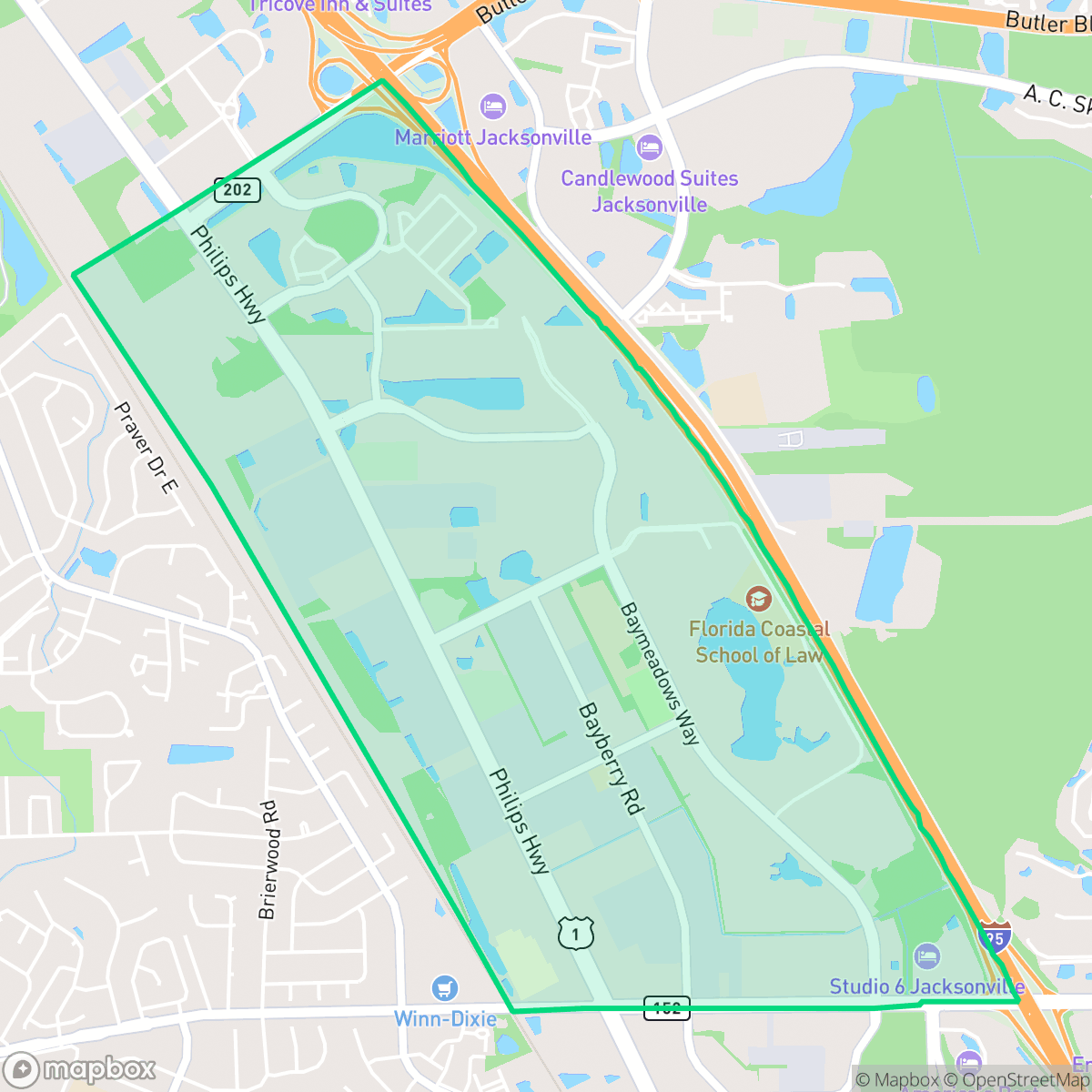
About Deerwood Center
Deerwood Center in Jacksonville, Florida, is historically significant for its site's transformation from the unsuccessful 1980s-era Grande Boulevard Mall into a key educational hub. Originally designed as an upscale, two-story shopping destination intended to serve the affluent Deerwood community—Florida’s first gated residential development—the mall struggled with market demand and was eventually acquired by the Florida Community College at Jacksonville (now FSCJ) in 1994. The building was repurposed into the FSCJ Deerwood Center, a unique example of adaptive reuse in the city. The broader Deerwood area itself originated from the extensive landholdings of the Skinner family, whose stewardship and subsequent development of the Southside region in the 1960s were instrumental in shaping the suburban expansion of Jacksonville.
The area functions as a lively center for Jacksonville residents, characterized by a standard suburban aesthetic that blends tract housing with commercial and retail nodes. It maintains a semi-rural feel with open land and greenery, providing a more balanced residential layout than many other parts of the city. According to data from iHuus, the community benefits from high levels of health insurance coverage and a diverse population, spanning young adults to seniors. The neighborhood provides a consistent degree of privacy for residents, with suburban lot layouts that offer separation between homes.
Prospective residents should consider the trade-offs of living in a transit-adjacent area, as the neighborhood experiences frequent auditory disturbances due to heavy traffic infrastructure. While the streets are generally safe for walking, pedestrian access can be inconsistent due to interrupted sidewalks. The local school district, managed by Duval County, presents a complex landscape where families may find success through competitive magnet programs despite broader challenges with district-wide consolidation and budget management.
Neighborhood Scores Across 15 Qualities
Suburban lot layouts provide a moderate degree of separation between homes, offering more privacy than the Jacksonville average. According to iHuus data, residential properties feature consistent buffering between neighbors.
Quiet residential streets allow for safe walking, though some sidewalks are interrupted. This area offers better pedestrian accessibility than the Jacksonville average.
Typical tract housing with modest yards defines the area, offering a more visually organized landscape than much of Jacksonville. According to iHuus data, the presence of nearby commercial and industrial zones sits alongside residential properties featuring private pools.
Public park access and wide green verges are scarce, as most greenery is located within private yards. According to iHuus data, this area offers slightly more recreational space for pets than the Jacksonville average.
Open land and scattered greenery are more common here than in much of Jacksonville. The landscape features a mix of residential blocks, commercial strips, and industrial warehouses according to iHuus data.
This area functions as a lively local center with much higher activity levels than the Jacksonville average. Residents have access to a diverse variety of dining, wellness services, and retail options concentrated near transit hubs and nearby educational institutions.
Frequent noise from nearby major roadways and transit infrastructure makes this area significantly louder than the Jacksonville average. Residents should expect consistent auditory disturbances due to the proximity of heavy traffic corridors.
Air quality levels fluctuate between acceptable and unhealthy, which may present occasional concerns for sensitive groups. According to iHuus data, the air quality in Deerwood Center remains significantly better than the Jacksonville city average.
Primarily residential and commercial in character, this area experiences significantly less industrial activity than the Jacksonville average. While most blocks are quiet, certain pockets near storage facilities and printing services may encounter intermittent heavy freight traffic or loading noise.
Health insurance access among residents is significantly higher than the Jacksonville average, according to iHuus data. This indicates a strong level of-medical coverage within the local community.
Political leanings are evenly split between conservative and liberal viewpoints, representing a much more balanced ideological landscape than the city average.
A varied mix of young adults, families, and seniors resides here, reflecting a more balanced age distribution than the Jacksonville average according to iHuus data.
Residual flood risks exist within this area, though safety levels remain significantly higher than the Jacksonville average according to iHuus data.
Address-Level Insights for Deerwood Center


iHuus Neighborhood Intelligence Insights
Get address-level neighborhood insights for Deerwood Center
- Street-level scores — see how individual blocks compare, not just neighborhood averages
- Micro-zone boundaries — identify quiet pockets, flood boundaries, and walkable clusters before you visit
- 15 dimensions in full — walkability, noise, air quality, school quality, insurance coverage, population age profile, urban/rural index, and more
- Boundary risk alerts — know if your address sits near a block boundary where scores drop, the kind of detail no listing will ever mention
- School insights — individual school ratings and insights, not just district-level data
- Compare before you commit — side-by-side data across neighborhoods, down to block precision
No credit card required
Compare with Any Neighborhood
| Dimension | Deerwood Center | 29th and Chase |
|---|---|---|
| 🚶 Walkabilityavg 3.96 | ||
| 🔊 Acoustic Comfortavg 4.37 | ||
| 🤫 Privacy Indexavg 4.3 | ||
| 🎨 Visual Appealavg 4.24 | ||
| 🐕 Dog Friendlinessavg 4.28 | ||
| 🗺️ Urban-Rural Indexavg 5.22 | ||
| ✨ Neighborhood Vibeavg 1.5 | ||
| 🏥 Health Insurance Coverageavg 4.35 | ||
| 🌿 Air Qualityavg 3.84 | ||
| 🏭 Industrial Proximityavg 5.11 | ||
| 🌊 Flood Safetyavg 4.01 | ||
| 🗳️ Ideological Leanavg 2.75 | ||
| 👥 Population Age Profileavg 3.26 | ||
| 🔥 Fire Safety | ||
| 🏫 School Quality |
Deerwood Center Rankings
School Districts Serving Deerwood Center
School Insights for Deerwood Center
Below average outcomes; significant attendance and academic challenges.
School Insights
See what's really behind every school rating near Deerwood Center
- Individual school ratings — each school's own score with outcome context, not just a district average
- Enrollment & class size data — student-to-teacher ratio and how it compares to the state average
- Full demographics breakdown — ethnicity and gender composition for every school in the enrollment zone
- Every school in the district — all schools within the enrollment boundary ranked by rating, not just the closest one
- Grade levels & benchmarks — elementary through high school, with below/above state-average flags
No credit card required