Confederate Point, Jacksonville
Updated · 3,836 residents
Confederate Point is a tranquil, semi-rural peninsula on the Cedar River that offers a mix of spacious single-family homes and waterfront apartment living. The area provides a quiet, secluded environment with better than average air quality and ample green space for outdoor activities.
Key Highlights
About Confederate Point
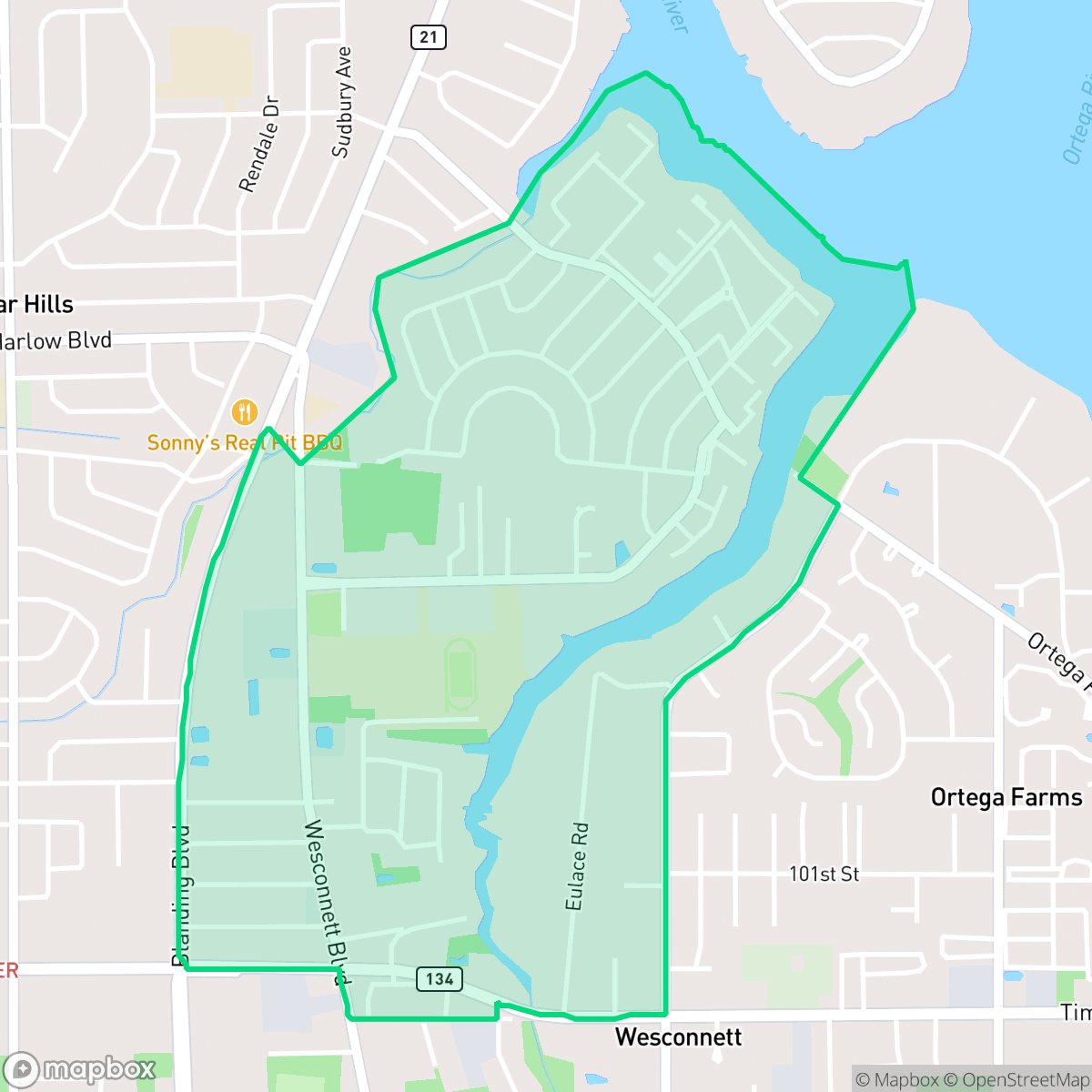
Confederate Point, located on Jacksonville’s Westside, was developed in the 1960s on reclaimed lowlands along the Cedar River. Geographically unique, the neighborhood functions as a small, isolated peninsula—often described as an island—surrounded by the Cedar River, Butcher Pen Creek, and Fishing Creek. Its layout is defined by limited access, with only one bridge connecting the area to the mainland. The neighborhood’s residential character is split between approximately 300 inland single-family homes and a larger concentration of waterfront apartment and condominium complexes that line the riverbanks. This distinct geography and its mid-century development history create a secluded, waterfront-focused residential enclave that remains physically and structurally separate from the surrounding Westside suburbs.
The area maintains a distinct, quiet atmosphere defined by its waterfront setting and limited commercial activity. Residents enjoy a visual landscape characterized by well maintained properties and suburban spacing that, according to iHuus data, offers more privacy than many other parts of the city. With minimal industrial presence, the neighborhood provides a calm environment that appeals to a diverse demographic, including families and retirees who value a peaceful residential enclave. The community remains largely free from heavy warehouses or large scale manufacturing, contributing to a polished, upscale suburban feel. Living here involves balancing the benefits of a secluded, scenic location with the reality of higher flood risk and the need for reliable transportation, as the area relies on a single access point to the mainland. While the neighborhood lacks dense commercial amenities, it remains a popular choice for those seeking a balance between suburban comfort and natural beauty. Families should note that local educational options are part of the Duval County School District, where success often depends on leveraging specialized magnet and advanced studies programs amid ongoing district wide transitions.
Neighborhood Scores Across 15 Qualities
Residential spacing offers a balance of separation, with more buffer between neighbors than is typical for the Jacksonville area. According to iHuus data, while apartment complexes present higher density, most houses maintain suburban distances from one another.
Low traffic volumes and sidewalks along primary access roads make walking easier here than in most of Jacksonville. Residents can navigate internal residential loops safely, although some areas lack continuous pedestrian infrastructure.
Large homes and frequent upscale amenities define the landscape, making the visual environment significantly more polished than the Jacksonville average. Many properties feature spacious driveways and access to private or communal pools according to iHuus data.
Abundant waterfront greenery and wide grassy verges between sidewalks and roads offer more space for pets than the Jacksonville average. According to iHuus data, these natural features provide better opportunities for outdoor activities compared to many other parts of the city.
Open land and woodland are frequently interspersed with scattered homes, making this area notably more rural than the Jacksonville average. According to iHuus data, some sections near the waterway also feature a denser suburban mix of single-family homes and apartment complexes.
Primarily residential and subdued in nature, this area offers more local activity than much of Jacksonville. While some pockets near universities provide scattered dining options, the neighborhood is largely characterized by calm streets and limited commercial density.
Steady sound from nearby busy streets defines the local environment, though levels are generally more tranquil than the Jacksonville average according to iHuus data.
Air conditions in Confederate Point are generally acceptable, though they frequently present more favorable levels than the Jacksonville average. Residents should remain mindful of occasional periods of poor air quality that may affect sensitive groups.
Industrial activity is notably low compared to the Jacksonville average, consisting primarily of residential streets and light commercial services. Residents can expect a landscape free from heavy warehouses or large-scale manufacturing plants.
Health insurance coverage rates in this area are notably higher than the Jacksonville average. According to iHuus data, residents have a better likelihood of being covered compared to many other parts of the city.
Political leanings in this area are split nearly evenly between conservative and liberal perspectives, making it more politically balanced than the city average according to iHuus data.
Residents live alongside a balanced mix of young adults, families, and seniors. According to iHuus data, this age distribution is significantly more varied than the city average.
Flood risk in this area is higher than the Jacksonville average, though specific risk levels remain undetermined because detailed federal studies for this zone are currently incomplete.
Address-Level Insights for Confederate Point


iHuus Neighborhood Intelligence Insights
Get address-level neighborhood insights for Confederate Point
- Street-level scores — see how individual blocks compare, not just neighborhood averages
- Micro-zone boundaries — identify quiet pockets, flood boundaries, and walkable clusters before you visit
- 15 dimensions in full — walkability, noise, air quality, school quality, insurance coverage, population age profile, urban/rural index, and more
- Boundary risk alerts — know if your address sits near a block boundary where scores drop, the kind of detail no listing will ever mention
- School insights — individual school ratings and insights, not just district-level data
- Compare before you commit — side-by-side data across neighborhoods, down to block precision
No credit card required
Compare with Any Neighborhood
| Dimension | Confederate Point | 29th and Chase |
|---|---|---|
| 🚶 Walkabilityavg 3.96 | ||
| 🔊 Acoustic Comfortavg 4.37 | ||
| 🤫 Privacy Indexavg 4.3 | ||
| 🎨 Visual Appealavg 4.24 | ||
| 🐕 Dog Friendlinessavg 4.28 | ||
| 🗺️ Urban-Rural Indexavg 5.22 | ||
| ✨ Neighborhood Vibeavg 1.5 | ||
| 🏥 Health Insurance Coverageavg 4.35 | ||
| 🌿 Air Qualityavg 3.84 | ||
| 🏭 Industrial Proximityavg 5.11 | ||
| 🌊 Flood Safetyavg 4.01 | ||
| 🗳️ Ideological Leanavg 2.75 | ||
| 👥 Population Age Profileavg 3.26 | ||
| 🔥 Fire Safety | ||
| 🏫 School Quality |
Confederate Point Rankings
School Districts Serving Confederate Point
School Insights for Confederate Point
Below average outcomes; significant attendance and academic challenges.
School Insights
See what's really behind every school rating near Confederate Point
- Individual school ratings — each school's own score with outcome context, not just a district average
- Enrollment & class size data — student-to-teacher ratio and how it compares to the state average
- Full demographics breakdown — ethnicity and gender composition for every school in the enrollment zone
- Every school in the district — all schools within the enrollment boundary ranked by rating, not just the closest one
- Grade levels & benchmarks — elementary through high school, with below/above state-average flags
No credit card required