Carver Manor, Jacksonville
Updated · 2,352 residents
Carver Manor offers a quiet, semi-rural atmosphere defined by spacious lots and a mature tree canopy. While the neighborhood provides a peaceful residential environment with diverse age groups, residents should expect consistent background traffic noise and limited local commercial amenities.
Key Highlights
About Carver Manor
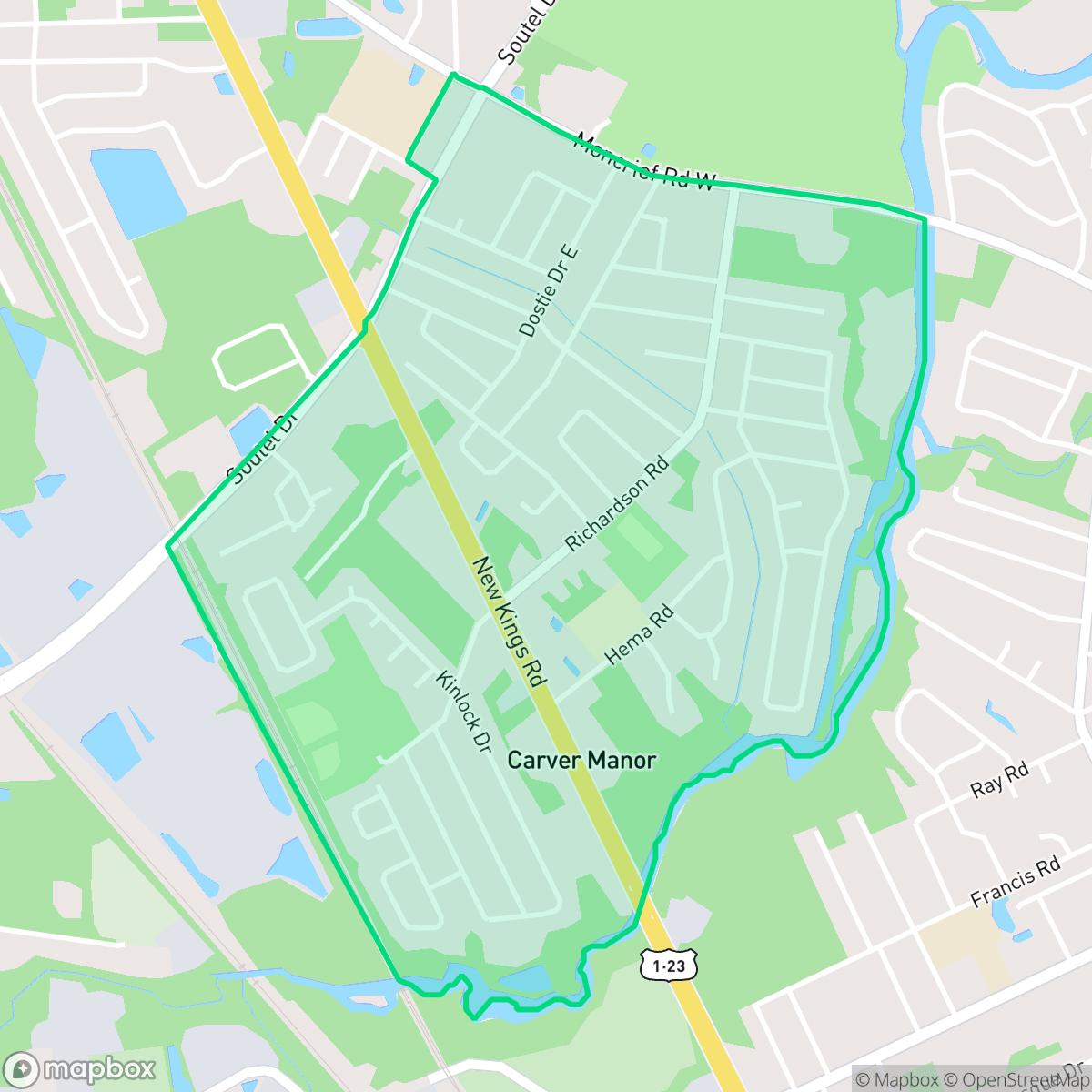
Carver Manor, located in Northwest Jacksonville, is historically significant for being developed on the grounds of the former Lincoln Golf and Country Club. Established in 1926 by Abraham Lincoln Lewis, the president of Florida's first Black-owned life insurance company, the club served as a vital social and recreational hub for affluent African-Americans during the era of segregation. For decades, the site hosted major golf tournaments and was a destination for formal gatherings and dining. Following the club's closure in the early 1960s, the land was redeveloped into the Carver Manor and Lincoln Estates subdivisions, which continue to define the neighborhood's residential character today.
The area maintains a distinct, low-density residential character that stands out from the typical Jacksonville urban landscape. The neighborhood features a mix of tract housing with tidy yards, offering more privacy and open space than many surrounding communities. Its demographic composition is notably varied, bringing together young adults, established families, and seniors in a setting that encourages quiet, pedestrian-friendly activities within its internal streets.
Prospective residents should consider the trade-offs of this location, including a higher-than-average potential for flooding and the presence of nearby industrial sites that warrant environmental awareness. While the residential streets are pleasant for walking, main arterial roads lack dedicated sidewalks, and the area experiences a steady hum of traffic noise. Families may navigate the broader Duval County school system, which offers both specialized magnet academies and a challenging landscape of ongoing school consolidations. This neighborhood is well-suited for those seeking a calm, community-oriented environment over proximity to nightlife or commercial hubs.
Neighborhood Scores Across 15 Qualities
Residential spacing offers a moderate level of seclusion with noticeable buffers between homes. This degree of privacy is notably higher than the Jacksonville average, according to iHuus data.
Low traffic volumes make residential streets pleasant for walking, even though dedicated sidewalks are absent along main arterial roads. According to iHuus data, this level of walkability is higher than the Jacksonville city average.
Standard tract housing characterizes the area with boxy roofs and tidy but small yards. This level of visual interest sits above the Jacksonville average according to iHuus data.
Abundant green spaces and wooded residential setbacks provide ample walking areas that are significantly more pet-friendly than the Jacksonville average. Wide paths and grassy verges between sidewalks and roads offer safe routes away from traffic.
Spacious lots and significant tree canopy create a more open, low-density environment than the typical Jacksonville urban landscape. Residents will find more frequent pockets of woodland and open land compared to the city average.
Residential streets offer a subdued atmosphere with very little commercial activity or nightlife. While more active than the city average, the area remains primarily composed of quiet housing blocks and parks with limited access to local amenities.
Local traffic from a nearby busy street creates a consistent hum. This level of acoustic activity is slightly higher than the average found across Jacksonville.
Air quality levels fluctuate between acceptable and unhealthy conditions, though they remain notably better than the Jacksonville average according to iHuus data. Sensitive groups may experience occasional concern during certain periods.
Primarily residential in character, this area features more industrial activity than the Jacksonville average due to nearby storage facilities and a local gas station. Residents should note the proximity to an EPA Superfund site which may present environmental concerns regarding soil and groundwater.
Health insurance access for residents in this area is slightly above the Jacksonville average, according to iHuus data.
Voting patterns and census indicators reflect a significantly more liberal political leaning than the Jacksonville average, according to iHuus data.
Residents live alongside a balanced mix of young adults, families, and seniors. According to iHuus data, this demographic variety is notably more diverse than the broader Jacksonville area.
Flood risk in this area remains uncertain because detailed studies for the neighborhood have not yet been finalized. According to iHuus data, the potential for flooding is higher than the average found across Jacksonville.
Address-Level Insights for Carver Manor


iHuus Neighborhood Intelligence Insights
Get address-level neighborhood insights for Carver Manor
- Street-level scores — see how individual blocks compare, not just neighborhood averages
- Micro-zone boundaries — identify quiet pockets, flood boundaries, and walkable clusters before you visit
- 15 dimensions in full — walkability, noise, air quality, school quality, insurance coverage, population age profile, urban/rural index, and more
- Boundary risk alerts — know if your address sits near a block boundary where scores drop, the kind of detail no listing will ever mention
- School insights — individual school ratings and insights, not just district-level data
- Compare before you commit — side-by-side data across neighborhoods, down to block precision
No credit card required
Compare with Any Neighborhood
| Dimension | Carver Manor | 29th and Chase |
|---|---|---|
| 🚶 Walkabilityavg 3.96 | ||
| 🔊 Acoustic Comfortavg 4.37 | ||
| 🤫 Privacy Indexavg 4.3 | ||
| 🎨 Visual Appealavg 4.24 | ||
| 🐕 Dog Friendlinessavg 4.28 | ||
| 🗺️ Urban-Rural Indexavg 5.22 | ||
| ✨ Neighborhood Vibeavg 1.5 | ||
| 🏥 Health Insurance Coverageavg 4.35 | ||
| 🌿 Air Qualityavg 3.84 | ||
| 🏭 Industrial Proximityavg 5.11 | ||
| 🌊 Flood Safetyavg 4.01 | ||
| 🗳️ Ideological Leanavg 2.75 | ||
| 👥 Population Age Profileavg 3.26 | ||
| 🔥 Fire Safety | ||
| 🏫 School Quality |
Carver Manor Rankings
School Districts Serving Carver Manor
School Insights for Carver Manor
Below average outcomes; significant attendance and academic challenges.
School Insights
See what's really behind every school rating near Carver Manor
- Individual school ratings — each school's own score with outcome context, not just a district average
- Enrollment & class size data — student-to-teacher ratio and how it compares to the state average
- Full demographics breakdown — ethnicity and gender composition for every school in the enrollment zone
- Every school in the district — all schools within the enrollment boundary ranked by rating, not just the closest one
- Grade levels & benchmarks — elementary through high school, with below/above state-average flags
No credit card required