Avondale, Jacksonville
Updated · 5,698 residents
Avondale is a historic Jacksonville neighborhood defined by its diverse early 20th-century architecture and tree-lined, pedestrian-friendly streets. Residents enjoy high walkability and access to local dining and independent shops, all balanced by a quiet, established suburban atmosphere.
Key Highlights
About Avondale
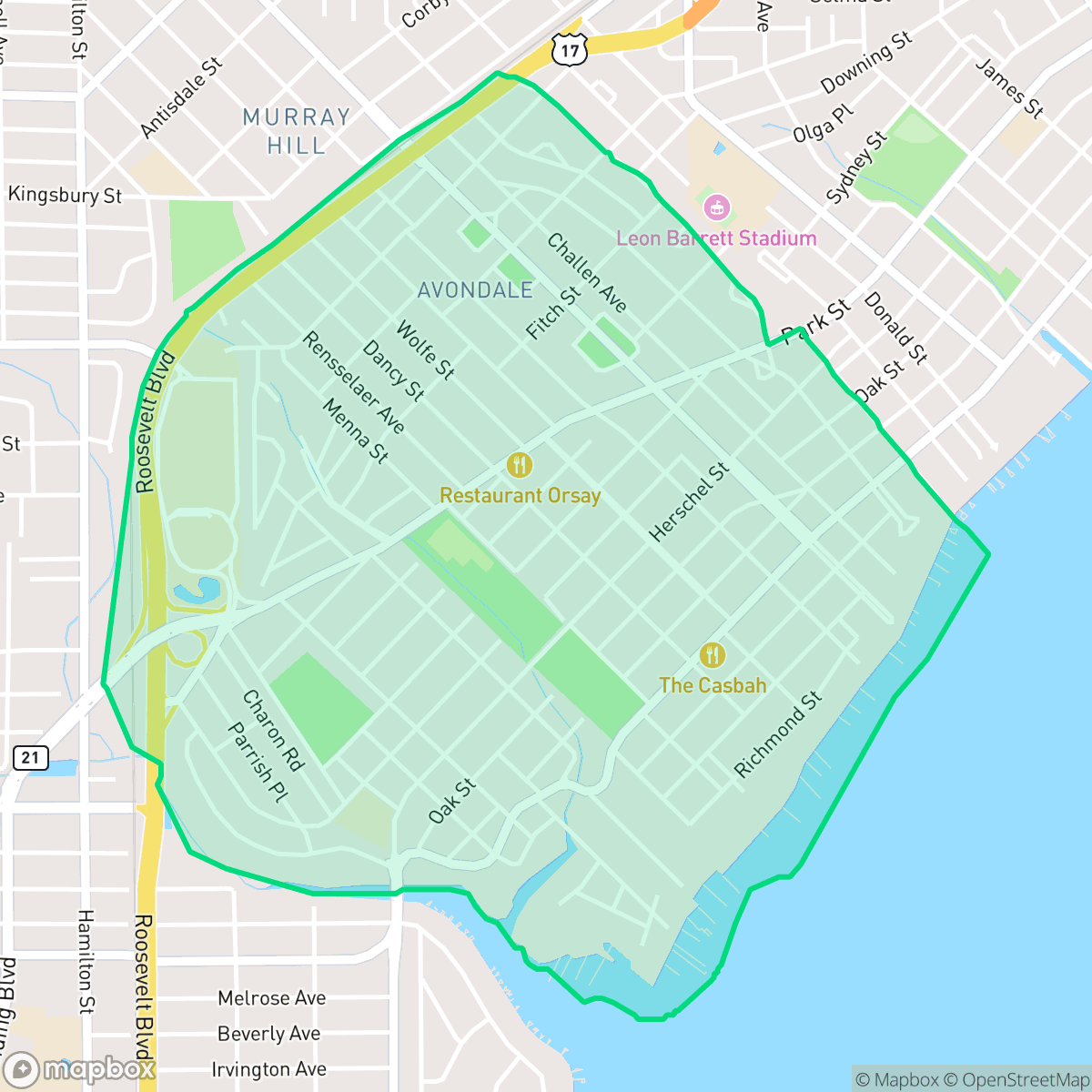
Developed in 1921 by Telfair Stockton & Co. on former Magnolia Plantation land, Avondale was envisioned as an exclusive, upscale planned community. It is a key component of the Riverside/Avondale Historic District, listed on the National Register of Historic Places. The neighborhood is celebrated for its early 20th-century architectural diversity, featuring a high concentration of Mediterranean Revival, Tudor, and Craftsman styles. Influenced by the Garden City and City Beautiful movements, Avondale is characterized by its curved, tree-lined streets and grassy rights-of-way. The Shoppes of Avondale, centered on St. Johns Avenue, serves as a historic commercial hub that has anchored the neighborhood since its founding. Public spaces like the historic Boone Park further define the area’s identity, preserving the aesthetic and planning ideals of Jacksonville’s 1920s land boom era.
The area maintains a distinct visual appeal through its manicured landscapes and spacious residential lots, which offer more privacy than many other parts of the city. The community benefits from a strong sense of place, supported by a mix of young professionals and long-term residents who value the neighborhood's established greenery and pedestrian infrastructure. While the overall environment is peaceful, the proximity to major thoroughfares introduces a consistent level of traffic noise that residents should anticipate. According to iHuus data, the neighborhood provides a notably more open and green feel than the typical urban landscape in Jacksonville.
Prospective residents should consider that while the neighborhood provides excellent access to local amenities, it sits within a floodplain, necessitating awareness of local flood safety measures. The area is served by the Duval County School District, where educational outcomes vary significantly between neighborhood schools and specialized magnet programs. It is best suited for those who prioritize architectural character, walkability, and a mature, tree-canopied environment over the absolute quiet of a more remote suburban setting.
Neighborhood Scores Across 15 Qualities
Residential spacing provides a greater sense of seclusion than the Jacksonville average, as mature trees and modest setbacks offer visual screening between neighbors. According to iHuus data, some areas feature clustered homes while others maintain larger wooded buffers.
Sidewalk networks and a dense, gridded street layout make much of the neighborhood much more pedestrian friendly than the Jacksonville average. Mature tree canopies provide significant shade along these low-traffic residential streets; however, nearby highways and rail lines act as major barriers to movement in the western portions of the area.
Manicured landscapes, large residential footprints, and frequent private amenities provide a visual quality significantly higher than the Jacksonville average. According to iHuus data, many properties feature high-quality landscaping and spacious lots.
Tree-lined streets with wide grassy verges and proximity to large public parks provide more accessible walking space for pets than the Jacksonville average. Extensive green spaces and athletic fields nearby offer ample room for outdoor exercise.
Mature tree canopies and low-density residential layouts provide a more open, green feel than the typical Jacksonville urban landscape. According to iHuus data, this area features a higher concentration of single-family homes and wooded pockets compared to the city average.
Activity levels range from quiet, tree-lined residential streets to surprisingly lively pockets of dining and independent shops. This neighborhood offers significantly more social energy and points of interest than the Jacksonville average.
Steady traffic sounds from nearby thoroughfares are common in this area. This level of acoustic activity is consistent with the average found across Jacksonville.
Air quality levels in Avondale are generally acceptable, though they occasionally reach levels that may cause concern for sensitive groups. According to iHuus data, the air quality here remains notably better than the average for Jacksonville.
Residential tranquility is maintained by an absence of heavy industry, though residents near the edge of the neighborhood may experience noise from a nearby rail line and highway. This area offers significantly less industrial exposure than the Jacksonville average according to iHuus data.
Health insurance enrollment among Avondale residents is significantly higher than the Jacksonville average, according to iHuus data.
Political leanings in this area trend more liberal than the Jacksonville average. Residents will find a modest opposing presence alongside a liberal majority, according to iHuus data.
Residents live alongside a broad demographic ranging from young professionals to seniors. According to iHuus data, the area features a much more even age distribution than the typical Jacksonville neighborhood.
Residual flood risk exists within this area because it sits inside a floodplain, though safety levels remain notably higher than the Jacksonville average according to iHuus data.
Address-Level Insights for Avondale


iHuus Neighborhood Intelligence Insights
Get address-level neighborhood insights for Avondale
- Street-level scores — see how individual blocks compare, not just neighborhood averages
- Micro-zone boundaries — identify quiet pockets, flood boundaries, and walkable clusters before you visit
- 15 dimensions in full — walkability, noise, air quality, school quality, insurance coverage, population age profile, urban/rural index, and more
- Boundary risk alerts — know if your address sits near a block boundary where scores drop, the kind of detail no listing will ever mention
- School insights — individual school ratings and insights, not just district-level data
- Compare before you commit — side-by-side data across neighborhoods, down to block precision
No credit card required
Compare with Any Neighborhood
| Dimension | Avondale | 29th and Chase |
|---|---|---|
| 🚶 Walkabilityavg 3.96 | ||
| 🔊 Acoustic Comfortavg 4.37 | ||
| 🤫 Privacy Indexavg 4.3 | ||
| 🎨 Visual Appealavg 4.24 | ||
| 🐕 Dog Friendlinessavg 4.28 | ||
| 🗺️ Urban-Rural Indexavg 5.22 | ||
| ✨ Neighborhood Vibeavg 1.5 | ||
| 🏥 Health Insurance Coverageavg 4.35 | ||
| 🌿 Air Qualityavg 3.84 | ||
| 🏭 Industrial Proximityavg 5.11 | ||
| 🌊 Flood Safetyavg 4.01 | ||
| 🗳️ Ideological Leanavg 2.75 | ||
| 👥 Population Age Profileavg 3.26 | ||
| 🔥 Fire Safety | ||
| 🏫 School Quality |
Avondale Rankings
School Districts Serving Avondale
School Insights for Avondale
Below average outcomes; significant attendance and academic challenges.
School Insights
See what's really behind every school rating near Avondale
- Individual school ratings — each school's own score with outcome context, not just a district average
- Enrollment & class size data — student-to-teacher ratio and how it compares to the state average
- Full demographics breakdown — ethnicity and gender composition for every school in the enrollment zone
- Every school in the district — all schools within the enrollment boundary ranked by rating, not just the closest one
- Grade levels & benchmarks — elementary through high school, with below/above state-average flags
No credit card required