Arlington, Jacksonville
Updated · 5,195 residents
Arlington is defined by its blend of mid-century architecture and proximity to the St. Johns River, offering a distinct suburban environment with significant natural woodland areas. Residents benefit from a balanced age demographic and better-than-average health insurance coverage, though the area experiences noticeable traffic noise from major arterial roads.
Key Highlights
About Arlington
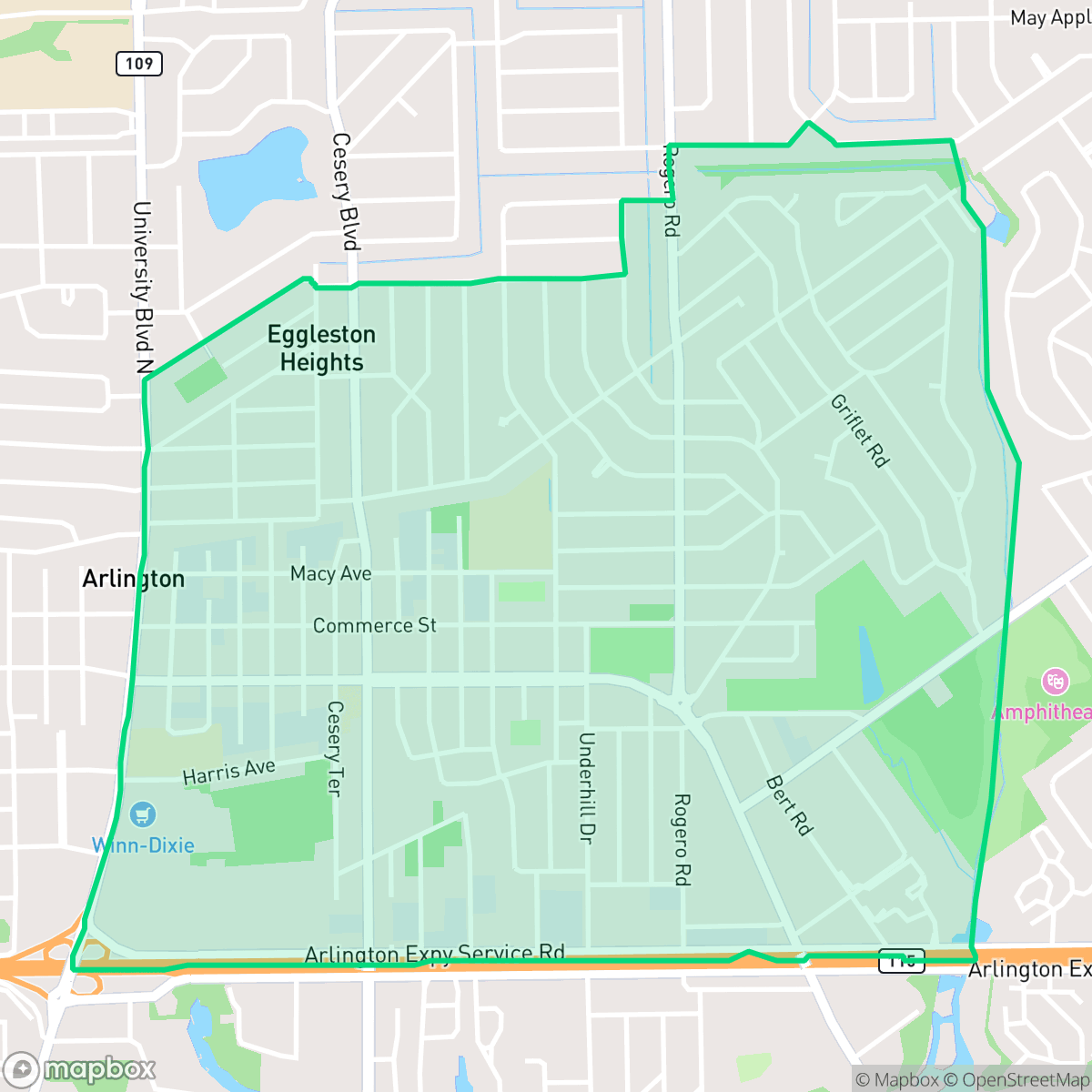
Arlington, located along the St. Johns River, features a rich history dating back to Native American settlements and the 1564 French establishment of Fort Caroline. By the 19th century, the area transitioned into a hub for plantations and steam-powered sawmills. Following the Civil War, it evolved into a winter resort destination for Northerners. A major turning point occurred in 1910 with the completion of Atlantic Boulevard, Florida's first modern improved highway. The neighborhood is culturally defined by its mid-century modern architecture, with significant homes designed by architects like Robert C. Broward and William Morgan, and the historic Norman Studios, a former silent film production site. Today, Arlington is home to Jacksonville University and protected natural spaces like the Timucuan Ecological and Historic Preserve, reflecting its blend of early colonial heritage and mid-20th-century suburban development.
The neighborhood functions as an active suburban hub with a mix of residential density and open, wooded spaces. It provides a semi-rural feel despite its proximity to the city center, characterized by tidy suburban lots and a lack of heavy industrial presence. Residents have access to a variety of local dining and civic institutions, contributing to a lively community atmosphere that remains distinct from the typical urban grid of Jacksonville. According to iHuus data, the area maintains a more balanced ideological landscape than the broader city average, fostering a diverse community feel.
While the neighborhood offers calm residential streets, the lack of continuous sidewalks along major thoroughfares can create challenges for pedestrians. The area maintains a moderate risk of flooding, and prospective residents should be aware of the proximity to a local EPA Superfund site. Education is managed by the Duval County School District, which provides access to specialized magnet programs alongside a complex landscape of school consolidations and budget-related shifts. It is well-suited for those seeking an established community that balances suburban convenience with access to nature.
Neighborhood Scores Across 15 Qualities
Residential density in Arlington provides more separation between neighbors than the Jacksonville average. According to iHuus data, the area features a mix of suburban lot sizes with moderate buffering between single-family homes and denser multi-family clusters.
Low-traffic residential streets provide a calm environment for walking, though the lack of continuous sidewalks on major roads can make crossing the neighborhood difficult. This area offers better pedestrian accessibility than the Jacksonville average, despite challenges posed by large arterial roads and heavy tree canopy.
Uniform tract housing and simple rooflines define the local landscape, providing a more visually structured environment than much of Jacksonville. According to iHuus data, the area features tidy but small yards alongside mid-range apartment complexes.
Residential blocks offer consistent green verges and access to local lakes or sports fields for exercise. According to iHuus data, these features provide more opportunities for pet owners than the city average.
Frequent open land and preserved woodlands provide a more open feel than the typical Jacksonville urban landscape. Residents will find a mix of single-family homes interspersed with large wooded wetlands and scattered fields.
Local activity levels are significantly higher than the Jacksonville average, offering a varied mix of dining, civic institutions, and community events. While some pockets remain quiet and residential, many areas function as active suburban hubs with accessible retail and nearby colleges.
Steady sounds from nearby busy streets characterize the area. According to iHuus data, acoustic comfort levels in Arlington are slightly below the Jacksonville average.
Air quality levels fluctuate between acceptable and unhealthy for sensitive groups, though conditions remain significantly better than the Jacksonville city average according to iHuus data.
Residential life dominates the area with significantly less industrial activity than most of Jacksonville. While light commercial uses like small warehouses and gas stations exist, there is no heavy industry nearby, though residents should note proximity to a nearby EPA Superfund site according to iHuus data.
Health insurance accessibility in Arlington is notably higher than the Jacksonville average. According to iHuus data, a significant portion of the local population maintains coverage.
Political views in this area are evenly divided between conservative and liberal leaning residents. This distribution represents a more balanced ideological landscape than the broader Jacksonville average, according to iHuus data.
Residents of all ages, ranging from young adults to seniors, are well represented in this area. According to iHuus data, the neighborhood features a more balanced age distribution than much of Jacksonville.
Residual flood risk exists within this area due to its location in a floodplain; however, safety levels remain significantly higher than the Jacksonville average according to iHuus data.
Address-Level Insights for Arlington


iHuus Neighborhood Intelligence Insights
Get address-level neighborhood insights for Arlington
- Street-level scores — see how individual blocks compare, not just neighborhood averages
- Micro-zone boundaries — identify quiet pockets, flood boundaries, and walkable clusters before you visit
- 15 dimensions in full — walkability, noise, air quality, school quality, insurance coverage, population age profile, urban/rural index, and more
- Boundary risk alerts — know if your address sits near a block boundary where scores drop, the kind of detail no listing will ever mention
- School insights — individual school ratings and insights, not just district-level data
- Compare before you commit — side-by-side data across neighborhoods, down to block precision
No credit card required
Compare with Any Neighborhood
| Dimension | Arlington | 29th and Chase |
|---|---|---|
| 🚶 Walkabilityavg 3.96 | ||
| 🔊 Acoustic Comfortavg 4.37 | ||
| 🤫 Privacy Indexavg 4.3 | ||
| 🎨 Visual Appealavg 4.24 | ||
| 🐕 Dog Friendlinessavg 4.28 | ||
| 🗺️ Urban-Rural Indexavg 5.22 | ||
| ✨ Neighborhood Vibeavg 1.5 | ||
| 🏥 Health Insurance Coverageavg 4.35 | ||
| 🌿 Air Qualityavg 3.84 | ||
| 🏭 Industrial Proximityavg 5.11 | ||
| 🌊 Flood Safetyavg 4.01 | ||
| 🗳️ Ideological Leanavg 2.75 | ||
| 👥 Population Age Profileavg 3.26 | ||
| 🔥 Fire Safety | ||
| 🏫 School Quality |
Arlington Rankings
School Districts Serving Arlington
School Insights for Arlington
Below average outcomes; significant attendance and academic challenges.
School Insights
See what's really behind every school rating near Arlington
- Individual school ratings — each school's own score with outcome context, not just a district average
- Enrollment & class size data — student-to-teacher ratio and how it compares to the state average
- Full demographics breakdown — ethnicity and gender composition for every school in the enrollment zone
- Every school in the district — all schools within the enrollment boundary ranked by rating, not just the closest one
- Grade levels & benchmarks — elementary through high school, with below/above state-average flags
No credit card required