Argyle Forest, Jacksonville
Updated · 5,529 residents
Argyle Forest is a semi-rural suburban enclave on Jacksonville's Westside known for its abundant tree canopy and quiet residential streets. While the area offers clean air and a visually appealing landscape with spacious lots, residents should be prepared for higher traffic noise from nearby major thoroughfares.
Key Highlights
About Argyle Forest
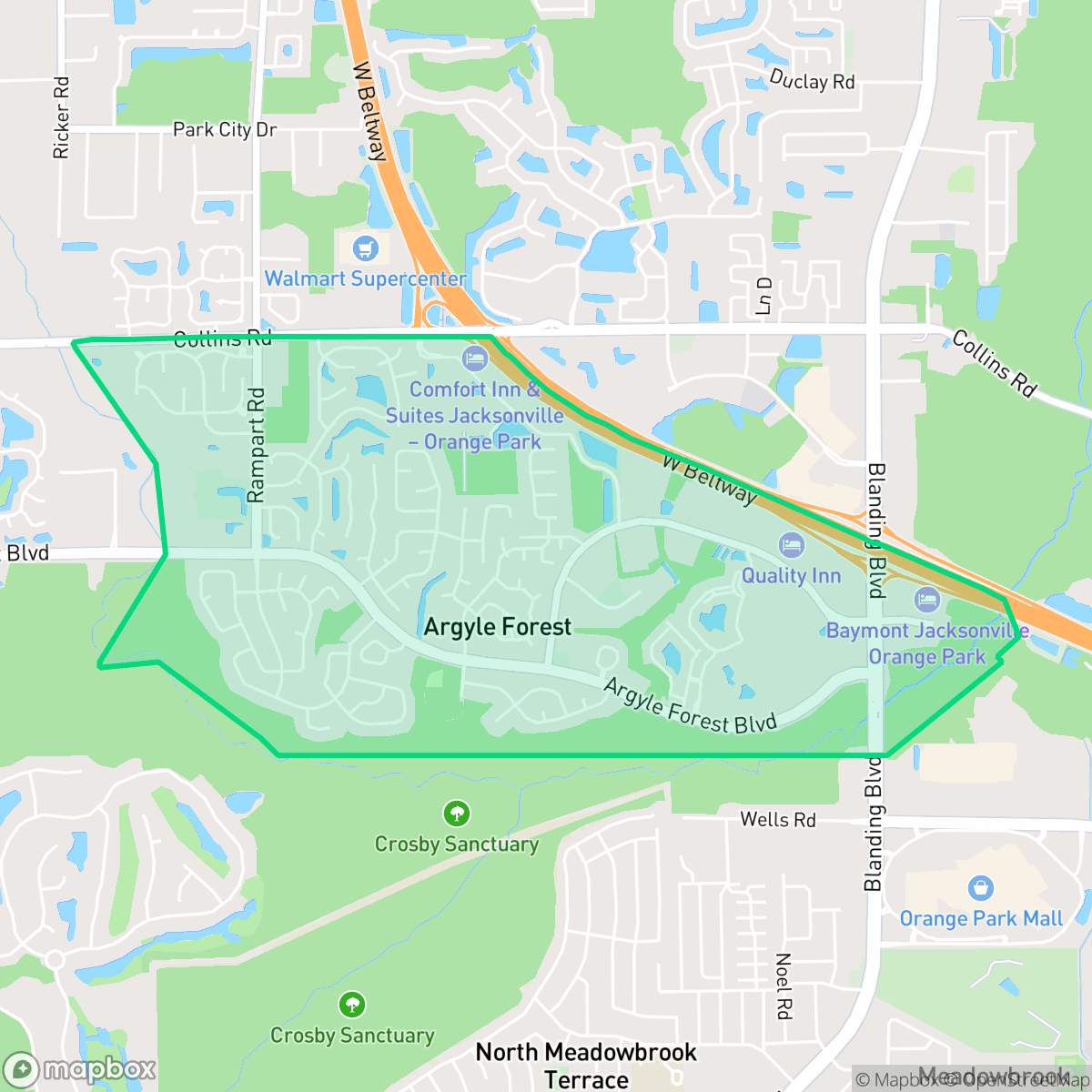
Argyle Forest, located on Jacksonville’s Westside, originated in 1975 as an ambitious master-planned project by Gulfstream Land Development, serving as one of Florida’s first designated 'Developments of Regional Impact.' The original vision for a unified community stalled due to the developer's financial difficulties, resulting in the property being subdivided among various owners. This fragmentation shaped the neighborhood's character, which evolved into a collection of diverse residential subdivisions rather than a single master-planned community. Significant growth occurred throughout the 1980s and 1990s, heavily influenced by the expansion of Argyle Forest Boulevard, which required extensive infrastructure agreements to overcome local building moratoriums. Today, the area is defined by its dense suburban landscape, proximity to Naval Air Station Jacksonville, and a housing stock predominantly built between the 1980s and early 1990s.
The area features a mix of single-family homes and multi-family clusters, benefiting from significant woodland buffers that provide a sense of separation between properties. The landscape is characterized by wide residential verges and a semi-rural atmosphere, making it a distinct departure from the density found in other parts of the city. According to iHuus data, the neighborhood provides a notably stable environment with high levels of health insurance coverage and very clean air quality.
While the neighborhood offers a peaceful environment for pet owners and families, the lack of sidewalks on major roads can present challenges for pedestrians. The area experiences elevated noise levels due to its proximity to transit corridors, and prospective residents should consider the ongoing educational landscape of the surrounding school districts. It is well-suited for those seeking a balance between suburban comfort and natural surroundings, provided they are comfortable navigating a car-dependent environment.
Neighborhood Scores Across 15 Qualities
Residential spacing provides more separation than the Jacksonville average, though density varies between multi-family clusters and single-family homes. Woodland buffers and larger setbacks for commercial structures offer notable buffers between neighbors according to iHuus data.
Low-traffic cul-de-sacs and residential streets provide safe walking conditions, though a lack of sidewalks on main roads can make navigating the area difficult. This level of walkability is higher than the Jacksonville average according to iHuus data.
Spacious driveways and private backyard pools contribute to a visual landscape that is notably more attractive than the Jacksonville average. According to iHuus data, the area features large homes and frequent upscale amenities compared to standard urban tracts.
Wide residential verges and abundant forest edges offer much more space for walking pets than the Jacksonville average. While dedicated dog parks are limited, the vast central greenery and connected paths provide a safe environment away from traffic.
Open land and woodland areas are frequently interspersed with residential zones, making this area notably more open than the Jacksonville average. According to iHuus data, the landscape features significant tree canopy and natural forest corridors alongside standard suburban layouts.
Activity levels are notably higher than the Jacksonville average, though much of the area remains a subdued residential landscape with sparse commercial activity. While some pockets function as lively local hubs for dining and wellness, many streets maintain a calm, semi-rural character.
Frequent noise from nearby major roadways and transit corridors impacts the area. According to iHuus data, acoustic levels in this neighborhood are notably higher than the Jacksonville average.
Air quality in this area remains consistently high with rare instances of elevated readings. According to iHuus data, these levels are significantly better than the Jacksonville city average.
Industrial activity is significantly lower than the Jacksonville average, as the area remains primarily residential with only occasional light commercial use. While most streets are quiet, some localized noise and traffic from storage facilities or transit hubs may be present near major intersections.
Health insurance accessibility in Argyle Forest is notably higher than the Jacksonville average, according to iHuus data. This indicates a more stable level of medical coverage among local residents compared to much of the city.
Political leanings in this area are split relatively evenly between conservative and liberal perspectives. This creates a more politically diverse environment than the city average, according to iHuus data.
Residents live alongside a varied demographic of young adults, families, and seniors. According to iHuus data, this neighborhood features a much more even distribution of age groups compared to the broader Jacksonville area.
Residual flood risks exist within this area due to its location in a 500-year floodplain. However, safety levels remain notably higher than the Jacksonville average according to iHuus data.
Address-Level Insights for Argyle Forest


iHuus Neighborhood Intelligence Insights
Get address-level neighborhood insights for Argyle Forest
- Street-level scores — see how individual blocks compare, not just neighborhood averages
- Micro-zone boundaries — identify quiet pockets, flood boundaries, and walkable clusters before you visit
- 15 dimensions in full — walkability, noise, air quality, school quality, insurance coverage, population age profile, urban/rural index, and more
- Boundary risk alerts — know if your address sits near a block boundary where scores drop, the kind of detail no listing will ever mention
- School insights — individual school ratings and insights, not just district-level data
- Compare before you commit — side-by-side data across neighborhoods, down to block precision
No credit card required
Compare with Any Neighborhood
| Dimension | Argyle Forest | 29th and Chase |
|---|---|---|
| 🚶 Walkabilityavg 3.96 | ||
| 🔊 Acoustic Comfortavg 4.37 | ||
| 🤫 Privacy Indexavg 4.3 | ||
| 🎨 Visual Appealavg 4.24 | ||
| 🐕 Dog Friendlinessavg 4.28 | ||
| 🗺️ Urban-Rural Indexavg 5.22 | ||
| ✨ Neighborhood Vibeavg 1.5 | ||
| 🏥 Health Insurance Coverageavg 4.35 | ||
| 🌿 Air Qualityavg 3.84 | ||
| 🏭 Industrial Proximityavg 5.11 | ||
| 🌊 Flood Safetyavg 4.01 | ||
| 🗳️ Ideological Leanavg 2.75 | ||
| 👥 Population Age Profileavg 3.26 | ||
| 🔥 Fire Safety | ||
| 🏫 School Quality |
Argyle Forest Rankings
School Districts Serving Argyle Forest
School Insights for Argyle Forest
Below average outcomes; significant attendance and academic challenges.
School Insights
See what's really behind every school rating near Argyle Forest
- Individual school ratings — each school's own score with outcome context, not just a district average
- Enrollment & class size data — student-to-teacher ratio and how it compares to the state average
- Full demographics breakdown — ethnicity and gender composition for every school in the enrollment zone
- Every school in the district — all schools within the enrollment boundary ranked by rating, not just the closest one
- Grade levels & benchmarks — elementary through high school, with below/above state-average flags
No credit card required