Downtown, Visalia
Updated · 1,989 residents
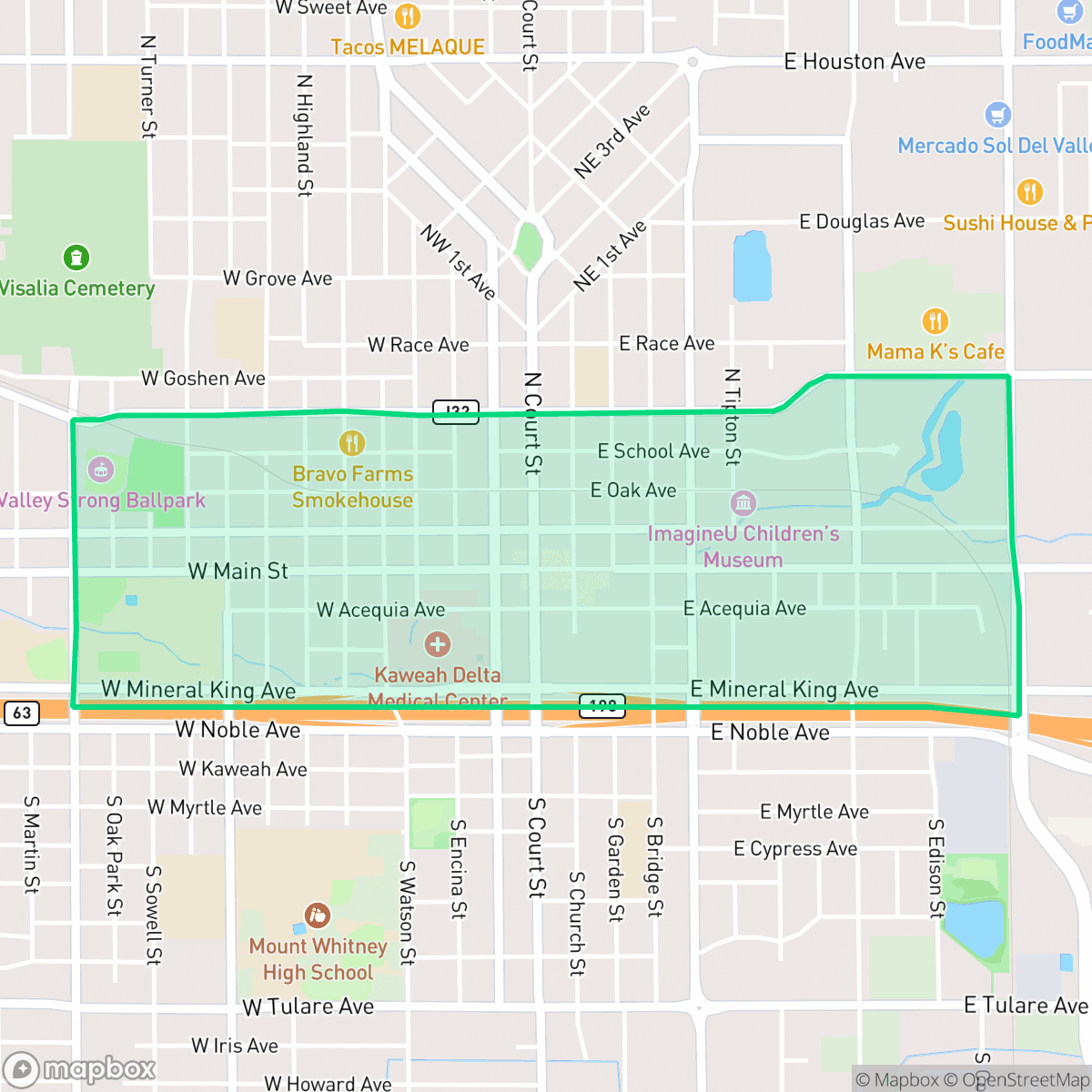
Downtown Visalia is a highly walkable urban hub defined by its active dining scene and historic street grid. Residents enjoy abundant green spaces for pets and a vibrant atmosphere, though the area faces challenges with traffic noise and flood vulnerability.
Key Highlights
About Downtown
Downtown Visalia, the historic core of the city, was established in 1852 near the site of the original Fort Visalia stockade at Oak and Bridge Streets. Serving as the Tulare County seat since 1853, the area evolved from a frontier settlement into a regional commercial hub, notably serving as a stop on the Butterfield Overland Stage route. The neighborhood is architecturally defined by significant landmarks such as the 1930 Fox Theatre, a prominent example of Spanish Colonial Revival design, and the 1933 U.S. Post Office, noted for its Art Deco style. Main Street remains the district's primary artery, where historic granite horse rings and early 20th-century brick buildings reflect its heritage. Following the rise of suburban malls in the 1960s, the downtown successfully transitioned from a traditional retail center into a vibrant district focused on dining, boutique commerce, and cultural preservation.
The neighborhood functions as a central hub for social activity, characterized by a high concentration of restaurants, coffee shops, and community spaces. The street layout supports easy pedestrian navigation, making it a convenient choice for those who prefer to walk to local destinations. While the architecture remains largely uniform in its residential sections, the overall atmosphere is bolstered by its status as an active community center. According to iHuus data, the area provides excellent amenities for pet owners due to its connected green spaces and accessible walking paths.
Prospective residents should consider specific trade-offs, including noticeable noise from nearby railroad tracks and heavy traffic. The area also requires awareness regarding higher flood risk and variable air quality. While the local school district offers strong vocational pathways, families should be prepared for inconsistent academic performance across the broader system. This neighborhood is well-suited for individuals who prioritize walkability and social engagement over absolute quiet or suburban privacy.
Neighborhood Scores Across 15 Qualities
Residential lots feature modest spacing between neighbors, providing a level of separation that is slightly lower than the Visalia average. According to iHuus data, houses are positioned in a standard grid with consistent buffers between structures.
Continuous sidewalks and clear pedestrian crossings across the dense street grid make navigating the area on foot easy. This level of accessibility is slightly above the Visalia average, though the nearby highway acts as a notable physical barrier to movement.
Standard tract housing with modest yards and uniform rooflines characterizes this area. According to iHuus data, the visual landscape is less varied than the city average.
Abundant parklands and wide, green sidewalk verges provide ample space for walking pets. According to iHuus data, these connected green spaces and safe paths offer significantly better amenities for dogs than the Visalia average.
Frequent open land and scattered homes provide a semi-rural feel that is slightly less dense than the Visalia average. According to iHuus data, the area features a transition between suburban residential blocks and more open, low-density zones.
Social activity is higher than the Visalia average, driven by a notable concentration of diverse dining, coffee shops, and community centers. While some areas near the railway and highway remain industrial, the presence of local landmarks creates a more vibrant atmosphere than most parts of the city.
Frequent noise from nearby railroad tracks and heavy vehicle traffic is common in this area. According to iHuus data, acoustic comfort levels are lower than the Visalia average.
Air quality in this area fluctuates between acceptable and unhealthy levels, sitting slightly below the Visalia city average. Sensitive groups may experience occasional concern on certain days, according to iHuus data.
Industrial activity is nearly non-existent in this area, offering a landscape dominated by residential and light commercial uses. While there is slightly more industrial proximity here than in the rest of Visalia, residents will find very few heavy warehouses or large-scale manufacturing hazards near their homes.
Access to health insurance among residents is lower than the average seen across Visalia. According to iHuus data, fewer people in this area possess health coverage compared to the rest of the city.
Political leanings in this area are diverse and lack a singular ideological dominance, representing a more even split between conservative and liberal views than is typically found across the rest of Visalia.
A balanced mix of young adults, families, and older residents characterizes this area. The age distribution is consistent with the broader Visalia city average.
Flood vulnerability in this area is significantly higher than the Visalia average. Residents should prepare for elevated insurance premiums and potential property impacts during extreme weather events.
Address-Level Insights for Downtown


iHuus Neighborhood Intelligence Insights
Get address-level neighborhood insights for Downtown
- Street-level scores — see how individual blocks compare, not just neighborhood averages
- Micro-zone boundaries — identify quiet pockets, flood boundaries, and walkable clusters before you visit
- 15 dimensions in full — walkability, noise, air quality, school quality, insurance coverage, population age profile, urban/rural index, and more
- Boundary risk alerts — know if your address sits near a block boundary where scores drop, the kind of detail no listing will ever mention
- School insights — individual school ratings and insights, not just district-level data
- Compare before you commit — side-by-side data across neighborhoods, down to block precision
No credit card required
Compare with Any Neighborhood
| Dimension | Downtown | Ashley Grove |
|---|---|---|
| 🚶 Walkabilityavg 8.53 | ||
| 🔊 Acoustic Comfortavg 4.25 | ||
| 🤫 Privacy Indexavg 5.99 | ||
| 🎨 Visual Appealavg 7.23 | ||
| 🐕 Dog Friendlinessavg 6.2 | ||
| 🗺️ Urban-Rural Indexavg 6.86 | ||
| ✨ Neighborhood Vibeavg 6.09 | ||
| 🏥 Health Insurance Coverageavg 7.63 | ||
| 🌿 Air Qualityavg 4.97 | ||
| 🏭 Industrial Proximityavg 9.16 | ||
| 🌊 Flood Safetyavg 1.99 | ||
| 🗳️ Ideological Leanavg 2.96 | ||
| 👥 Population Age Profileavg 4.63 | ||
| 🔥 Fire Safety | ||
| 🏫 School Quality |
Downtown Rankings
School Districts Serving Downtown
School Insights for Downtown
Below average outcomes; significant attendance and academic challenges.
School Insights
See what's really behind every school rating near Downtown
- Individual school ratings — each school's own score with outcome context, not just a district average
- Enrollment & class size data — student-to-teacher ratio and how it compares to the state average
- Full demographics breakdown — ethnicity and gender composition for every school in the enrollment zone
- Every school in the district — all schools within the enrollment boundary ranked by rating, not just the closest one
- Grade levels & benchmarks — elementary through high school, with below/above state-average flags
No credit card required