Saint Vincents Hill Historic District, Vallejo
Updated · 1,887 residents
Saint Vincents Hill is an exceptionally walkable neighborhood characterized by its dense, historic residential grid and proximity to the Vallejo waterfront. While residents enjoy easy access to local dining and cultural hubs, the area experiences significant noise from road traffic and limited privacy due to tightly packed housing.
Key Highlights
About Saint Vincents Hill Historic District
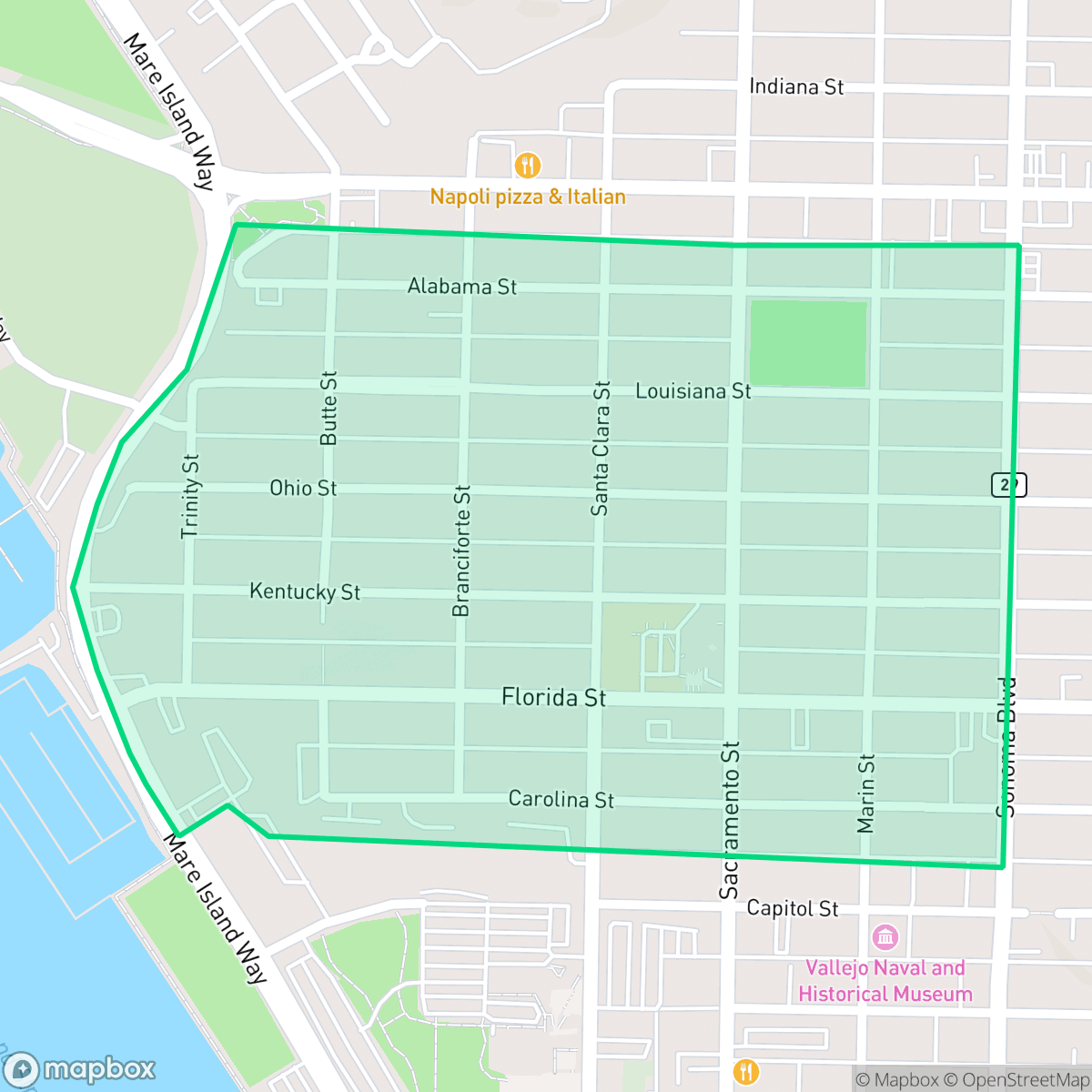
The Saint Vincent’s Hill Historic District in Vallejo, California, is a historic, working-class neighborhood closely tied to the nearby Mare Island Naval Shipyard. Bounded roughly by Mare Island Way and Sonoma Boulevard, the 33-block district developed primarily between 1870 and 1920, heavily influenced by Irish Catholic immigrant shipbuilders. It is named for the landmark Saint Vincent Ferrer Catholic Church, established on a prominent hill in 1868. Characterized by rolling topography reminiscent of San Francisco, the neighborhood features 542 contributing historic structures. Its diverse architectural stock ranges from 1850s Greek Revival cottages to Victorian-era Italianate, Queen Anne, and Craftsman homes built for local laborers. The district was formally listed on the National Register of Historic Places in 2003.
The neighborhood functions as a vibrant urban center where historic charm meets daily convenience. Residents benefit from a highly accessible street grid that connects them to local staples such as the Vallejo Naval Museum and a variety of neighborhood eateries. The presence of light industrial units and commercial blocks near the waterfront adds to the area's active energy, fostering a sense of community that is distinct from typical suburban developments.
Living here requires balancing the benefits of a central location with certain environmental and infrastructure trade-offs. The area faces notable noise levels from road traffic and has limited privacy due to narrow lot sizes and closely spaced homes. Prospective residents should also consider the broader challenges facing the local school district and the heightened risks associated with flood and fire safety in this part of the city. It is best suited for those who prioritize a walkable lifestyle and are comfortable with the realities of an older, dense urban environment.
Neighborhood Scores Across 15 Qualities
Residential structures are positioned with mixed spacing and some buffers between neighbors. This level of density is slightly higher than the Vallejo average, with certain areas featuring closely packed houses and narrow side yards.
Wide sidewalks and marked crosswalks make navigating the local grid easy for pedestrians. Residents benefit from consistent sidewalk availability on most streets and accessible waterfront paths, which is slightly above the Vallejo average according to iHuus data.
Standard tract housing and mid-sized commercial structures define the local landscape. According to iHuus data, the area lacks luxury estates or private pools and presents a more utilitarian visual character than the Vallejo average.
Sidewalk verges are narrow and public park access is limited, as most greenery is contained within private fenced backyards. According to iHuus data, this area offers fewer opportunities for off-leash activity than the Vallejo average.
Open land and scattered homes provide a more tranquil, semi-rural environment than the more densely developed areas found elsewhere in Vallejo. According to iHuus data, the district features a mix of woodland and fields that distinguishes it from the city's typical urban density.
Local dining and cultural attractions provide a higher level of activity than the typical Vallejo neighborhood. Residents can access various eateries and landmarks like the Vallejo Naval Museum within a mix of green spaces and suburban blocks.
Frequent noise from nearby railroad lines and heavy freeway traffic is a notable characteristic of this area. According to iHuus data, acoustic comfort in this district is significantly lower than the Vallejo average.
Air quality remains generally high with rare instances of elevated readings. However, air purity in this district is slightly lower than the Vallejo average according to iHuus data.
Primarily residential in character, this area features much less industrial activity than the Vallejo average. Residents can expect a landscape of historic homes with only occasional proximity to light commercial structures.
Health insurance enrollment in this area is lower than the Vallejo average. According to iHuus data, a minority of residents in this district maintain active health coverage.
Voting patterns and census indicators show a predominantly liberal community, which is slightly more pronounced than the average for Vallejo. According to iHuus data, this reflects a consistent ideological leaning within the district.
Residents live alongside a varied demographic of young adults, families, and seniors. This age distribution is largely comparable to the broader Vallejo area according to iHuus data.
Flood vulnerability in this area is significantly higher than the Vallejo average. According to iHuus data, the district's topography presents a greater risk of inundation during extreme weather events.
Address-Level Insights for Saint Vincents Hill Historic District


iHuus Neighborhood Intelligence Insights
Get address-level neighborhood insights for Saint Vincents Hill Historic District
- Street-level scores — see how individual blocks compare, not just neighborhood averages
- Micro-zone boundaries — identify quiet pockets, flood boundaries, and walkable clusters before you visit
- 15 dimensions in full — walkability, noise, air quality, school quality, insurance coverage, population age profile, urban/rural index, and more
- Boundary risk alerts — know if your address sits near a block boundary where scores drop, the kind of detail no listing will ever mention
- School insights — individual school ratings and insights, not just district-level data
- Compare before you commit — side-by-side data across neighborhoods, down to block precision
No credit card required
Compare with Any Neighborhood
| Dimension | Saint Vincents Hill Historic District | vallejo heights |
|---|---|---|
| 🚶 Walkabilityavg 8.69 | ||
| 🔊 Acoustic Comfortavg 3.43 | ||
| 🤫 Privacy Indexavg 5.46 | ||
| 🎨 Visual Appealavg 6.3 | ||
| 🐕 Dog Friendlinessavg 7.43 | ||
| 🗺️ Urban-Rural Indexavg 6.94 | ||
| ✨ Neighborhood Vibeavg 4.54 | ||
| 🏥 Health Insurance Coverageavg 7.27 | ||
| 🌿 Air Qualityavg 9.21 | ||
| 🏭 Industrial Proximityavg 8.67 | ||
| 🌊 Flood Safetyavg 2 | ||
| 🗳️ Ideological Leanavg 9.71 | ||
| 👥 Population Age Profileavg 5 | ||
| 🔥 Fire Safety | ||
| 🏫 School Quality |
Saint Vincents Hill Historic District Rankings
School Districts Serving Saint Vincents Hill Historic District
School Insights for Saint Vincents Hill Historic District
Below average outcomes; significant attendance and academic challenges.
School Insights
See what's really behind every school rating near Saint Vincents Hill Historic District
- Individual school ratings — each school's own score with outcome context, not just a district average
- Enrollment & class size data — student-to-teacher ratio and how it compares to the state average
- Full demographics breakdown — ethnicity and gender composition for every school in the enrollment zone
- Every school in the district — all schools within the enrollment boundary ranked by rating, not just the closest one
- Grade levels & benchmarks — elementary through high school, with below/above state-average flags
No credit card required