Olde Torrance, Torrance
Updated · 13,663 residents
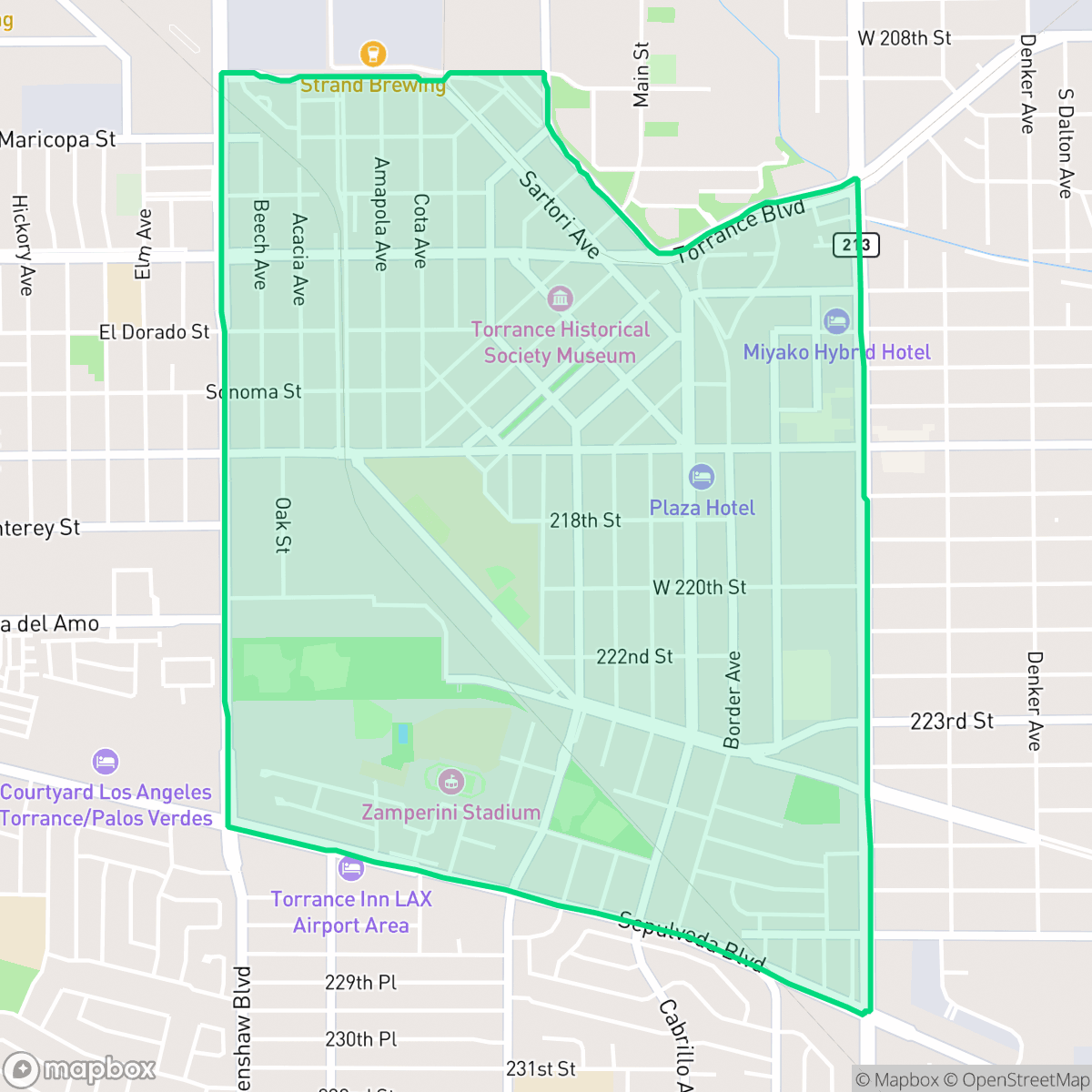
Olde Torrance is a highly walkable neighborhood defined by its historic charm and dense residential layout. Residents benefit from excellent air quality and proximity to top-tier schools, though the area experiences notable road noise and limited private yard space.
Key Highlights
About Olde Torrance
Founded in 1912, Olde Torrance serves as the historic heart of the city, originally planned by renowned landscape architect Frederick Law Olmsted Jr. using "Garden City" design principles. The neighborhood features a rich collection of early-20th-century architecture, including civic and transit structures designed by celebrated architect Irving Gill, such as the 1913 El Prado Bridge and the 1912 Pacific Electric Railway Depot. At the neighborhood's center lies El Prado Park, a grassy greenbelt anchoring the pedestrian-friendly commercial district. Notable local landmarks include the 1936 Art Deco former library—now home to the Torrance Historical Society & Museum on Post Avenue—and the 1928 Pacific Telephone and Telegraph building, which currently houses the Red Car Brewery on Sartori Avenue. Today, the area preserves its nostalgic character with historic brick buildings, antique shops, and local eateries.
Olde Torrance functions as a dense, transit-oriented suburban environment that prioritizes pedestrian access. While the neighborhood maintains a calm atmosphere, it features a diverse culinary scene and active commercial pockets that provide residents with convenient daily amenities. The local school system remains a significant draw, as the district is recognized for academic excellence and high graduation rates, making it an attractive option for families seeking stable educational opportunities. The area is characterized by high-density housing with minimal separation between structures, which impacts overall privacy. The environment is notably loud due to consistent road traffic, and the proximity to commercial zones means that some industrial-style warehouses are present in the southern sections. This location is best suited for those who prioritize walkability and access to high-quality public education over quiet, secluded living.
Neighborhood Scores Across 15 Qualities
Structures in this area are situated with moderate separation, though some clusters feature closely packed homes and shared walls. This level of density is slightly higher than the average seen across Torrance.
Comprehensive sidewalk networks and clearly marked pedestrian crossings exist on both sides of most residential and commercial streets. This level of connectivity is even more robust than the average for Torrance, according to iHuus data.
Standard tract housing and apartment complexes define the landscape, featuring uniform rooflines and small yards. According to iHuus data, the visual variety is slightly lower than the Torrance average.
Access to large athletic fields and green corridors provides good walking opportunities, though the availability of off-leash space is slightly below the Torrance average. Residents can utilize several nearby community parks, but some residential sectors feature narrower sidewalks and less public greenery.
A blend of residential blocks and commercial corridors defines this area, matching the typical urban-rural balance found across Torrance. According to iHuus data, the landscape features a mix of single-family homes, apartment complexes, and industrial warehouse zones.
Suburban streets and light industrial zones create a calm atmosphere that is slightly less active than the Torrance average. While diverse dining options are present near the railway, most essential services require a short drive as few businesses are within easy walking distance.
Frequent noise from nearby railroads and heavy freeway traffic characterizes the area. According to iHuus data, acoustic comfort is notably lower than the Torrance city average.
Air quality remains consistently clean with rare instances of elevated readings. According to iHuus data, the air quality in this area is slightly better than the Torrance average.
Light industrial warehouses and commercial loading docks are interspersed with residential pockets. This-use environment contains more industrial activity than the Torrance average, including some proximity to a nearby Superfund site.
Health insurance enrollment among residents is relatively high, though it sits slightly below the Torrance city average according to iHuus data.
Political leanings in this area lean towards the liberal side, slightly more so than the average found throughout Torrance.
Residents live alongside a diverse mix of young adults, families, and seniors. This age distribution is consistent with the broader Torrance area.
Flood risk levels in Olde Torrance are higher than the Torrance average, though specific risk details remain undetermined because FEMA has not yet completed a detailed study for this area.
Address-Level Insights for Olde Torrance


iHuus Neighborhood Intelligence Insights
Get address-level neighborhood insights for Olde Torrance
- Street-level scores — see how individual blocks compare, not just neighborhood averages
- Micro-zone boundaries — identify quiet pockets, flood boundaries, and walkable clusters before you visit
- 15 dimensions in full — walkability, noise, air quality, school quality, insurance coverage, population age profile, urban/rural index, and more
- Boundary risk alerts — know if your address sits near a block boundary where scores drop, the kind of detail no listing will ever mention
- School insights — individual school ratings and insights, not just district-level data
- Compare before you commit — side-by-side data across neighborhoods, down to block precision
No credit card required
Compare with Any Neighborhood
| Dimension | Olde Torrance | Chatelaine |
|---|---|---|
| 🚶 Walkabilityavg 9.22 | ||
| 🔊 Acoustic Comfortavg 2.86 | ||
| 🤫 Privacy Indexavg 4.5 | ||
| 🎨 Visual Appealavg 6.49 | ||
| 🐕 Dog Friendlinessavg 5.97 | ||
| 🗺️ Urban-Rural Indexavg 6.5 | ||
| ✨ Neighborhood Vibeavg 4.9 | ||
| 🏥 Health Insurance Coverageavg 8.4 | ||
| 🌿 Air Qualityavg 7.82 | ||
| 🏭 Industrial Proximityavg 7.83 | ||
| 🌊 Flood Safetyavg 3.32 | ||
| 🗳️ Ideological Leanavg 7.66 | ||
| 👥 Population Age Profileavg 5.25 | ||
| 🔥 Fire Safetyavg 0.06 | ||
| 🏫 School Quality |
Olde Torrance Rankings
School Districts Serving Olde Torrance
School Insights for Olde Torrance
Below average outcomes; significant attendance and academic challenges.
School Insights
See what's really behind every school rating near Olde Torrance
- Individual school ratings — each school's own score with outcome context, not just a district average
- Enrollment & class size data — student-to-teacher ratio and how it compares to the state average
- Full demographics breakdown — ethnicity and gender composition for every school in the enrollment zone
- Every school in the district — all schools within the enrollment boundary ranked by rating, not just the closest one
- Grade levels & benchmarks — elementary through high school, with below/above state-average flags
No credit card required