West Downtown, Santa Barbara
Updated · 3,215 residents
West Downtown is a dense, highly walkable urban neighborhood defined by its collection of historic Victorian and Craftsman residences. Residents benefit from immediate access to local culinary landmarks like the Santa Barbara Public Market, though the area is characterized by tightly packed housing and elevated noise levels from road traffic.
Key Highlights
About West Downtown
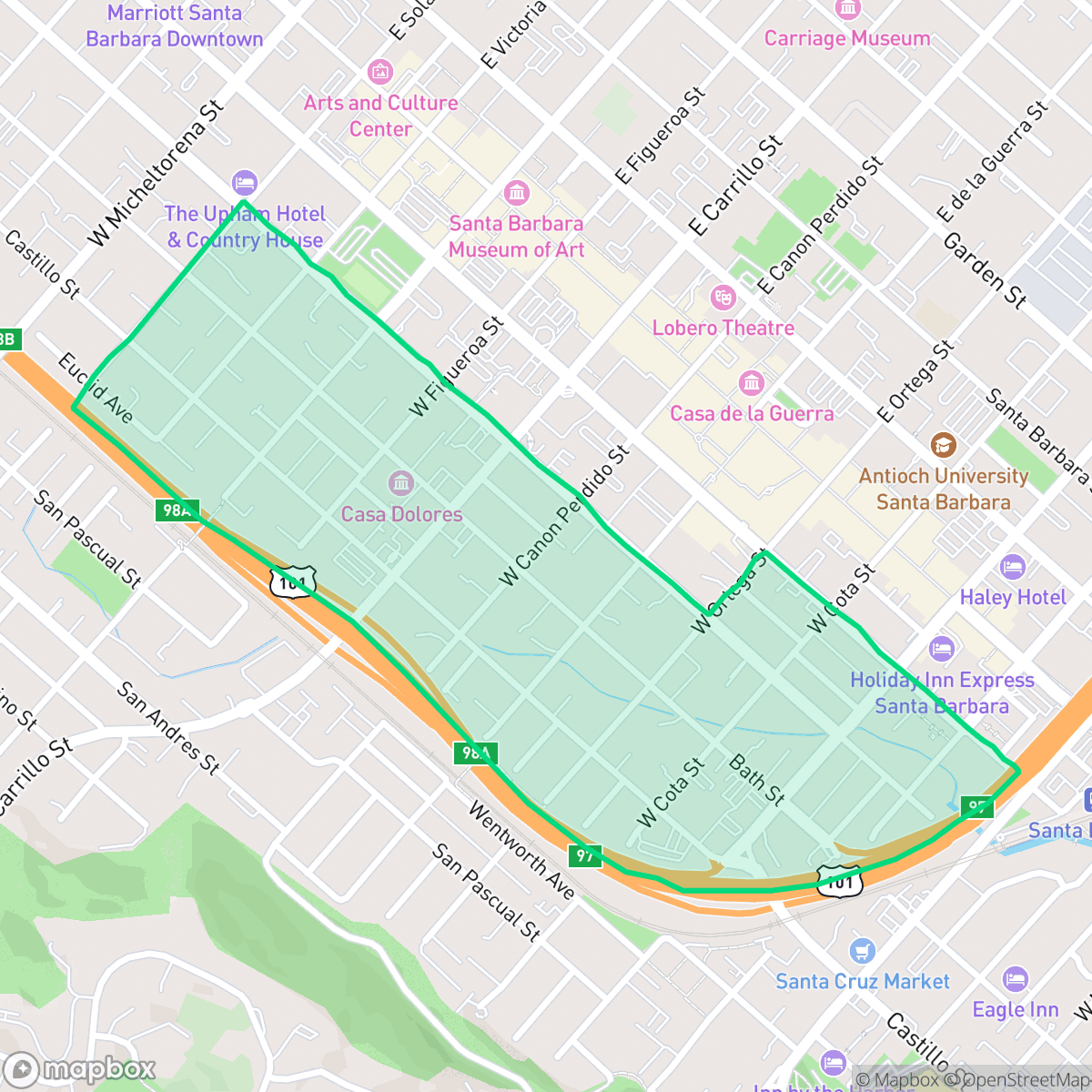
West Downtown Santa Barbara, bounded by West De la Guerra, Chapala, and West Haley streets and Highway 101, developed during the city's American period following California's statehood. The neighborhood serves as a complete catalog of early local residential architecture, showcasing the transition from Victorian to Arts and Crafts designs. It features two key historic areas: the Lower De la Vina Historic District (circa 1870–1910), known for its Victorian and early Craftsman bungalows, and the Castillo Street Historic District (1890–1925), which highlights the shift to Arts and Crafts bungalows. Additionally, the neighborhood is home to historic Spanish Colonial Revival and Craftsman bungalow courts, as well as the Santa Barbara Public Market, a modern culinary hub that defines its contemporary character.
The neighborhood functions as a central, high-density residential and commercial hub within Santa Barbara. Its grid layout promotes exceptional pedestrian access to daily amenities, including diverse dining options and local coffee roasters. The area maintains a vibrant, active atmosphere that reflects its proximity to the city core, offering a lifestyle centered on convenience and architectural heritage. Prospective residents should consider the trade-offs inherent in this dense urban environment. According to iHuus data, the area experiences higher noise levels from road traffic and limited private outdoor space, which may be less ideal for pet owners seeking expansive public green areas. It is best suited for individuals who prioritize walkability and proximity to city services over suburban seclusion or acoustic privacy.
Neighborhood Scores Across 15 Qualities
Residential spacing varies between tightly packed apartments and detached houses with small yards. According to iHuus data, the density of buildings and shared property lines in this area is higher than the Santa Barbara average.
Pedestrian connectivity is exceptional due to a dense street grid, wide sidewalks, and pedestrian bridges that navigate the highway divide. Most daily errands can be completed on foot, as the area offers much greater walkability than the typical Santa Barbara neighborhood.
Large, well-maintained homes and manicured landscaping define the area. According to iHuus data, the visual quality of the neighborhood sits slightly above the Santa Barbara average.
Public parks and wooded trails offer ample space for walking dogs, though access to large, open green verges is somewhat more limited than in other parts of the city. Most greenery in this area is situated within private lots or steep hillsides.
Frequent open land and scattered greenery provide a more open feel than the more urbanized city average. This landscape features a blend of low-density residential areas and pockets of woodland according to iHuus data.
Diverse dining, coffee shops, and cultural landmarks provide a level of activity that is notably higher than the Santa Barbara average. According to iHuus data, the area offers a rich variety of local destinations ranging from specialty roasters to established eateries.
Frequent noise from nearby railroad tracks and freeway traffic makes this area louder than the Santa Barbara average. Residents may experience consistent auditory disturbances from passing trains and heavy vehicle transit.
Air quality remains consistently excellent with very low levels of pollutants. According to iHuus data, these conditions are on par with the rest of Santa Barbara.
The area is composed entirely of residential and light commercial structures with no detected warehouses or heavy industrial hazards. This lack of industrial activity is even more pronounced here than in the broader Santa Barbara area, according to iHuus data.
Health insurance coverage among residents is notably lower than the Santa Barbara average, according to iHuus data. This indicates a higher proportion of uninsured individuals living in the area.
Voting patterns and census indicators reflect a deeply liberal political leaning that is even more pronounced than the Santa Barbara city average.
Residents live alongside a balanced variety of young adults, families, and seniors. This demographic spread is slightly lower than the Santa Barbara average, according to iHuus data.
Flood risk levels in this area remain undetermined because official federal studies are currently incomplete. According to iHuus data, the risk profile is roughly comparable to the rest of Santa Barbara.
Address-Level Insights for West Downtown


iHuus Neighborhood Intelligence Insights
Get address-level neighborhood insights for West Downtown
- Street-level scores — see how individual blocks compare, not just neighborhood averages
- Micro-zone boundaries — identify quiet pockets, flood boundaries, and walkable clusters before you visit
- 15 dimensions in full — walkability, noise, air quality, school quality, insurance coverage, population age profile, urban/rural index, and more
- Boundary risk alerts — know if your address sits near a block boundary where scores drop, the kind of detail no listing will ever mention
- School insights — individual school ratings and insights, not just district-level data
- Compare before you commit — side-by-side data across neighborhoods, down to block precision
No credit card required
Compare with Any Neighborhood
| Dimension | West Downtown | Alta Mesa |
|---|---|---|
| 🚶 Walkabilityavg 8.12 | ||
| 🔊 Acoustic Comfortavg 3.7 | ||
| 🤫 Privacy Indexavg 5.66 | ||
| 🎨 Visual Appealavg 7.77 | ||
| 🐕 Dog Friendlinessavg 7.45 | ||
| 🗺️ Urban-Rural Indexavg 7.13 | ||
| ✨ Neighborhood Vibeavg 5.46 | ||
| 🏥 Health Insurance Coverageavg 6.92 | ||
| 🌿 Air Qualityavg 10 | ||
| 🏭 Industrial Proximityavg 9.73 | ||
| 🌊 Flood Safetyavg 3.72 | ||
| 🗳️ Ideological Leanavg 9.64 | ||
| 👥 Population Age Profileavg 5.23 | ||
| 🔥 Fire Safetyavg 0.32 | ||
| 🏫 School Quality |
West Downtown Rankings
School Districts Serving West Downtown
School Insights for West Downtown
Below average outcomes; significant attendance and academic challenges.
School Insights
See what's really behind every school rating near West Downtown
- Individual school ratings — each school's own score with outcome context, not just a district average
- Enrollment & class size data — student-to-teacher ratio and how it compares to the state average
- Full demographics breakdown — ethnicity and gender composition for every school in the enrollment zone
- Every school in the district — all schools within the enrollment boundary ranked by rating, not just the closest one
- Grade levels & benchmarks — elementary through high school, with below/above state-average flags
No credit card required