West Beach, Santa Barbara
Updated · 1,458 residents
West Beach is a highly walkable coastal enclave defined by its immediate proximity to the ocean and a vibrant mix of recreational amenities. While the area offers exceptional access to local landmarks and pet-friendly spaces, residents should anticipate frequent road noise and limited residential privacy.
Key Highlights
About West Beach
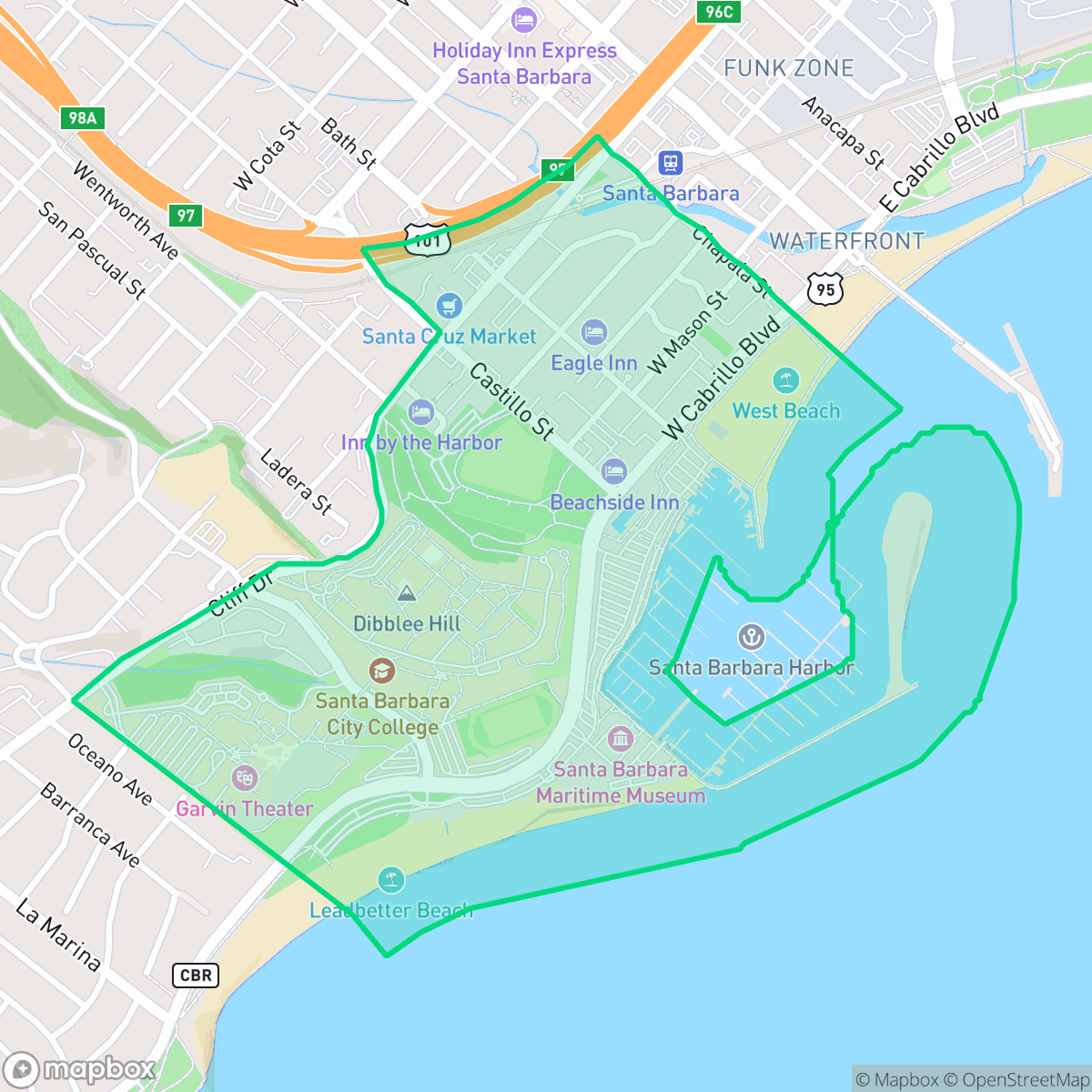
Bounded by West Cabrillo Boulevard and Bath Street, Santa Barbara’s West Beach neighborhood holds layers of indigenous, resort, and architectural history. It encompasses Burton Mound, the former site of a major Chumash village and later the location of the grand Potter Hotel, built in 1902 to accommodate wealthy travelers arriving via the new railroad. After a devastating 1921 fire destroyed the luxury resort, the land was subdivided into the Ambassador Tract. During the 1920s and 1930s, West Beach transformed into a bustling tourist and residential hub characterized by Spanish Colonial Revival multi-family courtyard apartments, cottages, and motels. Today, this proposed historic district retains its classic coastal charm, anchored by local landmarks like Ambassador Park, Pershing Park, Stearns Wharf, and the historic Los Baños del Mar Pool.
The neighborhood serves as a primary gateway to the Santa Barbara waterfront, offering residents immediate access to iconic sites like Stearns Wharf and the Pacific Ocean. The streetscape is defined by a blend of classic architecture and modern amenities, creating a lively environment that supports a high degree of daily pedestrian activity. With an excellent air quality rating and a perfect walkability score, the area is well-suited for those who prioritize an active, outdoor-oriented lifestyle near the city's most popular coastal attractions.
Living in this area involves specific trade-offs, particularly regarding acoustic comfort and safety. The neighborhood experiences significant ambient sound from road traffic, which is a notable factor for those seeking quiet living. Additionally, the area faces elevated risks regarding flood and fire safety, and residential privacy is relatively low due to the density of the housing stock. While the local school district provides access to specialized academic programs, it is currently navigating a period of demographic and fiscal transition. This area is best suited for individuals or small households who value convenience and coastal proximity over absolute solitude.
Neighborhood Scores Across 15 Qualities
Residential spacing varies between dense apartment clusters and detached homes with small yards and mature trees. This level of privacy is consistent with the average density found across Santa Barbara.
Pedestrian access is easy due to continuous sidewalks and low-traffic street grids. This level of walkability is slightly above the Santa Barbara average, making it convenient for navigating the mix of residential and commercial zones.
Large coastal properties and well-manicured landscaping contribute to a high level of visual interest. According to iHuus data, the area features more private pools and spacious hillside estates than the typical Santa Barbara neighborhood.
Extensive access to Shoreline Park, wooded trails, and large athletic fields provides ample space for pets. According to iHuus data, the availability of connected green spaces and wide paths makes this area more dog friendly than the Santa Barbara average.
Residential areas feature a mix of single-family homes and multi-unit complexes, presenting a slightly less developed feel than the Santa Barbara average. This layout provides a blend of classic suburban density and accessible commercial hubs according to iHuus data.
Coastal streets and green spaces host a noticeable concentration of social hubs and dining, making the area more active than the Santa Barbara average. While some blocks remain calm and suburban, others feature a diverse landscape of local eateries and lifestyle businesses according to iHuus data.
Frequent noise from nearby railroad tracks and major roadways characterizes this area. According to iHuus data, acoustic comfort in West Beach is lower than the Santa Barbara average.
Air quality remains consistently high with minimal health concerns for residents. This level of air purity is on par with the rest of Santa Barbara.
Industrial activity, warehouses, and heavy manufacturing are entirely absent from this area. According to iHuus data, West Beach remains exclusively residential and recreational, maintaining a cleaner profile than the broader Santa Barbara area.
Health insurance access is notably lower in West Beach than the Santa Barbara city average, according to iHuus data.
Voting patterns and census indicators show a predominantly liberal community that is slightly more progressive than the Santa Barbara city average.
A varied demographic of young adults, families, and seniors resides here, presenting a slightly less concentrated age profile than the Santa Barbara average according to iHuus data.
Located within a coastal high-hazard zone, this area faces significant vulnerability to wave action and flooding. According to iHuus data, the risk level is substantially higher than the Santa Barbara average, which may result in elevated or prohibitive insurance costs for residents.
Address-Level Insights for West Beach


iHuus Neighborhood Intelligence Insights
Get address-level neighborhood insights for West Beach
- Street-level scores — see how individual blocks compare, not just neighborhood averages
- Micro-zone boundaries — identify quiet pockets, flood boundaries, and walkable clusters before you visit
- 15 dimensions in full — walkability, noise, air quality, school quality, insurance coverage, population age profile, urban/rural index, and more
- Boundary risk alerts — know if your address sits near a block boundary where scores drop, the kind of detail no listing will ever mention
- School insights — individual school ratings and insights, not just district-level data
- Compare before you commit — side-by-side data across neighborhoods, down to block precision
No credit card required
Compare with Any Neighborhood
| Dimension | West Beach | Alta Mesa |
|---|---|---|
| 🚶 Walkabilityavg 8.12 | ||
| 🔊 Acoustic Comfortavg 3.7 | ||
| 🤫 Privacy Indexavg 5.66 | ||
| 🎨 Visual Appealavg 7.77 | ||
| 🐕 Dog Friendlinessavg 7.45 | ||
| 🗺️ Urban-Rural Indexavg 7.13 | ||
| ✨ Neighborhood Vibeavg 5.46 | ||
| 🏥 Health Insurance Coverageavg 6.92 | ||
| 🌿 Air Qualityavg 10 | ||
| 🏭 Industrial Proximityavg 9.73 | ||
| 🌊 Flood Safetyavg 3.72 | ||
| 🗳️ Ideological Leanavg 9.64 | ||
| 👥 Population Age Profileavg 5.23 | ||
| 🔥 Fire Safetyavg 0.32 | ||
| 🏫 School Quality |
West Beach Rankings
School Districts Serving West Beach
School Insights for West Beach
Below average outcomes; significant attendance and academic challenges.
School Insights
See what's really behind every school rating near West Beach
- Individual school ratings — each school's own score with outcome context, not just a district average
- Enrollment & class size data — student-to-teacher ratio and how it compares to the state average
- Full demographics breakdown — ethnicity and gender composition for every school in the enrollment zone
- Every school in the district — all schools within the enrollment boundary ranked by rating, not just the closest one
- Grade levels & benchmarks — elementary through high school, with below/above state-average flags
No credit card required