Upper East, Santa Barbara
Updated · 4,357 residents
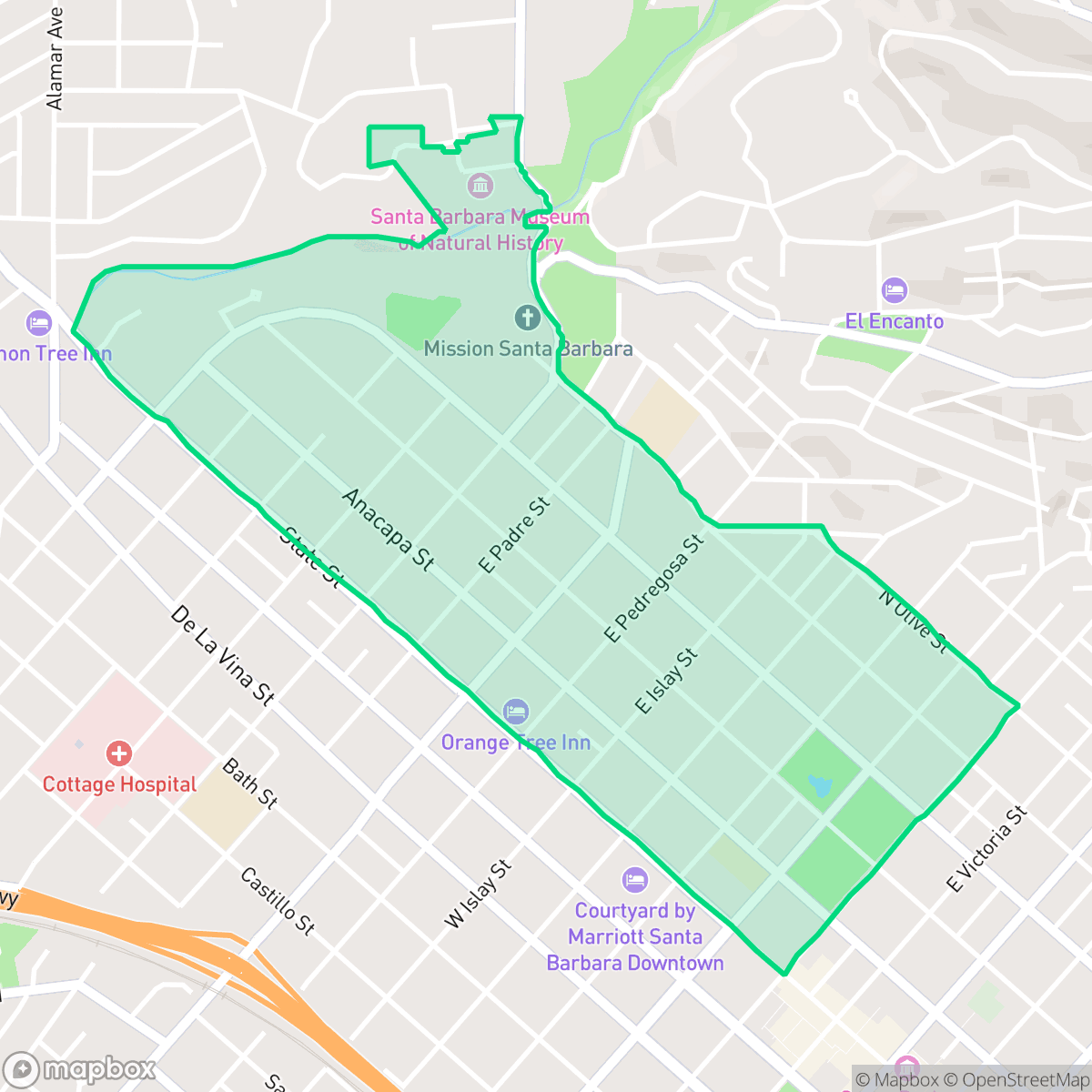
The Upper East is a highly walkable neighborhood defined by its rich architectural heritage and proximity to iconic landmarks like Old Mission Santa Barbara. Residents benefit from exceptional air quality and a peaceful, residential atmosphere that balances historic charm with modern accessibility.
Key Highlights
About Upper East
Developed in the late 19th and early 20th centuries, Santa Barbara’s Upper East neighborhood is a prestigious, walkable residential enclave lying within the city's historic street grid. Significant portions of the neighborhood are protected within the El Pueblo Viejo Historical Landmark District. It is renowned for its diverse architectural heritage, showcasing stately Spanish Colonial Revival homes influenced by the post-1925 earthquake reconstruction, alongside Craftsman bungalows, Victorian estates, and Italianate villas. The Upper East is anchored by iconic civic and cultural landmarks, most notably the historic Old Mission Santa Barbara (the “Queen of the Missions”) and its adjacent A.C. Postel Memorial Rose Garden. Other central neighborhood fixtures include the lush Alice Keck Park Memorial Garden, Alameda Park, and St. Anthony’s Seminary, reflecting the area's rich cultural and architectural legacy.
The area functions as a quiet, pedestrian-friendly enclave where a dense grid of sidewalks connects residents to local cafes and green spaces. According to iHuus data, the neighborhood maintains a strong sense of community through its accessible parks and diverse dining options, which provide a lively contrast to the calm residential streets. The lack of industrial activity ensures a clean environment, while the consistent tree canopy and well-maintained verges enhance the aesthetic appeal of the local streetscape.
Prospective residents should consider that the neighborhood faces specific environmental challenges, including elevated fire risk and moderate flood vulnerability. While the Santa Barbara Unified School District offers access to specialized programs at the high school level, families should be aware of the district's ongoing efforts to address achievement gaps and enrollment shifts. Acoustic comfort is moderate, with road traffic serving as the primary noise source, though the area remains a highly desirable location for those seeking a blend of historic character and urban convenience.
Neighborhood Scores Across 15 Qualities
Residential spacing is consistent with the city average, featuring a mix of single-family homes with clear setbacks and some multi-family units with shared walls. According to iHuus data, most properties maintain modest buffers between neighbors.
Continuous sidewalk networks and low-traffic residential grids provide a pedestrian-friendly environment that is more walkable than the Santa Barbara average. Most residential blocks feature well-defined crossings and structured pathways for easy navigation on foot.
Lush landscaping, private pools, and large homes with complex rooflines create a highly polished aesthetic that is slightly above the Santa Barbara average. According to iHuus data, the presence of well-maintained estates and premium amenities defines the area's visual character.
Abundant street trees and proximity to large public parks and sports fields provide ample green access. This area offers more connected green spaces and wider, safer paths than the Santa Barbara average.
Residential pockets offer a mix of single-family homes and multi-story buildings set within a significant green canopy. This landscape is largely comparable to the broader Santa Barbara area in terms of its balance between developed spaces and open land.
Local dining and coffee shops provide a steady social rhythm that is more active than the typical Santa Barbara neighborhood. While many blocks remain calm and residential, there is a noticeable concentration of walkable social hubs and green spaces near landmarks like Alice Keck Park.
A steady hum from local traffic is present due to proximity to a busy street. According to iHuus data, acoustic conditions here are notably quieter than the average for Santa Barbara.
Air quality remains consistently high with minimal health concerns. According to iHuus data, these levels are on par with the rest of Santa Barbara.
Residential and light commercial zoning ensures an absence of warehouses or industrial hazards. This area is even more free of industrial structures than the Santa Barbara average, according to iHuus data.
Health insurance accessibility is exceptionally high among residents, significantly surpassing the Santa Barbara city average according to iHuus data.
Voting patterns and census indicators reflect a predominantly liberal political landscape, which is slightly more pronounced here than in the rest of Santa Barbara.
Residents will find a balanced demographic spread of young adults, families, and seniors. According to iHuus data, this age diversity is slightly higher than the Santa Barbara city average.
Flood risk levels in this area are higher than the Santa Barbara average. According to iHuus data, the precise level of risk remains undetermined as a detailed study has not yet been completed for this specific location.
High fire hazard levels persist throughout this area, which is consistent with the broader Santa Barbara average. According to iHuus data, residents should prepare for extreme fire safety risks and implement maximum protection measures.
Address-Level Insights for Upper East


iHuus Neighborhood Intelligence Insights
Get address-level neighborhood insights for Upper East
- Street-level scores — see how individual blocks compare, not just neighborhood averages
- Micro-zone boundaries — identify quiet pockets, flood boundaries, and walkable clusters before you visit
- 15 dimensions in full — walkability, noise, air quality, school quality, insurance coverage, population age profile, urban/rural index, and more
- Boundary risk alerts — know if your address sits near a block boundary where scores drop, the kind of detail no listing will ever mention
- School insights — individual school ratings and insights, not just district-level data
- Compare before you commit — side-by-side data across neighborhoods, down to block precision
No credit card required
Compare with Any Neighborhood
| Dimension | Upper East | Alta Mesa |
|---|---|---|
| 🚶 Walkabilityavg 8.12 | ||
| 🔊 Acoustic Comfortavg 3.7 | ||
| 🤫 Privacy Indexavg 5.66 | ||
| 🎨 Visual Appealavg 7.77 | ||
| 🐕 Dog Friendlinessavg 7.45 | ||
| 🗺️ Urban-Rural Indexavg 7.13 | ||
| ✨ Neighborhood Vibeavg 5.46 | ||
| 🏥 Health Insurance Coverageavg 6.92 | ||
| 🌿 Air Qualityavg 10 | ||
| 🏭 Industrial Proximityavg 9.73 | ||
| 🌊 Flood Safetyavg 3.72 | ||
| 🗳️ Ideological Leanavg 9.64 | ||
| 👥 Population Age Profileavg 5.23 | ||
| 🔥 Fire Safetyavg 0.32 | ||
| 🏫 School Quality |
Upper East Rankings
School Districts Serving Upper East
School Insights for Upper East
Below average outcomes; significant attendance and academic challenges.
School Insights
See what's really behind every school rating near Upper East
- Individual school ratings — each school's own score with outcome context, not just a district average
- Enrollment & class size data — student-to-teacher ratio and how it compares to the state average
- Full demographics breakdown — ethnicity and gender composition for every school in the enrollment zone
- Every school in the district — all schools within the enrollment boundary ranked by rating, not just the closest one
- Grade levels & benchmarks — elementary through high school, with below/above state-average flags
No credit card required