Samarkand, Santa Barbara
Updated · 1,639 residents
Samarkand is a highly walkable and dog-friendly neighborhood known for its vibrant atmosphere and proximity to green spaces like Mackenzie Park. While it offers a distinct sense of community and excellent air quality, residents should note that the area experiences elevated noise levels from local road traffic.
Key Highlights
About Samarkand
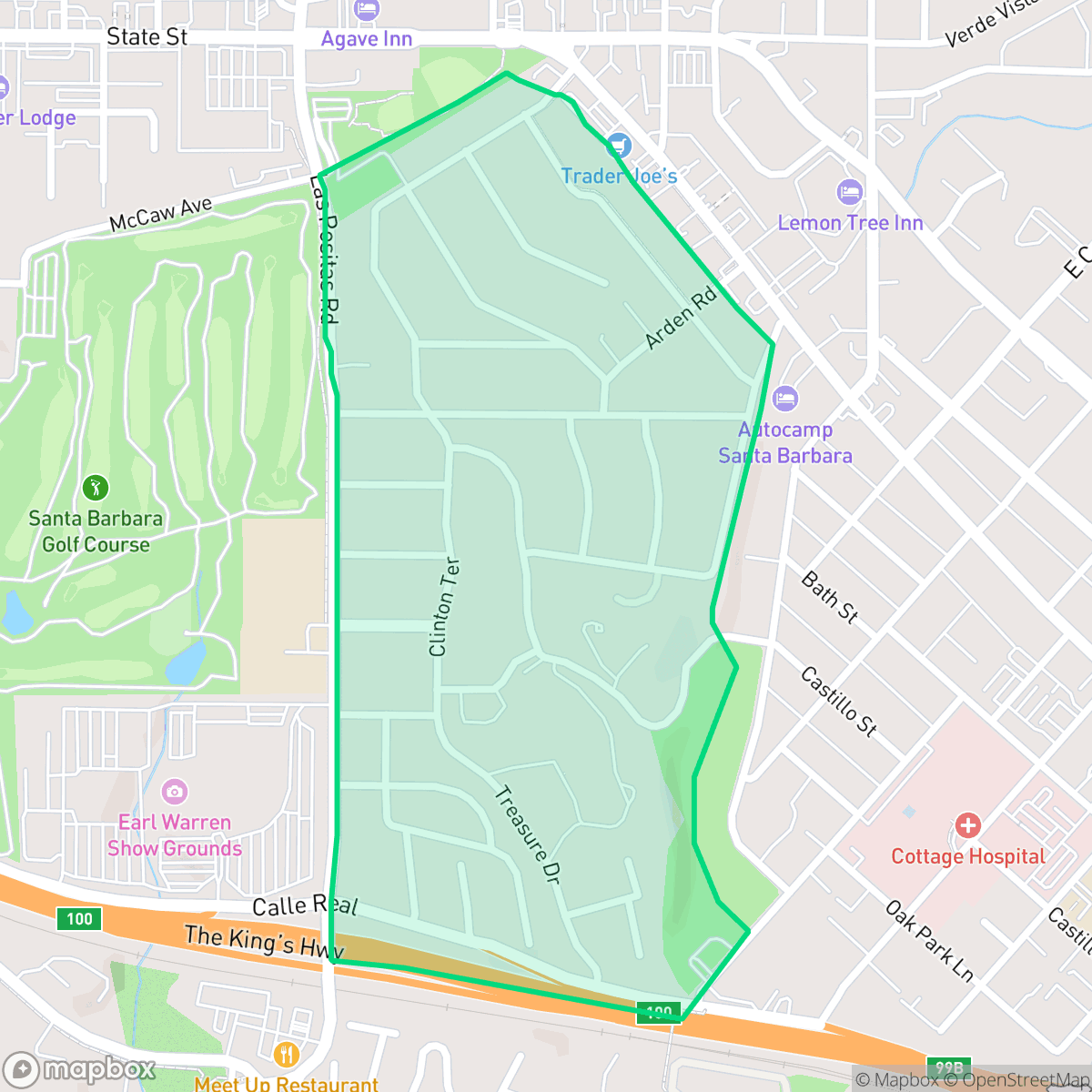
The Samarkand neighborhood in Santa Barbara owes its name and exotic origin to a 32-acre property developed in 1915 by educator Dr. Prynce Hopkins. He built "Boyland II," a boys' school featuring Persian-style architecture and terraced gardens. Following the school's closure during World War I and its brief use as an influenza hospital, Hopkins's mother, Mary, transformed the site in 1920 into the luxurious, Persian-themed Samarkand Hotel, meaning "the land of heart's desire". The surrounding area was subdivided the same year as the Casa Loma Tract. Notable early residents included aviation pioneer Earle Ovington, the nation's first unofficial airmail pilot, who built his home at 3030 Samarkand Drive and established the adjacent Casa Loma Air Field. In 1955, the historic hotel was converted into a retirement community, which remains a neighborhood landmark today.
The area is characterized by its residential charm and high degree of walkability, making it a popular choice for those who prefer an active, pedestrian-friendly lifestyle. Residents enjoy convenient access to local dining and recreational facilities, including the well-regarded Mackenzie Park. According to iHuus data, the neighborhood maintains high visual appeal and exceptional air quality, contributing to its status as a desirable residential enclave within Santa Barbara.
Prospective residents should consider the acoustic environment, as the area records higher-than-average noise levels primarily due to road traffic. The neighborhood also presents a significant fire safety risk that warrants attention from homeowners. With an older demographic profile and access to the stable Hope Elementary School District, the area is well-suited for families and retirees who prioritize community engagement and outdoor accessibility over absolute acoustic seclusion.
Neighborhood Scores Across 15 Qualities
Residential spacing provides a moderate level of separation between neighbors, sitting slightly above the Santa Barbara average. While detached homes feature clear setbacks and yards, some multi-family units in the area share close proximity or walls.
Pedestrian-friendly street layouts and a dense sidewalk network make navigating residential blocks easy. According to iHuus data, the neighborhood offers a more walkable environment than the Santa Barbara average.
Lush landscaping, private pools, and large custom homes create a visually polished environment that sits slightly above the Santa Barbara average. This high level of aesthetic maintenance and architectural detail is a consistent feature throughout the area, according to iHuus data.
Tree-lined streets and nearby forested trails provide ample space for exercise. Access to large public green spaces and wide paths makes this area slightly more pet-friendly than the Santa Barbara average.
Residential layouts consist of a blend of single-family homes and multi-story apartments with less open land than the Santa Barbara average. According to iHuus data, the landscape features a mix of dense suburban pockets and small commercial clusters.
Socially active streets and diverse dining options create a vibrant atmosphere that is notably more energetic than the Santa Barbara average. Residents have access to a variety of local cafes, parks, and eateries, though some areas near major transit corridors maintain a more subdued suburban rhythm.
Frequent noise from nearby freeway and railroad corridors is common here. This level of acoustic disturbance is slightly higher than the average found throughout Santa Barbara.
Air quality remains consistently high with minimal health concerns for residents. This level of cleanliness is on par with the rest of Santa Barbara.
Industrial activity and warehouses are absent from this area, which consists entirely of residential, institutional, and green spaces. According to iHuus data, this neighborhood maintains a higher level of separation from industrial hazards than the city average.
Health insurance coverage among residents is slightly higher than the Santa Barbara city average, according to iHuus data.
Voting patterns and census indicators show a deeply liberal political leaning that is slightly more pronounced than the Santa Barbara city average.
A diverse range of age groups resides here, including young professionals, families, and older adults. According to iHuus data, this demographic spread is slightly more varied than the Santa Barbara city average.
Flood risk levels in this area are slightly higher than the Santa Barbara average, though a lack of detailed FEMA studies means the precise vulnerability remains unquantified. According to iHuus data, residents should exercise caution as the area lacks a completed federal flood study.
Wildfire hazards in this area are exceptionally high, representing a much greater danger than the typical risk found across Santa Barbara. Residents should be aware that according to iHuus data, this neighborhood requires maximum fire protection and preparedness measures.
Address-Level Insights for Samarkand


iHuus Neighborhood Intelligence Insights
Get address-level neighborhood insights for Samarkand
- Street-level scores — see how individual blocks compare, not just neighborhood averages
- Micro-zone boundaries — identify quiet pockets, flood boundaries, and walkable clusters before you visit
- 15 dimensions in full — walkability, noise, air quality, school quality, insurance coverage, population age profile, urban/rural index, and more
- Boundary risk alerts — know if your address sits near a block boundary where scores drop, the kind of detail no listing will ever mention
- School insights — individual school ratings and insights, not just district-level data
- Compare before you commit — side-by-side data across neighborhoods, down to block precision
No credit card required
Compare with Any Neighborhood
| Dimension | Samarkand | Alta Mesa |
|---|---|---|
| 🚶 Walkabilityavg 8.12 | ||
| 🔊 Acoustic Comfortavg 3.7 | ||
| 🤫 Privacy Indexavg 5.66 | ||
| 🎨 Visual Appealavg 7.77 | ||
| 🐕 Dog Friendlinessavg 7.45 | ||
| 🗺️ Urban-Rural Indexavg 7.13 | ||
| ✨ Neighborhood Vibeavg 5.46 | ||
| 🏥 Health Insurance Coverageavg 6.92 | ||
| 🌿 Air Qualityavg 10 | ||
| 🏭 Industrial Proximityavg 9.73 | ||
| 🌊 Flood Safetyavg 3.72 | ||
| 🗳️ Ideological Leanavg 9.64 | ||
| 👥 Population Age Profileavg 5.23 | ||
| 🔥 Fire Safetyavg 0.32 | ||
| 🏫 School Quality |
Samarkand Rankings
School Districts Serving Samarkand
School Insights for Samarkand
Below average outcomes; significant attendance and academic challenges.
School Insights
See what's really behind every school rating near Samarkand
- Individual school ratings — each school's own score with outcome context, not just a district average
- Enrollment & class size data — student-to-teacher ratio and how it compares to the state average
- Full demographics breakdown — ethnicity and gender composition for every school in the enrollment zone
- Every school in the district — all schools within the enrollment boundary ranked by rating, not just the closest one
- Grade levels & benchmarks — elementary through high school, with below/above state-average flags
No credit card required