Riviera, Santa Barbara
Updated · 2,083 residents
The Riviera is characterized by its high-elevation landscape, offering exceptional visual appeal and a distinct rural atmosphere within Santa Barbara. While the area provides a quiet, serene environment with high air quality, residents should anticipate a car-dependent lifestyle and a notable fire risk due to the hillside terrain.
Key Highlights
About Riviera
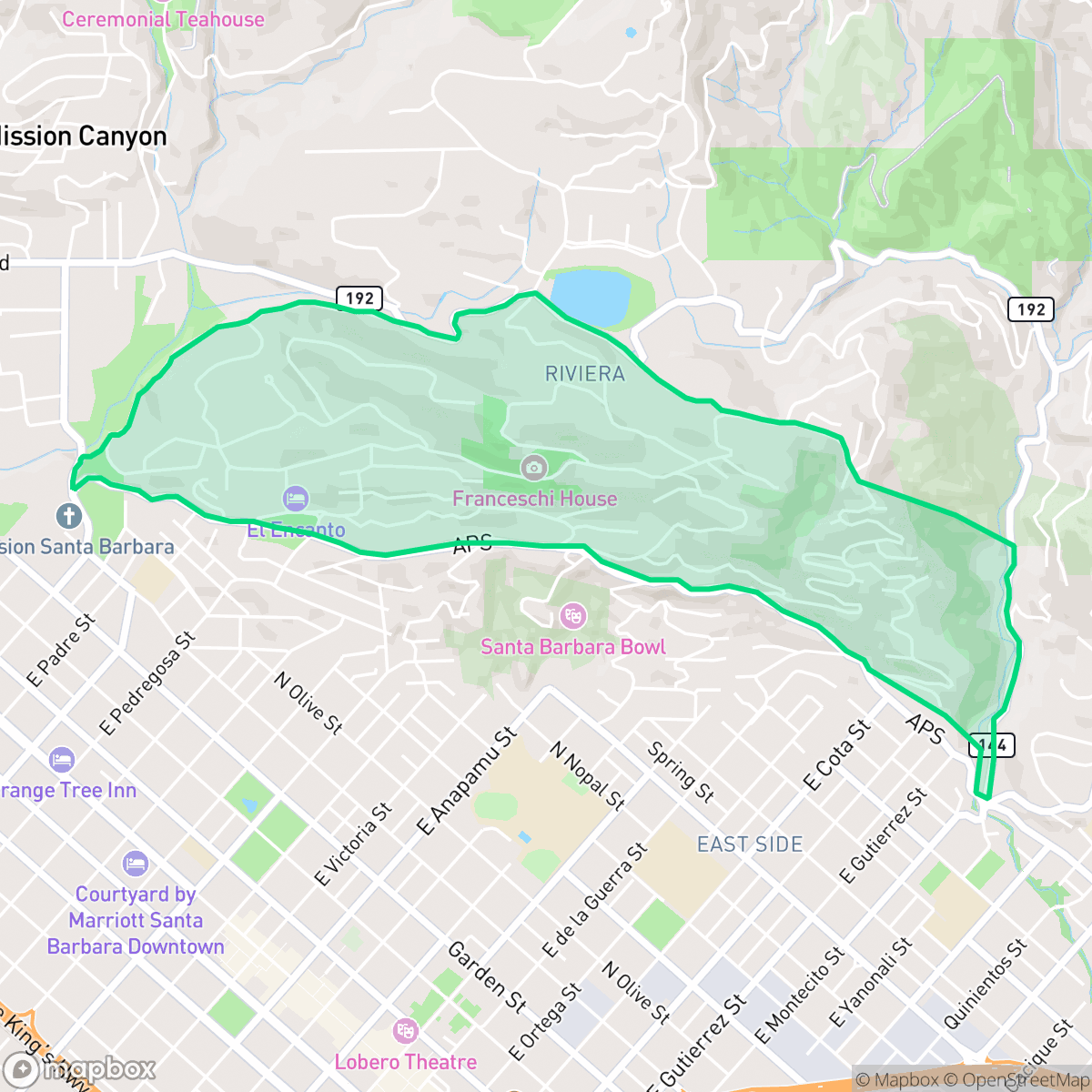
Once a barren, rocky hillside known as Mission Ridge, Santa Barbara’s Riviera neighborhood was transformed starting in 1913 when developer George Batchelder formed the Riviera Company, envisioning a Mediterranean-style enclave reminiscent of coastal France and Italy. The area’s development surged following the 1909 establishment of the State Normal School on the ridge. To house students, James M. Warren constructed cottages that in 1917 became the historic El Encanto Hotel. Today, the neighborhood is divided into Upper and Lower sections by the winding Alameda Padre Serra. It is celebrated for its 1920s Spanish Colonial Revival architecture, terraced gardens crafted by 20th-century Italian stonemasons, and historic landmarks like the Riviera Theatre and Franceschi Park, the former horticultural estate of botanist Francesco Franceschi.
The Riviera is defined by its steep, elevated topography, which provides residents with sweeping views of the city and the Pacific Ocean. This neighborhood maintains a secluded, low-density character that prioritizes privacy and natural beauty over urban convenience. The layout is primarily residential, featuring significant open space and quiet streets that contribute to a tranquil living environment far removed from the activity of the downtown core. The area is marked by its high visual appeal and consistent air quality, making it a desirable location for those who prioritize a peaceful, nature-adjacent setting.
Prospective residents should note that the neighborhood is car-dependent, as there are few local businesses or commercial services within walking distance. While the area offers a high degree of privacy and excellent access to health insurance, the hillside location presents a higher fire risk compared to other parts of the city. It is best suited for individuals or families who value a quiet, rural-like atmosphere and are comfortable with the trade-offs of limited walkability and the necessity of personal vehicle travel for daily errands.
Neighborhood Scores Across 15 Qualities
Large lots with significant separation between homes provide a higher level of privacy than the Santa Barbara average. According to iHuus data, ridge-top residences offer particularly secluded living, though some lower street segments feature closer neighbors.
Low traffic volumes on winding roads allow for safe neighborhood strolls, though many streets lack formal sidewalks. This makes the area less walkable than the Santa Barbara average.
Spacious custom estates with private amenities and significant greenery define the landscape, providing a level of visual quality that is notably higher than the Santa Barbara average.
Canyon-adjacent edges and residential verges provide ample space for walking dogs away from traffic. According to iHuus data, the accessibility of these green spaces is higher than the Santa Barbara average.
Winding canyon roads and a high ratio of foliage to structures create a much more open, wooded environment than the typical Santa Barbara suburb. According to iHuus data, this area features frequent open land and scattered homes set amidst dense greenery.
Residential life here is characterized by a serene, low-density landscape with very little commercial activity. This area is significantly more tranquil and remote than the typical Santa Barbara neighborhood, offering vast open spaces but requiring a car for most errands.
A steady hum from local traffic persists along busy streets, though acoustic levels remain more favorable than the Santa Barbara city average.
Air quality remains exceptionally high with minimal health concerns for residents. This level of air purity is consistent with the average found throughout Santa Barbara.
No warehouses, industrial facilities, or hazard sites are present within the area. This neighborhood maintains an exclusively residential and institutional character that is even more removed from industrial activity than the city average.
Health insurance access is exceptionally high among residents, significantly outpacing the Santa Barbara city average according to iHuus data.
Voting patterns and census indicators show a highly liberal leaning that is consistent with the broader Santa Barbara area.
Residents live among a balanced mix of young professionals, families, and seniors. According to iHuus data, this demographic spread is more varied than the average found across Santa Barbara.
Flood risk in this area is notably higher than the Santa Barbara average due to its location within a floodplain. While many properties remain secure, some residual risk exists during extreme weather events according to iHuus data.
Extreme fire hazards are present throughout this area, matching the high level of risk found across the rest of Santa Barbara. According to iHuus data, residents must prioritize maximum protection measures due to the severe danger of wildfires.
Address-Level Insights for Riviera


iHuus Neighborhood Intelligence Insights
Get address-level neighborhood insights for Riviera
- Street-level scores — see how individual blocks compare, not just neighborhood averages
- Micro-zone boundaries — identify quiet pockets, flood boundaries, and walkable clusters before you visit
- 15 dimensions in full — walkability, noise, air quality, school quality, insurance coverage, population age profile, urban/rural index, and more
- Boundary risk alerts — know if your address sits near a block boundary where scores drop, the kind of detail no listing will ever mention
- School insights — individual school ratings and insights, not just district-level data
- Compare before you commit — side-by-side data across neighborhoods, down to block precision
No credit card required
Compare with Any Neighborhood
| Dimension | Riviera | Alta Mesa |
|---|---|---|
| 🚶 Walkabilityavg 8.12 | ||
| 🔊 Acoustic Comfortavg 3.7 | ||
| 🤫 Privacy Indexavg 5.66 | ||
| 🎨 Visual Appealavg 7.77 | ||
| 🐕 Dog Friendlinessavg 7.45 | ||
| 🗺️ Urban-Rural Indexavg 7.13 | ||
| ✨ Neighborhood Vibeavg 5.46 | ||
| 🏥 Health Insurance Coverageavg 6.92 | ||
| 🌿 Air Qualityavg 10 | ||
| 🏭 Industrial Proximityavg 9.73 | ||
| 🌊 Flood Safetyavg 3.72 | ||
| 🗳️ Ideological Leanavg 9.64 | ||
| 👥 Population Age Profileavg 5.23 | ||
| 🔥 Fire Safetyavg 0.32 | ||
| 🏫 School Quality |
Riviera Rankings
School Districts Serving Riviera
School Insights for Riviera
Below average outcomes; significant attendance and academic challenges.
School Insights
See what's really behind every school rating near Riviera
- Individual school ratings — each school's own score with outcome context, not just a district average
- Enrollment & class size data — student-to-teacher ratio and how it compares to the state average
- Full demographics breakdown — ethnicity and gender composition for every school in the enrollment zone
- Every school in the district — all schools within the enrollment boundary ranked by rating, not just the closest one
- Grade levels & benchmarks — elementary through high school, with below/above state-average flags
No credit card required