Oak Park, Santa Barbara
Updated · 7,245 residents
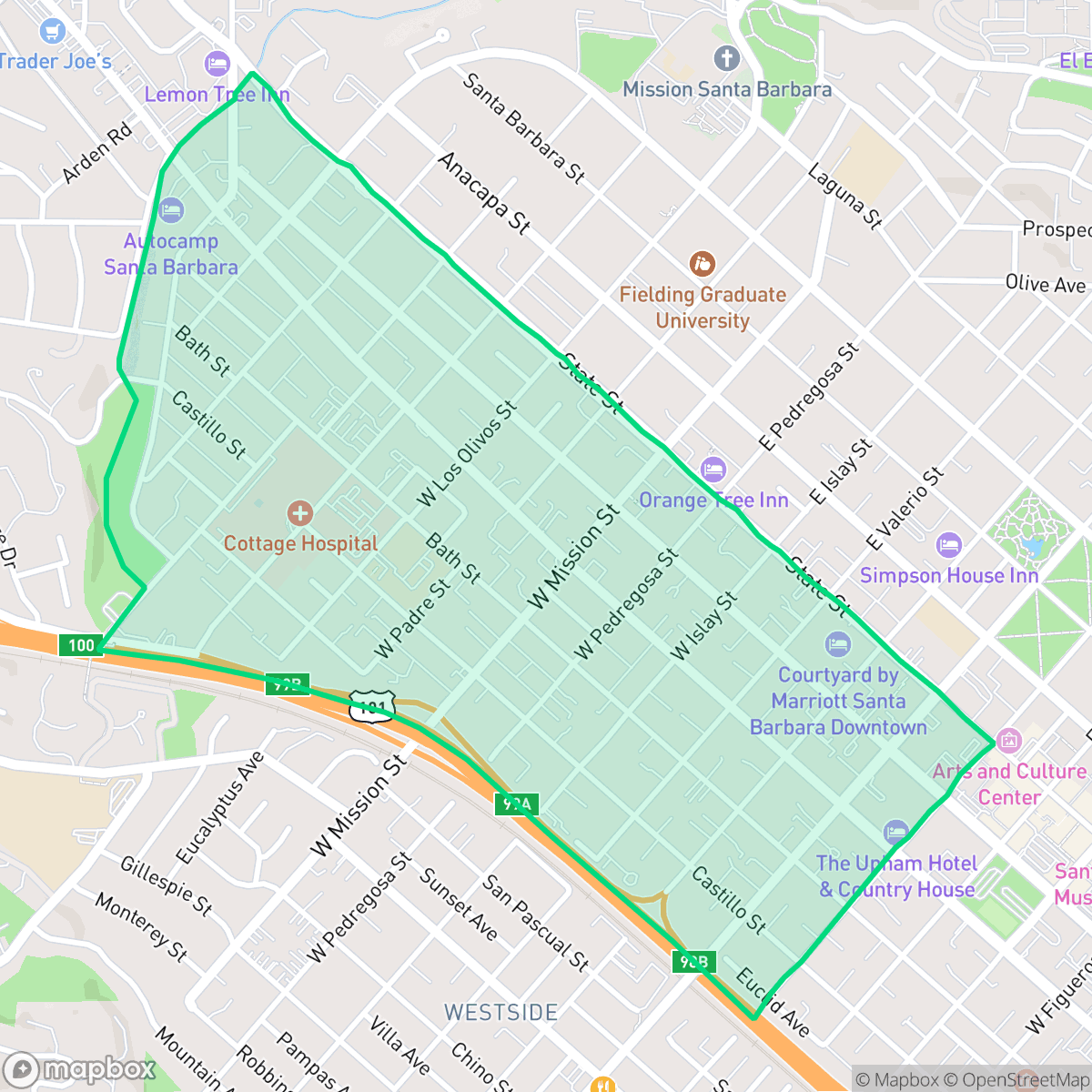
Oak Park is a highly walkable residential enclave defined by its extensive sidewalk network and proximity to diverse local eateries and coffee roasters. While the neighborhood offers a clean, industrial-free environment, residents should be aware of significant noise levels from nearby freeway and rail traffic.
Key Highlights
About Oak Park
The Oak Park neighborhood in Santa Barbara is anchored by its namesake 21-acre park, a site historically valued for its oak-lined stretch of Mission Creek. Originally a gathering place during the Spanish era, the land was preserved from housing development in 1904 through the civic efforts of Henry Tallant, who organized a community fund drive supported by local schoolchildren. The surrounding residential area saw significant growth following the 1891 opening of nearby Cottage Hospital and the 1896 expansion of the streetcar line. Today, the neighborhood is characterized by a mix of architectural styles, including Craftsman and Spanish Colonial Revival homes. The park remains the cultural heart of the community, long serving as a venue for Sunday band concerts, ethnic festivals, and seasonal recreation, maintaining the area's identity as a walkable, central residential enclave.
The area functions as a lively local hub, characterized by a dense concentration of social gathering spots and varied dining options. Its exceptional pedestrian infrastructure, featuring continuous sidewalks throughout the residential grid, makes navigating the neighborhood on foot significantly easier than in many other parts of the city. The demographic profile is diverse, consisting of a balanced mix of young professionals, families, and seniors who contribute to a strongly liberal community atmosphere. The landscape provides a pleasant suburban transition, marked by well-manicured landscaping and large homes with distinct architectural details.
Prospective residents should consider a few trade-offs when evaluating the neighborhood. The area experiences notable noise pollution due to its proximity to active railroad tracks and heavy freeway traffic. Additionally, property spacing is relatively tight, which creates a more communal feel but offers less privacy than more sprawling districts. While the environment benefits from excellent air quality, health insurance coverage rates among residents are lower than the city average. Furthermore, families should note that the local school district is currently navigating a period of operational transition and addressing performance disparities across its campuses.
Neighborhood Scores Across 15 Qualities
Property spacing varies between closely situated multi-family units and single-family homes with modest backyard buffers. According to iHuus data, this level of neighbor proximity is slightly higher than the Santa Barbara city average.
Extensive sidewalk networks and clear pedestrian crossings throughout the residential grid make navigating the area on foot exceptionally easy. This level of pedestrian infrastructure is notably superior to the city average, featuring continuous sidewalks on both sides of most streets.
Large homes with complex rooflines and lush, well-manicured landscaping characterize much of this area. According to iHuus data, the overall visual quality is slightly below the Santa Barbara city average.
Green verges and tree-lined streets provide decent walking space, though the availability of large public parks is below the Santa Barbara average. North-east areas offer access to forested trails, but some denser residential pockets have much narrower sidewalks.
Residential streets feature a mix of single-family homes and multi-unit complexes within a landscape that is less dense than the Santa Barbara average. This area offers a blend of suburban development and accessible green canopy according to iHuus data.
A notable concentration of social hubs and diverse dining options makes this area more active than the Santa Barbara average. Residents can find various local landmarks, coffee roasters, and eateries interspersed throughout the suburban streets and green spaces.
Frequent noise from nearby railroad tracks and heavy freeway traffic characterizes this area. Acoustic comfort is notably lower than the Santa Barbara city average, according to iHuus data.
Air quality is exceptionally high and presents no notable health concerns. This level of purity is consistent with the average found across Santa Barbara.
Industrial activity and large warehouses are entirely absent from this area. According to iHuus data, the neighborhood contains no detected industrial hazards or heavy manufacturing sites, providing a cleaner environment than the city average.
Health insurance accessibility is lower in Oak Park than in the rest of Santa Barbara. According to iHuus data, a minority of local residents are covered by health insurance plans.
Voting patterns and census indicators show a very high concentration of liberal-leaning residents, slightly more so than the broader Santa Barbara area according to iHuus data.
Residents live alongside a balanced mix of young professionals, families, and seniors. This demographic spread is very similar to the broader Santa Barbara area, according to iHuus data.
Flood risk in this area remains undetermined due to a lack of detailed FEMA studies, though the level of concern is slightly higher than the Santa Barbara city average according to iHuus data.
Address-Level Insights for Oak Park


iHuus Neighborhood Intelligence Insights
Get address-level neighborhood insights for Oak Park
- Street-level scores — see how individual blocks compare, not just neighborhood averages
- Micro-zone boundaries — identify quiet pockets, flood boundaries, and walkable clusters before you visit
- 15 dimensions in full — walkability, noise, air quality, school quality, insurance coverage, population age profile, urban/rural index, and more
- Boundary risk alerts — know if your address sits near a block boundary where scores drop, the kind of detail no listing will ever mention
- School insights — individual school ratings and insights, not just district-level data
- Compare before you commit — side-by-side data across neighborhoods, down to block precision
No credit card required
Compare with Any Neighborhood
| Dimension | Oak Park | Alta Mesa |
|---|---|---|
| 🚶 Walkabilityavg 8.12 | ||
| 🔊 Acoustic Comfortavg 3.7 | ||
| 🤫 Privacy Indexavg 5.66 | ||
| 🎨 Visual Appealavg 7.77 | ||
| 🐕 Dog Friendlinessavg 7.45 | ||
| 🗺️ Urban-Rural Indexavg 7.13 | ||
| ✨ Neighborhood Vibeavg 5.46 | ||
| 🏥 Health Insurance Coverageavg 6.92 | ||
| 🌿 Air Qualityavg 10 | ||
| 🏭 Industrial Proximityavg 9.73 | ||
| 🌊 Flood Safetyavg 3.72 | ||
| 🗳️ Ideological Leanavg 9.64 | ||
| 👥 Population Age Profileavg 5.23 | ||
| 🔥 Fire Safetyavg 0.32 | ||
| 🏫 School Quality |
Oak Park Rankings
School Districts Serving Oak Park
School Insights for Oak Park
Below average outcomes; significant attendance and academic challenges.
School Insights
See what's really behind every school rating near Oak Park
- Individual school ratings — each school's own score with outcome context, not just a district average
- Enrollment & class size data — student-to-teacher ratio and how it compares to the state average
- Full demographics breakdown — ethnicity and gender composition for every school in the enrollment zone
- Every school in the district — all schools within the enrollment boundary ranked by rating, not just the closest one
- Grade levels & benchmarks — elementary through high school, with below/above state-average flags
No credit card required