Milpas, Santa Barbara
Updated · 1,111 residents
Milpas is a central Santa Barbara corridor defined by its dense, community-focused residential blocks and a diverse, established culinary scene. While the area offers high walkability and excellent air quality, residents should anticipate significant road traffic noise and limited privacy due to the close proximity of neighboring homes.
Key Highlights
About Milpas
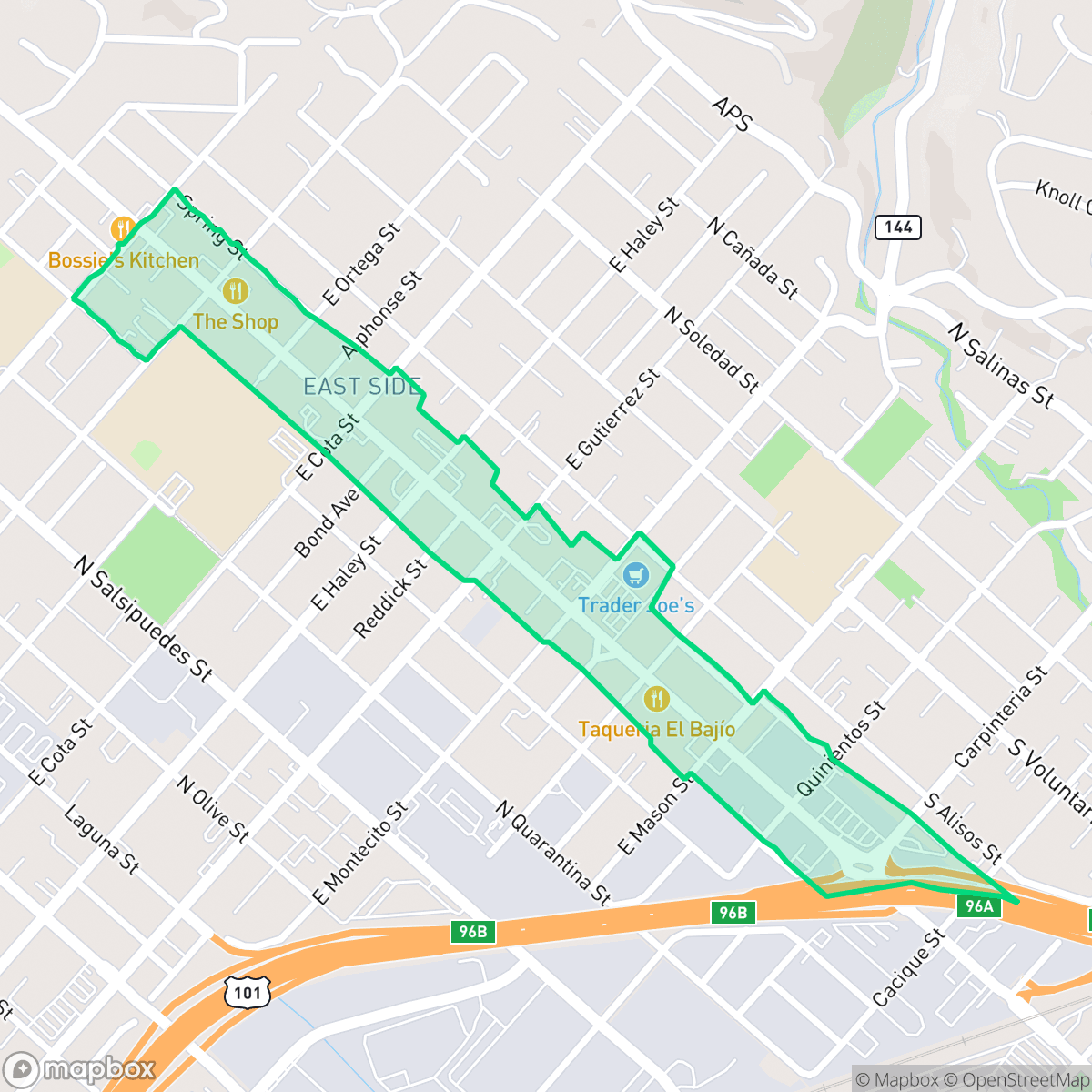
Milpas Street, or "Calle Milpas," serves as the cultural and commercial backbone of Santa Barbara’s Eastside. Its name derives from the Nahuatl word for "cornfields," reflecting the 1860s efforts to transform the area's mosquito-ridden wetlands into fertile agricultural land and dairy farms. By the 1920s, local bogs were reclaimed to build Eastside homes, schools, and Ortega Park. The neighborhood is anchored by landmarks like the 1936 Santa Barbara Bowl and the 1937 Streamline Moderne Live Oak Dairy building, featuring the historic "Bossie the Cow" statue. Milpas became a vibrant hub of Chicano culture in the 1970s, serving as a hotspot for lowrider cruising and the home of La Casa de la Raza. Today, it is celebrated for its thriving family-run businesses, including the legendary La Super-Rica Taqueria.
The neighborhood functions as a dense urban-suburban mix, characterized by a grid of single-family homes and multi-unit housing. It maintains a steady, active rhythm supported by local businesses and public spaces like Sunflower Park. According to iHuus data, the community benefits from high air quality and a consistent sidewalk network, making it a functional choice for those who prioritize the ability to navigate the city on foot over quiet seclusion. The area serves as a practical hub for residents who value being close to commercial amenities and central transit routes.
Prospective residents should weigh this accessibility against the acoustic environment. The area experiences high levels of traffic noise, and the dense housing layout results in limited privacy between properties. With a fire safety profile that reflects regional environmental risks and a need for more expansive dog-friendly amenities, the neighborhood is best suited for individuals who prioritize a central location and local convenience over large private yards or a tranquil, low-decibel living experience.
Neighborhood Scores Across 15 Qualities
Residential spacing varies across the area, with some homes positioned close to neighbors while hillside properties offer more separation. According to iHuus data, privacy levels are slightly lower than the Santa Barbara average due to higher density pockets.
Pedestrian navigation is straightforward due to a consistent grid of sidewalks and safe crosswalks, though a major highway bisects the area. Most local errands and park access are achievable on foot, performing roughly in line with the city average.
Residential views range from modest suburban lots to larger estate homes in the northern hills. This area offers slightly less visual variety and fewer luxury amenities than the Santa Barbara city average, according to iHuus data.
Large public parks and leafy residential verges provide decent walking options, though overall accessibility to green space is below the Santa Barbara average. According to iHuus data, much of the area's greenery is contained within private yards rather than interconnected public trails.
Residential areas feature a dense suburban fabric with a mix of single-family homes and multi-unit housing. This landscape is slightly less open than the average for Santa Barbara, as it contains more developed commercial and institutional zones.
A steady rhythm of local eateries and green spaces exists alongside calmer suburban streets, though the level of activity is lower than the city average. While diverse dining options are available, many businesses are not within easy walking distance of residential areas according to iHuus data.
Frequent disturbances from nearby railroad tracks and major freeway traffic characterize this area. Acoustic comfort in Milpas is lower than the typical experience found elsewhere in Santa Barbara, according to iHuus data.
Air quality remains consistently high with minimal health concerns for residents. This level of clean air is on par with the rest of Santa Barbara.
Residential and light commercial uses dominate the area, with significantly less industrial activity than the Santa Barbara average. Heavy warehouses and large-scale storage tanks are largely absent from this neighborhood.
Health insurance enrollment in this area is notably lower than the Santa Barbara city average, according to iHuus data.
Voting patterns and census indicators show a deeply liberal political leaning that is even more pronounced than the Santa Barbara city average, according to iHuus data.
A balanced variety of young adults, families, and seniors resides here, representing a demographic spread slightly lower than the Santa Barbara average according to iHuus data.
Properties in this area are located within a designated floodplain, making them significantly more vulnerable to flooding than the Santa Barbara average. According to iHuus data, residents should expect a higher likelihood of flood-related incidents and may be required to maintain flood insurance.
Address-Level Insights for Milpas


iHuus Neighborhood Intelligence Insights
Get address-level neighborhood insights for Milpas
- Street-level scores — see how individual blocks compare, not just neighborhood averages
- Micro-zone boundaries — identify quiet pockets, flood boundaries, and walkable clusters before you visit
- 15 dimensions in full — walkability, noise, air quality, school quality, insurance coverage, population age profile, urban/rural index, and more
- Boundary risk alerts — know if your address sits near a block boundary where scores drop, the kind of detail no listing will ever mention
- School insights — individual school ratings and insights, not just district-level data
- Compare before you commit — side-by-side data across neighborhoods, down to block precision
No credit card required
Compare with Any Neighborhood
| Dimension | Milpas | Alta Mesa |
|---|---|---|
| 🚶 Walkabilityavg 8.12 | ||
| 🔊 Acoustic Comfortavg 3.7 | ||
| 🤫 Privacy Indexavg 5.66 | ||
| 🎨 Visual Appealavg 7.77 | ||
| 🐕 Dog Friendlinessavg 7.45 | ||
| 🗺️ Urban-Rural Indexavg 7.13 | ||
| ✨ Neighborhood Vibeavg 5.46 | ||
| 🏥 Health Insurance Coverageavg 6.92 | ||
| 🌿 Air Qualityavg 10 | ||
| 🏭 Industrial Proximityavg 9.73 | ||
| 🌊 Flood Safetyavg 3.72 | ||
| 🗳️ Ideological Leanavg 9.64 | ||
| 👥 Population Age Profileavg 5.23 | ||
| 🔥 Fire Safetyavg 0.32 | ||
| 🏫 School Quality |
Milpas Rankings
School Districts Serving Milpas
School Insights for Milpas
Below average outcomes; significant attendance and academic challenges.
School Insights
See what's really behind every school rating near Milpas
- Individual school ratings — each school's own score with outcome context, not just a district average
- Enrollment & class size data — student-to-teacher ratio and how it compares to the state average
- Full demographics breakdown — ethnicity and gender composition for every school in the enrollment zone
- Every school in the district — all schools within the enrollment boundary ranked by rating, not just the closest one
- Grade levels & benchmarks — elementary through high school, with below/above state-average flags
No credit card required