Lower Riviera, Santa Barbara
Updated · 3,534 residents
The Lower Riviera is a picturesque residential enclave known for its diverse architectural heritage and proximity to iconic venues like the Santa Barbara Bowl. Residents enjoy a quiet, highly walkable environment with excellent air quality and abundant green space, making it a peaceful retreat near the heart of the city.
Key Highlights
About Lower Riviera
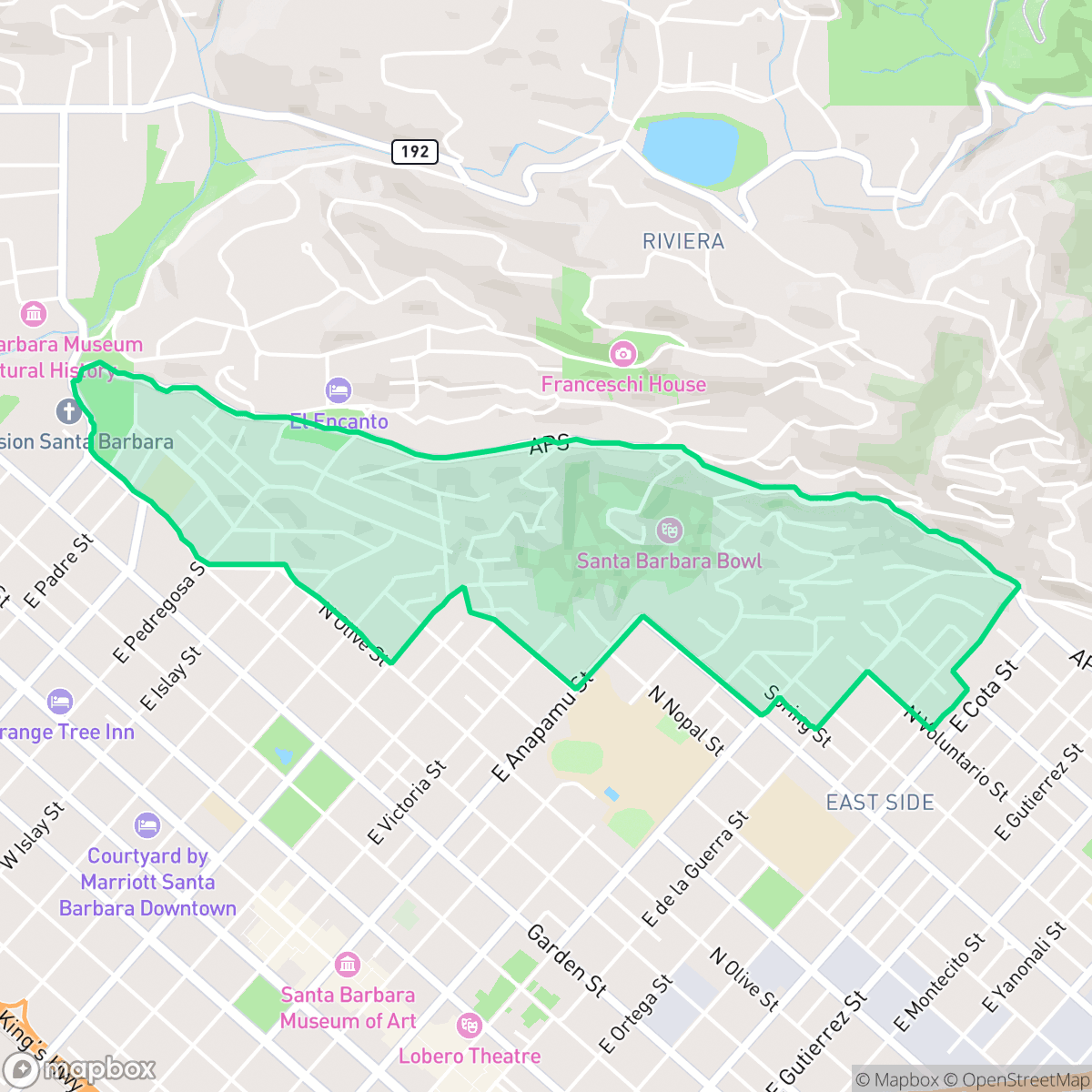
The Lower Riviera neighborhood of Santa Barbara, bounded on the north by Alameda Padre Serra (APS) and extending to Laguna and Milpas streets, developed on former Mission lands sold in the late 19th century. The area’s growth was catalyzed by an 1887 streetcar line along Garden Street and a 1910 line on APS, which created the street’s signature sweeping curves. Originally traversed by Chumash trails and Mexican ox-cart paths (now Grand Avenue), the neighborhood features a rich architectural mix, including Spanish Colonial Revival, Craftsman, the 1902 Japanese-inspired Pagoda House, and rare Secessionist styles. Key local landmarks include Orpet Park, a horticultural gem designed by park superintendent E.O. Orpet, and the historic Santa Barbara Bowl, an iconic outdoor amphitheater established in 1936.
The area is defined by its blend of historic residential architecture and tranquil, tree-lined streets. It maintains a calm, suburban atmosphere that prioritizes privacy and aesthetic appeal, characterized by well-manicured properties and open recreational areas. The presence of the Santa Barbara Bowl serves as a central cultural anchor, providing world-class entertainment within a short distance of residential blocks.
While the neighborhood offers a high standard of living with exceptional air quality and dog-friendly amenities, prospective residents should note specific environmental considerations. The area faces significant challenges regarding fire safety, which is a critical factor for property owners in this region. Additionally, while the local streets are quiet and pedestrian-friendly, the overall vibe is relatively subdued, catering to those who prefer a low-density residential experience over a bustling urban center. Families may also consider the local school district, which is currently undergoing a period of academic and operational transition.
Neighborhood Scores Across 15 Qualities
Residential spacing offers a balanced level of seclusion, featuring a mix of detached homes and multi-family units with slightly more separation than the Santa Barbara average according to iHuus data.
Pedestrian navigation is efficient due to a consistent grid with visible sidewalks and high-visibility crosswalks. This area offers a level of walkability that is on par with the rest of Santa Barbara, featuring easy access to local parks and commercial buildings.
Large estate-style homes, private pools, and well-maintained landscaping create a highly polished aesthetic that is more visually appealing than the Santa Barbara average. According to iHuus data, the area features prominent amenities such as tennis courts and manicured yards throughout the hilly northern sections.
Large public parks, athletic fields, and wide sidewalks offer excellent opportunities for dog walking. This area provides more access to connected green spaces and tree-lined paths than the Santa Barbara average, according to iHuus data.
Residential lots feature a mix of single-family homes and multi-unit complexes. This area offers a suburban layout that is very similar to the broader Santa Barbara area.
A blend of quiet, low-density residential streets and pockets of activity defines the area. While some blocks offer easy access to local dining and parks, the overall level of social energy is slightly lower than the Santa Barbara average.
Steady traffic sounds from nearby busy streets are present, though levels are notably more tranquil than the average found throughout Santa Barbara. According to iHuus data, the area maintains a consistent but manageable acoustic environment.
Air quality remains consistently excellent and matches the high standards found throughout Santa Barbara. Residents can expect very low levels of pollution and minimal health concerns according to iHuus data.
Industrial hazards and warehouses are entirely absent from this area, which consists solely of residential, educational, and recreational zones. This lack of heavy industry makes the neighborhood slightly more removed from industrial activity than the Santa Barbara average, according to iHuus data.
Health insurance access is widespread among residents, appearing notably higher than the Santa Barbara city average according to iHuus data.
Voting patterns and census indicators reflect a deeply liberal political leaning that is slightly more pronounced than the Santa Barbara city average.
Residents will find a diverse age distribution ranging from young professionals to older adults. According to iHuus data, this demographic spread is largely consistent with the broader Santa Barbara area.
Properties in this area are located within a designated floodplain, which indicates a significantly higher risk of flooding than the Santa Barbara average. According to iHuus data, residents may find that flood insurance is a typical requirement for homes in this neighborhood.
Wildfire danger is exceptionally high in this area, representing a more significant hazard than most parts of Santa Barbara. According to iHuus data, residents should prioritize maximum fire prevention and safety measures due to the extreme level of risk.
Address-Level Insights for Lower Riviera


iHuus Neighborhood Intelligence Insights
Get address-level neighborhood insights for Lower Riviera
- Street-level scores — see how individual blocks compare, not just neighborhood averages
- Micro-zone boundaries — identify quiet pockets, flood boundaries, and walkable clusters before you visit
- 15 dimensions in full — walkability, noise, air quality, school quality, insurance coverage, population age profile, urban/rural index, and more
- Boundary risk alerts — know if your address sits near a block boundary where scores drop, the kind of detail no listing will ever mention
- School insights — individual school ratings and insights, not just district-level data
- Compare before you commit — side-by-side data across neighborhoods, down to block precision
No credit card required
Compare with Any Neighborhood
| Dimension | Lower Riviera | Alta Mesa |
|---|---|---|
| 🚶 Walkabilityavg 8.12 | ||
| 🔊 Acoustic Comfortavg 3.7 | ||
| 🤫 Privacy Indexavg 5.66 | ||
| 🎨 Visual Appealavg 7.77 | ||
| 🐕 Dog Friendlinessavg 7.45 | ||
| 🗺️ Urban-Rural Indexavg 7.13 | ||
| ✨ Neighborhood Vibeavg 5.46 | ||
| 🏥 Health Insurance Coverageavg 6.92 | ||
| 🌿 Air Qualityavg 10 | ||
| 🏭 Industrial Proximityavg 9.73 | ||
| 🌊 Flood Safetyavg 3.72 | ||
| 🗳️ Ideological Leanavg 9.64 | ||
| 👥 Population Age Profileavg 5.23 | ||
| 🔥 Fire Safetyavg 0.32 | ||
| 🏫 School Quality |
Lower Riviera Rankings
School Districts Serving Lower Riviera
School Insights for Lower Riviera
Below average outcomes; significant attendance and academic challenges.
School Insights
See what's really behind every school rating near Lower Riviera
- Individual school ratings — each school's own score with outcome context, not just a district average
- Enrollment & class size data — student-to-teacher ratio and how it compares to the state average
- Full demographics breakdown — ethnicity and gender composition for every school in the enrollment zone
- Every school in the district — all schools within the enrollment boundary ranked by rating, not just the closest one
- Grade levels & benchmarks — elementary through high school, with below/above state-average flags
No credit card required