Hope, Santa Barbara
Updated · 3,673 residents
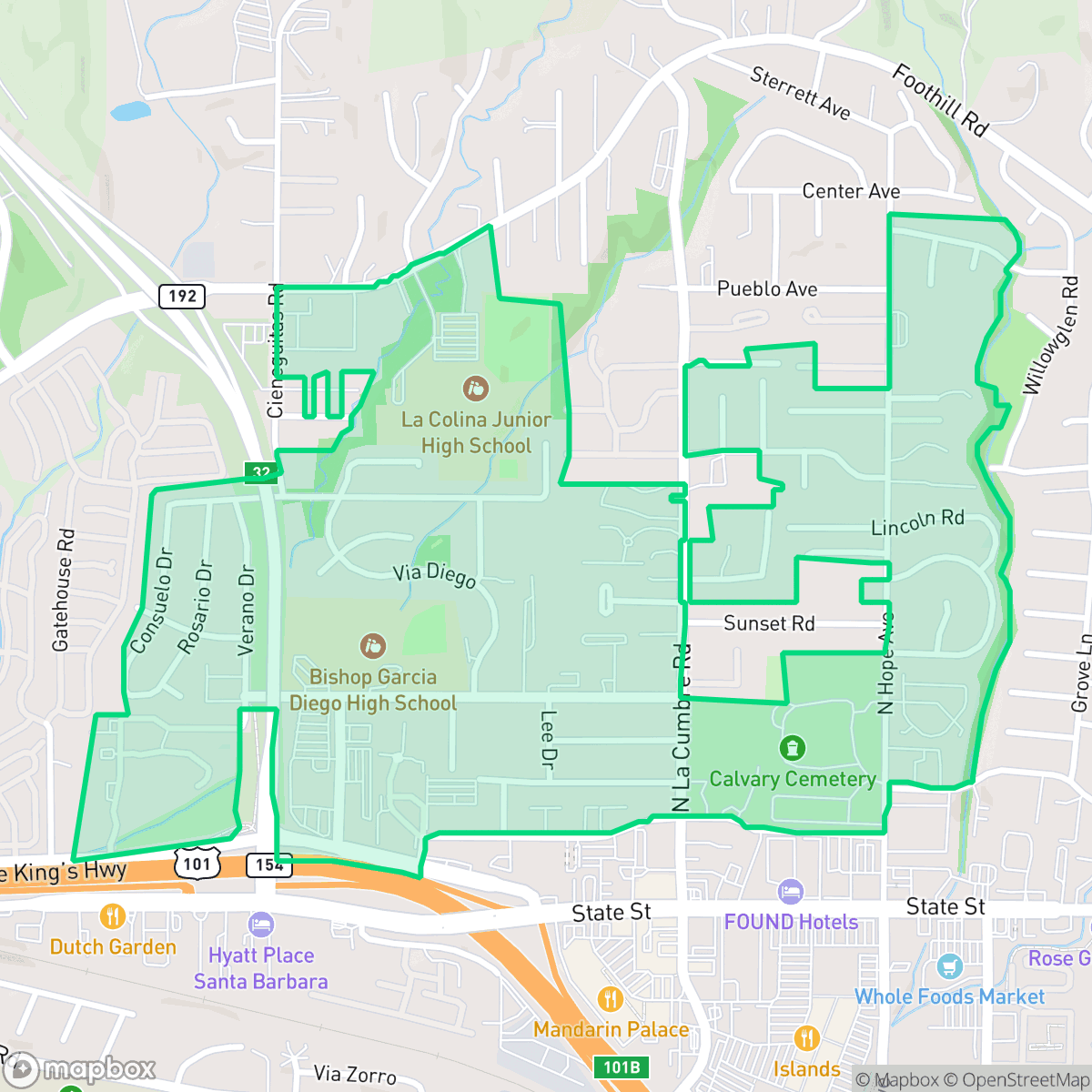
Hope is a residential enclave in Santa Barbara characterized by a blend of suburban density and well-maintained green spaces. Residents benefit from high air quality and strong health insurance coverage, though the area experiences notable noise levels due to its proximity to major road traffic.
Key Highlights
About Hope
Named after Irish immigrant Thomas Hope, who purchased the land in 1861 for a highly profitable sheep ranching operation, the exclusive neighborhood of Hope Ranch in Santa Barbara was transformed into a residential enclave in the 1920s. Developer Harold S. Chase purchased the land in 1923, establishing the Hope Ranch Park Homes Association in 1924 and planting over 50,000 trees to create its signature park-like atmosphere. The neighborhood’s architectural heritage includes the 1875 Victorian-style Thomas Hope House, designed by Peter Barber, alongside grand 1920s estates designed by renowned architects like George Washington Smith. Today, Hope Ranch is defined by its strong equestrian identity, featuring over 20 miles of dedicated riding trails, a private beach, and the historic La Cumbre Country Club surrounding Laguna Blanca.
The neighborhood features a mix of single-family homes and apartment complexes, offering a suburban feel with consistent sidewalk networks that connect to local parks. According to iHuus data, the area maintains excellent air quality and a high degree of visual appeal with manicured properties. The community is served by high-performing schools, including Monte Vista Elementary and La Colina Junior High, making it a stable environment for families seeking academic access.
While the area provides a walkable environment with access to social hubs like Willow Glen Park, residents should note the acoustic impact of nearby highways. The neighborhood is largely residential with minimal industrial presence, though prospective buyers should be aware of regional fire safety considerations. It is well-suited for those prioritizing a quiet, established atmosphere and reliable community infrastructure.
Neighborhood Scores Across 15 Qualities
Residential spacing varies between dense apartment clusters with shared walls and detached homes featuring mature tree screening. According to iHuus data, this level of privacy is slightly lower than the Santa Barbara average.
Consistent sidewalk networks and low-traffic residential grids provide easy access to nearby commercial hubs and parks. While the area is slightly more walkable than the city average, a major highway acts as a significant barrier for pedestrians.
Property aesthetics vary significantly, ranging from well-manicured estates with private pools to denser areas of mobile home parks and tract housing. According to iHuus data, the overall visual quality of this area sits below the Santa Barbara city average.
Abundant green verges and a large public park with ballfields offer reliable walking space. While slightly below the city average for connected green spaces, the area provides safe paths that are largely separated from traffic.
Open land and scattered homes characterize this area, providing a landscape slightly less dense than the typical Santa Barbara urban profile. Residential pockets include a mix of single-family homes and mobile home parks interspersed with woodland and fields.
Residential pockets balance quiet, low-density streets with more active blocks that host local dining and social hubs. This level of activity is roughly in line with the rest of Santa Barbara.
Frequent acoustic disturbances from nearby railroad tracks and freeway traffic are common in this area. According to iHuus data, noise levels in Hope are significantly higher than the Santa Barbara average.
Air quality is consistently high with minimal health concerns. This level of cleanliness is on par with the rest of Santa Barbara.
Industrial presence is nonexistent in this area, as the neighborhood consists entirely of residential, educational, and light commercial uses. This lack of heavy industry or warehouses makes the area even more secluded from industrial activity than the rest of Santa Barbara.
Health insurance accessibility is notably higher in Hope than the Santa Barbara average, according to iHuus data. This indicates a strong level of medical coverage among the local population.
Voting patterns and census indicators in Hope align closely with the broader liberal lean of Santa Barbara. Residents will find a political landscape that is consistent with the city average.
A balanced mix of young adults, families, and older residents characterizes this area. According to iHuus data, the age distribution is more varied than the Santa Barbara city average.
Flood risk levels in Hope are currently undetermined because detailed studies have not been completed for this area; however, the risk is higher than the average found throughout Santa Barbara. According to iHuus data, residents should remain aware of potential drainage concerns during heavy rain events.
High fire vulnerability characterizes this area, representing a risk level that is slightly higher than the Santa Barbara average. According to iHuus data, extreme precautions and robust fire protection measures are necessary for residents.
Address-Level Insights for Hope


iHuus Neighborhood Intelligence Insights
Get address-level neighborhood insights for Hope
- Street-level scores — see how individual blocks compare, not just neighborhood averages
- Micro-zone boundaries — identify quiet pockets, flood boundaries, and walkable clusters before you visit
- 15 dimensions in full — walkability, noise, air quality, school quality, insurance coverage, population age profile, urban/rural index, and more
- Boundary risk alerts — know if your address sits near a block boundary where scores drop, the kind of detail no listing will ever mention
- School insights — individual school ratings and insights, not just district-level data
- Compare before you commit — side-by-side data across neighborhoods, down to block precision
No credit card required
Compare with Any Neighborhood
| Dimension | Hope | Alta Mesa |
|---|---|---|
| 🚶 Walkabilityavg 8.12 | ||
| 🔊 Acoustic Comfortavg 3.7 | ||
| 🤫 Privacy Indexavg 5.66 | ||
| 🎨 Visual Appealavg 7.77 | ||
| 🐕 Dog Friendlinessavg 7.45 | ||
| 🗺️ Urban-Rural Indexavg 7.13 | ||
| ✨ Neighborhood Vibeavg 5.46 | ||
| 🏥 Health Insurance Coverageavg 6.92 | ||
| 🌿 Air Qualityavg 10 | ||
| 🏭 Industrial Proximityavg 9.73 | ||
| 🌊 Flood Safetyavg 3.72 | ||
| 🗳️ Ideological Leanavg 9.64 | ||
| 👥 Population Age Profileavg 5.23 | ||
| 🔥 Fire Safetyavg 0.32 | ||
| 🏫 School Quality |
Hope Rankings
School Districts Serving Hope
School Insights for Hope
Below average outcomes; significant attendance and academic challenges.
School Insights
See what's really behind every school rating near Hope
- Individual school ratings — each school's own score with outcome context, not just a district average
- Enrollment & class size data — student-to-teacher ratio and how it compares to the state average
- Full demographics breakdown — ethnicity and gender composition for every school in the enrollment zone
- Every school in the district — all schools within the enrollment boundary ranked by rating, not just the closest one
- Grade levels & benchmarks — elementary through high school, with below/above state-average flags
No credit card required