Funk Zone, Santa Barbara
Updated · 275 residents
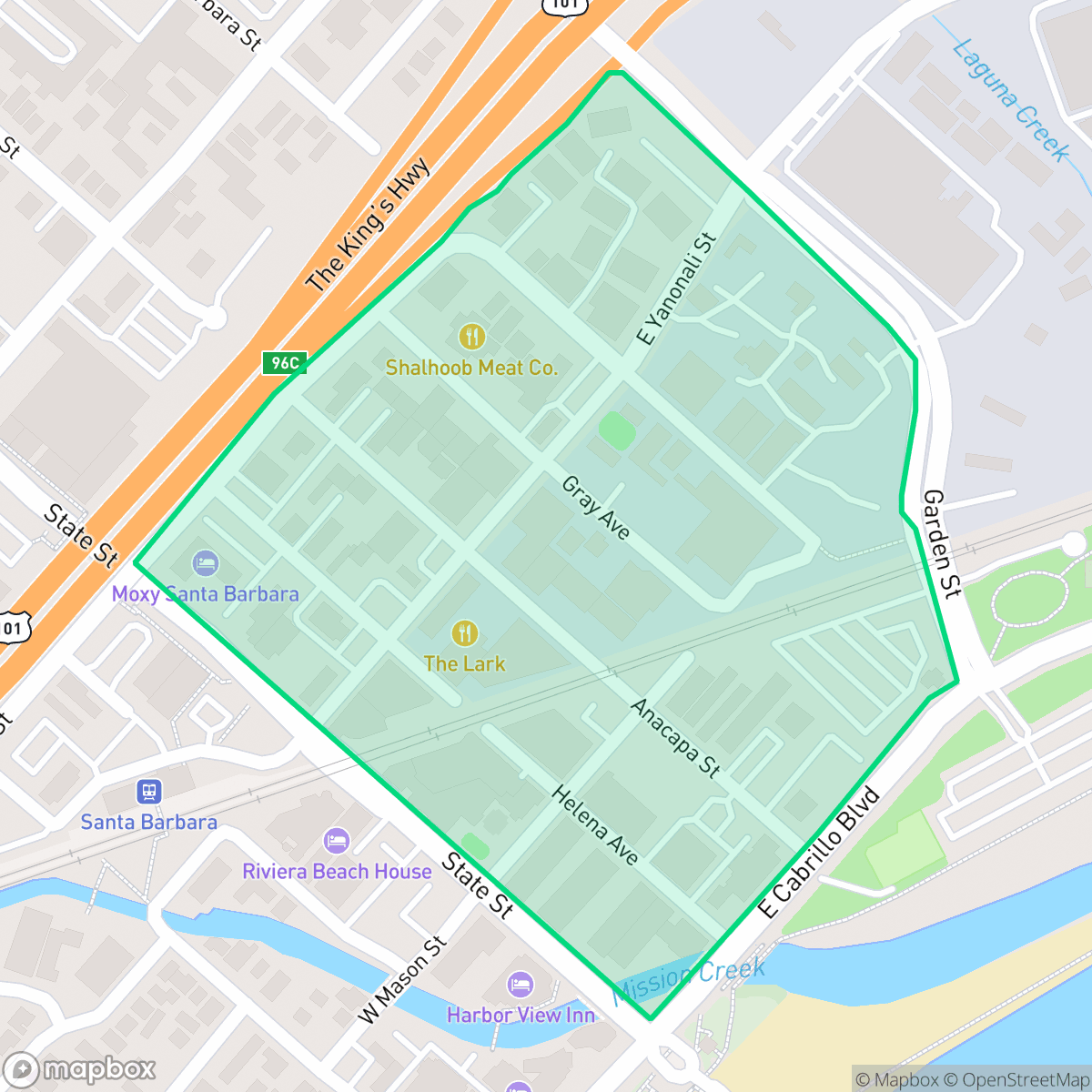
The Funk Zone is a highly walkable and dog-friendly coastal district known for its converted industrial warehouses that now host art galleries, craft breweries, and diverse eateries. While it offers a lively atmosphere and excellent air quality, residents should be aware of the notably high noise levels from nearby road traffic and limited privacy.
Key Highlights
About Funk Zone
Historically Santa Barbara's industrial and marine hub, the Funk Zone was home to early grain mills, the Castagnola fishing empire, Radon boat building, and the birthplace of the Lockheed Corporation. The neighborhood's name originated from the pungent aroma of its historic fish-processing plants and its eclectic mix of dilapidated warehouses and quonset huts. By the late 1980s and 1990s, rising city rents drove local artists and craftsmen into these neglected industrial spaces. To protect this emerging creative community, arts commissioner Patrick Davis and city planners established "art-friendly" zoning in the early 2000s. Today, the ten-block district has transformed into a vibrant cultural hub, celebrated for its colorful outdoor murals, contemporary art galleries, craft breweries, and tasting rooms along the Urban Wine Trail.
The area serves as a vibrant cultural intersection near the Santa Barbara coastline, characterized by its high density of creative businesses, tasting rooms, and local favorites like Dart Coffee Co. and Moxi. It maintains a strong visual identity through its adapted architecture, providing a highly accessible environment where most daily needs are within walking distance. Living in this district involves specific trade-offs, particularly regarding acoustic comfort, as road traffic noise is significant. The area also faces high risks related to flood and fire safety, which prospective residents should carefully consider. It is best suited for those who prioritize a walkable, social lifestyle and proximity to the city's creative core over quiet, secluded residential living.
Neighborhood Scores Across 15 Qualities
Neighboring structures have mixed spacing with some available buffers. According to iHuus data, this level of density is slightly higher than the Santa Barbara average.
Pedestrian movement is easy due to safe crossings and sidewalks present on one side of the street. This level of accessibility is slightly above the Santa Barbara average according to iHuus data.
The area features a mix of converted warehouses and dense commercial spaces, presenting a more utilitarian aesthetic than the Santa Barbara average. Visual variety is driven by street art and repurposed structures rather than spacious residential landscapes.
Accessible green spaces and wide paths provide ample opportunities for walks. This level of dog friendliness is consistent with the rest of Santa Barbara.
A blend of dense coastal development and light industrial structures creates a landscape that is less open than the Santa Barbara average. According to iHuus data, the area features significant commercial buildings interspersed with developed plots.
Concentrated pockets of dining, galleries, and coffee shops create a social atmosphere that is more active than the Santa Barbara average. This energy is centered around various light industrial and coastal areas featuring a mix of local eateries and cultural venues.
Frequent acoustic disturbances occur due to the proximity of active railroad tracks and major transit corridors. According to iHuus data, noise levels in this area are significantly higher than the Santa Barbara average.
Air quality in this area remains consistently high with minimal health concerns. This level of air cleanliness is on par with the rest of Santa Barbara.
Occasional light commercial activity and a nearby wastewater treatment plant are present, making the area slightly more industrial than most of Santa Barbara. Aside from these specific sites, the neighborhood remains primarily composed of residential and mixed-use spaces.
Health insurance access for residents is notably higher than the Santa Barbara city average, according to iHuus data.
Voting patterns and census indicators show a predominantly liberal community that is slightly more progressive than the Santa Barbara average, according to iHuus data.
Residents live alongside a balanced distribution of young adults, families, and older individuals. This demographic spread is consistent with the average seen across Santa Barbara.
Located within a coastal high-hazard zone, this area is subject to significant wave action and much higher flood risk than the rest of Santa Barbara. Residents should prepare for elevated or potentially prohibitive flood insurance costs according to iHuus data.
Address-Level Insights for Funk Zone


iHuus Neighborhood Intelligence Insights
Get address-level neighborhood insights for Funk Zone
- Street-level scores — see how individual blocks compare, not just neighborhood averages
- Micro-zone boundaries — identify quiet pockets, flood boundaries, and walkable clusters before you visit
- 15 dimensions in full — walkability, noise, air quality, school quality, insurance coverage, population age profile, urban/rural index, and more
- Boundary risk alerts — know if your address sits near a block boundary where scores drop, the kind of detail no listing will ever mention
- School insights — individual school ratings and insights, not just district-level data
- Compare before you commit — side-by-side data across neighborhoods, down to block precision
No credit card required
Compare with Any Neighborhood
| Dimension | Funk Zone | Alta Mesa |
|---|---|---|
| 🚶 Walkabilityavg 8.12 | ||
| 🔊 Acoustic Comfortavg 3.7 | ||
| 🤫 Privacy Indexavg 5.66 | ||
| 🎨 Visual Appealavg 7.77 | ||
| 🐕 Dog Friendlinessavg 7.45 | ||
| 🗺️ Urban-Rural Indexavg 7.13 | ||
| ✨ Neighborhood Vibeavg 5.46 | ||
| 🏥 Health Insurance Coverageavg 6.92 | ||
| 🌿 Air Qualityavg 10 | ||
| 🏭 Industrial Proximityavg 9.73 | ||
| 🌊 Flood Safetyavg 3.72 | ||
| 🗳️ Ideological Leanavg 9.64 | ||
| 👥 Population Age Profileavg 5.23 | ||
| 🔥 Fire Safetyavg 0.32 | ||
| 🏫 School Quality |
Funk Zone Rankings
School Districts Serving Funk Zone
School Insights for Funk Zone
Below average outcomes; significant attendance and academic challenges.
School Insights
See what's really behind every school rating near Funk Zone
- Individual school ratings — each school's own score with outcome context, not just a district average
- Enrollment & class size data — student-to-teacher ratio and how it compares to the state average
- Full demographics breakdown — ethnicity and gender composition for every school in the enrollment zone
- Every school in the district — all schools within the enrollment boundary ranked by rating, not just the closest one
- Grade levels & benchmarks — elementary through high school, with below/above state-average flags
No credit card required