Eastside, Santa Barbara
Updated · 6,265 residents
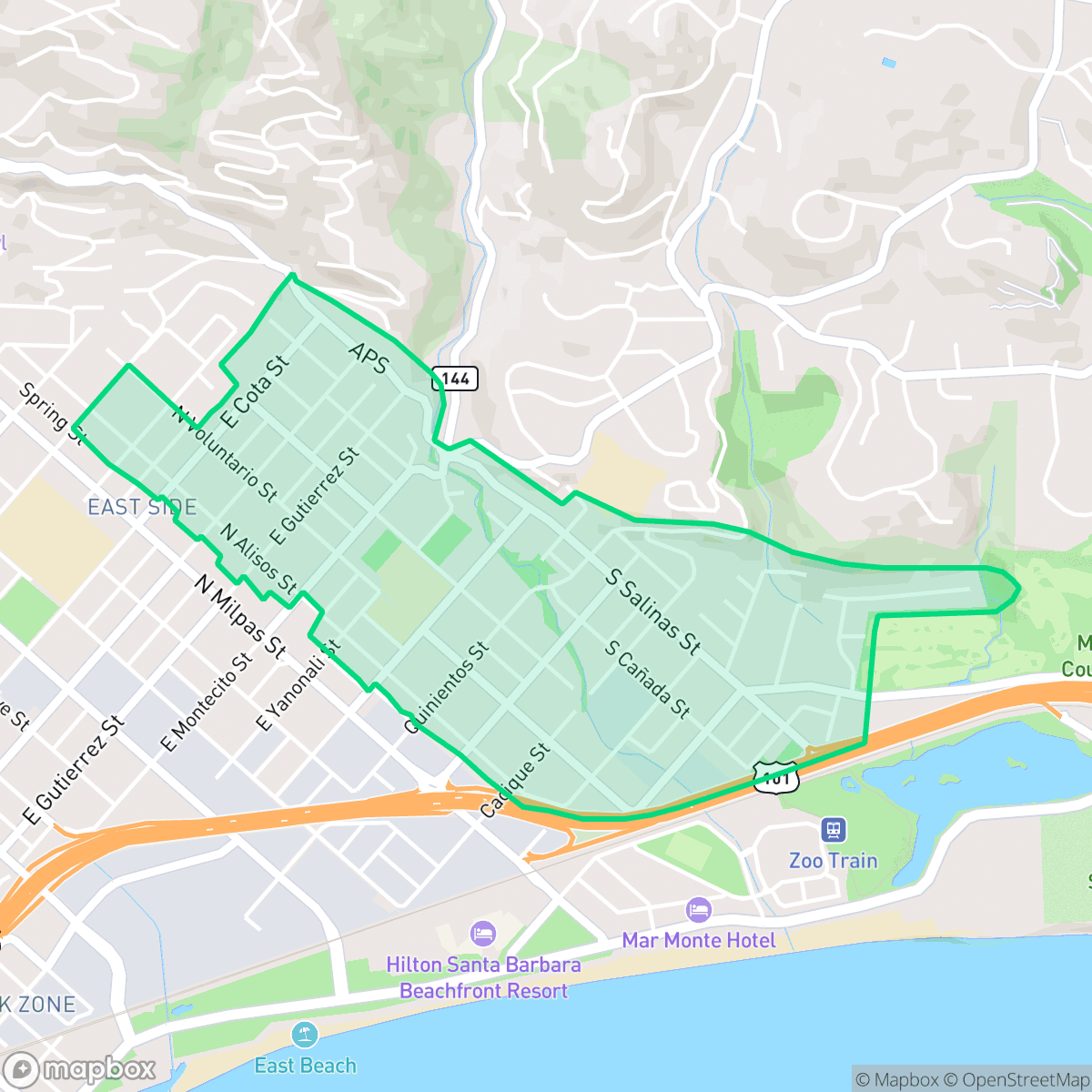
The Eastside is a culturally rich neighborhood defined by its historic Craftsman bungalows and the vibrant commercial corridor of Milpas Street. Residents enjoy a quiet, suburban atmosphere with a semi-rural canyon feel, though the area experiences noticeable noise from nearby transit and infrastructure.
Key Highlights
About Eastside
Santa Barbara’s Eastside, historically known as the 'barrio' or Pueblo Nuevo, emerged as a working-class enclave for Mexican laborers in the late 19th century, following the arrival of the railroad in 1887. Once a marshy area used as a city dump, the neighborhood underwent a significant transformation in the 1920s when the bog was reclaimed to create Ortega Park and Santa Barbara Junior High School. The area’s character is defined by the Milpas Street corridor, which evolved from early dairy and vegetable farms into a vibrant commercial hub. Architecturally, the neighborhood features a mix of early-20th-century wood-frame cottages and Craftsman bungalows. It holds deep cultural significance as a center for Chicano history, marked by landmarks like La Casa de la Raza and a long-standing tradition of lowrider culture and community activism.
The area offers a diverse residential landscape, ranging from dense, closely-packed blocks to expansive properties nestled in the hillside. It maintains a strong sense of community, characterized by a predominantly liberal demographic and a stable mix of families and professionals. While the neighborhood is largely free from industrial activity, its location near major transit arteries contributes to a consistent level of background noise. According to iHuus data, the neighborhood provides a unique blend of suburban pockets and woodland landscapes that feels distinct from the more urbanized parts of the city.
Prospective residents should note that the neighborhood faces significant environmental considerations, including a high risk for wildfires and an uncertain flood profile. While the area provides moderate walkability and access to local green spaces, it is best suited for those who prioritize a quiet, suburban lifestyle over high-density urban retail. Families with children will find themselves within the Santa Barbara Unified School District, which offers access to specialized academic programs despite ongoing district-wide transitions.
Neighborhood Scores Across 15 Qualities
Privacy levels fluctuate depending on your specific location, with closely packed central blocks offering less seclusion than the more spacious homes found in the hillside areas. According to iHuus data, overall privacy is roughly in line with the Santa Barbara average.
Sidewalks and crosswalks are common throughout much of the area, though a major highway can interrupt the street network. This level of walkability is slightly below the Santa Barbara city average.
Large estate-style homes and private pools are visible in the northern hills, though some areas consist of more standard suburban housing. This visual diversity is slightly below the Santa Barbara city average according to iHuus data.
Abundant residential greenery and proximity to large golf courses and ball fields provide ample space for pets. While this area is slightly below the city average for dog friendliness, the presence of canyon edges and wide paths offers safe routes away from traffic.
Winding roads and a high foliage to structure ratio create a semi-rural atmosphere that is slightly less developed than the Santa Barbara average. According to iHuus data, the area features a mix of dense suburban pockets and canyon landscapes with scattered homes amidst woodlands.
Residential streets and open green spaces provide a serene atmosphere, though local commercial activity is less concentrated than the city average. While notable dining spots and parks are accessible, the area features a lower density of walkable retail services compared to other Santa Barbara neighborhoods.
Frequent noise from nearby transit corridors and rail lines makes this area noisier than the Santa Barbara average. According to iHuus data, residents may experience regular disturbances from heavy traffic and infrastructure activity.
Air quality remains consistently high with minimal health concerns, matching the excellent standards found across Santa Barbara.
Industrial hazards and large warehouses are absent from this neighborhood, which consists primarily of residential and institutional land uses. This area is slightly more industrial-free than the Santa Barbara average, according to iHuus data.
Health insurance access among residents is relatively high, though slightly below the average for Santa Barbara. According to iHuus data, most members of the community have access to medical coverage.
Voting patterns and census indicators reflect a very strong liberal leaning, which is slightly more pronounced than the Santa Barbara city average according to iHuus data.
A varied demographic of young adults, families, and older residents characterizes this area, representing a distribution similar to the rest of Santa Barbara.
Flood risk in this area remains undetermined because FEMA has not completed a detailed study for this specific zone. According to iHuus data, the level of risk is slightly higher than the average for Santa Barbara.
Wildfire hazard levels in this area are critical; this risk is notably higher than the average for Santa Barbara. Residents should prepare for extreme fire safety precautions according to iHuus data.
Address-Level Insights for Eastside


iHuus Neighborhood Intelligence Insights
Get address-level neighborhood insights for Eastside
- Street-level scores — see how individual blocks compare, not just neighborhood averages
- Micro-zone boundaries — identify quiet pockets, flood boundaries, and walkable clusters before you visit
- 15 dimensions in full — walkability, noise, air quality, school quality, insurance coverage, population age profile, urban/rural index, and more
- Boundary risk alerts — know if your address sits near a block boundary where scores drop, the kind of detail no listing will ever mention
- School insights — individual school ratings and insights, not just district-level data
- Compare before you commit — side-by-side data across neighborhoods, down to block precision
No credit card required
Compare with Any Neighborhood
| Dimension | Eastside | Alta Mesa |
|---|---|---|
| 🚶 Walkabilityavg 8.12 | ||
| 🔊 Acoustic Comfortavg 3.7 | ||
| 🤫 Privacy Indexavg 5.66 | ||
| 🎨 Visual Appealavg 7.77 | ||
| 🐕 Dog Friendlinessavg 7.45 | ||
| 🗺️ Urban-Rural Indexavg 7.13 | ||
| ✨ Neighborhood Vibeavg 5.46 | ||
| 🏥 Health Insurance Coverageavg 6.92 | ||
| 🌿 Air Qualityavg 10 | ||
| 🏭 Industrial Proximityavg 9.73 | ||
| 🌊 Flood Safetyavg 3.72 | ||
| 🗳️ Ideological Leanavg 9.64 | ||
| 👥 Population Age Profileavg 5.23 | ||
| 🔥 Fire Safetyavg 0.32 | ||
| 🏫 School Quality |
Eastside Rankings
School Districts Serving Eastside
School Insights for Eastside
Below average outcomes; significant attendance and academic challenges.
School Insights
See what's really behind every school rating near Eastside
- Individual school ratings — each school's own score with outcome context, not just a district average
- Enrollment & class size data — student-to-teacher ratio and how it compares to the state average
- Full demographics breakdown — ethnicity and gender composition for every school in the enrollment zone
- Every school in the district — all schools within the enrollment boundary ranked by rating, not just the closest one
- Grade levels & benchmarks — elementary through high school, with below/above state-average flags
No credit card required