East San Roque, Santa Barbara
Updated · 2,500 residents
East San Roque is a tree-lined residential enclave in Santa Barbara known for its diverse architectural heritage and central Argonne Circle. Residents benefit from excellent air quality and access to local dining, though the area experiences moderate road traffic noise. According to iHuus data, the neighborhood offers a highly walkable, affluent environment with comprehensive health insurance coverage for its population.
Key Highlights
About East San Roque
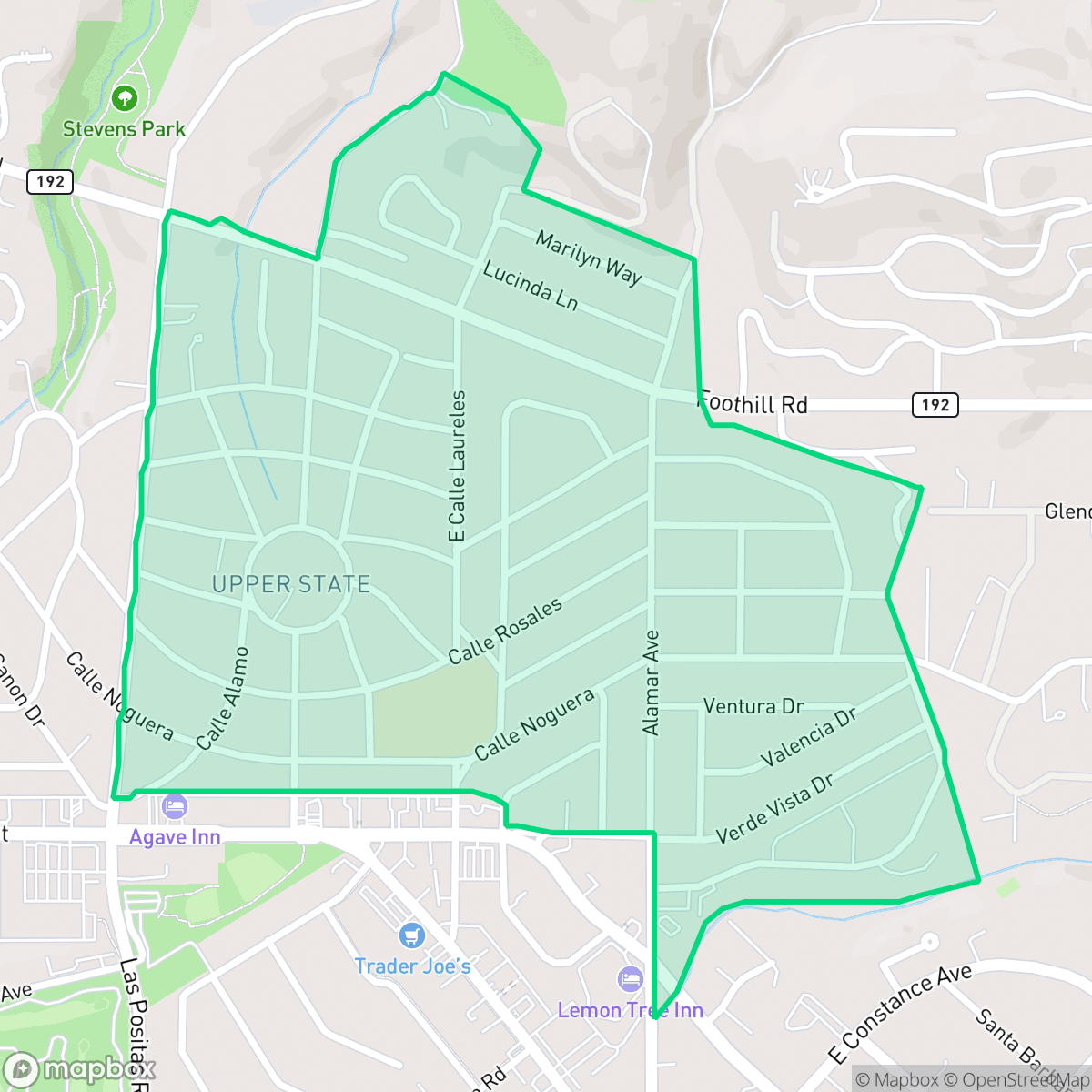
East San Roque is a historic residential neighborhood in Santa Barbara, California, whose modern development began in 1917 when Stephen Rutherford purchased 123 acres of the Dixie W. Thompson Ranch to establish Rutherford Park. This subdivision features streets radiating from Argonne Circle, a central hub named in honor of Rutherford's son, who died in World War I. While Spanish Colonial Revival architecture is highly prominent, Rutherford's Scottish heritage influenced a notable concentration of Tudor Revival homes alongside Craftsman and English Vernacular styles. Originally a rural farming area used for growing beans and hay, the neighborhood underwent a major housing boom between 1945 and 1970. Today, East San Roque is a highly preserved, tree-lined enclave defined by its distinct street layout, single-family homes, and multi-family residences along its southeastern boundary on Miradero Drive.
The area serves as a dense suburban hub characterized by well-manicured landscapes and custom homes. It maintains a lively atmosphere supported by local commercial clusters, including popular dining establishments like Petrini's Italian and Tiburon Tavern. The infrastructure supports a high level of walkability, providing residents with convenient access to neighborhood amenities while maintaining a cohesive, residential feel despite the proximity to busier thoroughfares.
Prospective residents should consider that while the neighborhood offers exceptional air quality and high health insurance coverage, it is subject to moderate noise levels from road traffic. The area is well-suited for those prioritizing a stable, established community with a mix of single-family homes and multi-family residences. While the local school district faces ongoing demographic and operational transitions, the presence of highly-rated options like Peabody Charter remains a significant draw for families. iHuus data indicates that the neighborhood maintains a balanced profile, blending suburban convenience with a distinct, historic identity.
Neighborhood Scores Across 15 Qualities
Detached homes feature moderate setbacks and private yards, providing slightly more separation between neighbors than the Santa Barbara average. Some areas contain multi-family units where buildings share walls or sit in closer proximity.
Pedestrian-friendly layouts and safe crossings connect residential blocks to nearby commercial strips, though the area is slightly less walkable than the Santa Barbara average according to iHuus data.
Large custom homes with complex rooflines and well-manicured landscaping define the area's aesthetic. This level of visual appeal is slightly higher than the Santa Barbara average, according to iHuus data.
Tree-lined streets, wide paths, and proximity to large forested areas and golf course greens provide more accessible walking space than the Santa Barbara average. According to iHuus data, the neighborhood offers safe, connected green spaces and trails that are well-suited for pet owners.
Residential areas feature a mix of single-family homes and low-rise apartments situated near large natural spaces. This balance of suburban density and nearby open land is consistent with the broader Santa Barbara area.
Local dining hubs and social anchors provide a noticeable energy that is higher than the Santa Barbara average. While some sections offer a quiet residential rhythm, many streets feature a steady concentration of cafes and eateries according to iHuus data.
Frequent noise from nearby transit corridors and rail lines is common in this area. According to iHuus data, acoustic levels are slightly higher than the city average.
Air quality remains consistently excellent with minimal health concerns. According to iHuus data, these levels are on par with the rest of Santa Barbara.
Industrial activity is non-existent in this area, as the landscape consists solely of residential, light commercial, and recreational spaces. This lack of warehouses or heavy industrial facilities is even more pronounced here than in the rest of Santa Barbara.
Health insurance enrollment is exceptionally high among residents, significantly surpassing the average for Santa Barbara. According to iHuus data, nearly all inhabitants of this area maintain active coverage.
Voting patterns and census indicators in East San Roque reflect a deeply liberal leaning that is slightly more pronounced than the Santa Barbara city average.
Residents live among a diverse range of age groups, from young adults to seniors. According to iHuus data, this area features a more balanced age distribution than the Santa Barbara average.
Flood risk in this area is higher than the Santa Barbara average, though specific risk levels remain undetermined because detailed FEMA studies for this zone are not yet complete.
Elevated wildfire hazards exist throughout this area, representing a significantly higher risk level than the Santa Barbara average. Residents should prioritize enhanced fire mitigation and preparedness measures.
Address-Level Insights for East San Roque


iHuus Neighborhood Intelligence Insights
Get address-level neighborhood insights for East San Roque
- Street-level scores — see how individual blocks compare, not just neighborhood averages
- Micro-zone boundaries — identify quiet pockets, flood boundaries, and walkable clusters before you visit
- 15 dimensions in full — walkability, noise, air quality, school quality, insurance coverage, population age profile, urban/rural index, and more
- Boundary risk alerts — know if your address sits near a block boundary where scores drop, the kind of detail no listing will ever mention
- School insights — individual school ratings and insights, not just district-level data
- Compare before you commit — side-by-side data across neighborhoods, down to block precision
No credit card required
Compare with Any Neighborhood
| Dimension | East San Roque | Alta Mesa |
|---|---|---|
| 🚶 Walkabilityavg 8.12 | ||
| 🔊 Acoustic Comfortavg 3.7 | ||
| 🤫 Privacy Indexavg 5.66 | ||
| 🎨 Visual Appealavg 7.77 | ||
| 🐕 Dog Friendlinessavg 7.45 | ||
| 🗺️ Urban-Rural Indexavg 7.13 | ||
| ✨ Neighborhood Vibeavg 5.46 | ||
| 🏥 Health Insurance Coverageavg 6.92 | ||
| 🌿 Air Qualityavg 10 | ||
| 🏭 Industrial Proximityavg 9.73 | ||
| 🌊 Flood Safetyavg 3.72 | ||
| 🗳️ Ideological Leanavg 9.64 | ||
| 👥 Population Age Profileavg 5.23 | ||
| 🔥 Fire Safetyavg 0.32 | ||
| 🏫 School Quality |
East San Roque Rankings
School Districts Serving East San Roque
School Insights for East San Roque
Below average outcomes; significant attendance and academic challenges.
School Insights
See what's really behind every school rating near East San Roque
- Individual school ratings — each school's own score with outcome context, not just a district average
- Enrollment & class size data — student-to-teacher ratio and how it compares to the state average
- Full demographics breakdown — ethnicity and gender composition for every school in the enrollment zone
- Every school in the district — all schools within the enrollment boundary ranked by rating, not just the closest one
- Grade levels & benchmarks — elementary through high school, with below/above state-average flags
No credit card required