East Mesa, Santa Barbara
Updated · 3,616 residents
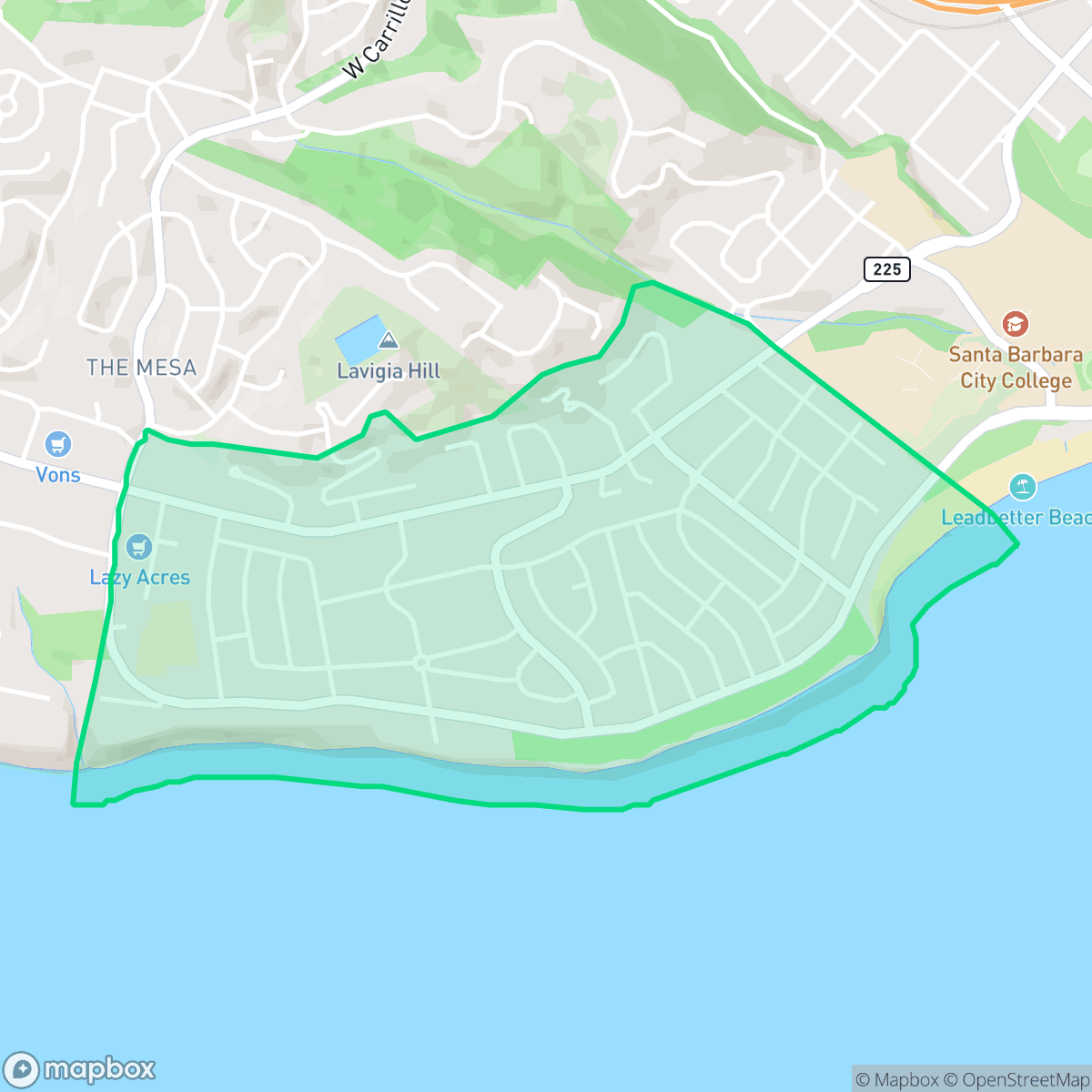
East Mesa is a serene coastal neighborhood defined by its proximity to Shoreline Park and Leadbetter Beach. The area features a mix of mid-century cottages and modern estates, offering a quiet residential atmosphere with exceptional air quality and no industrial activity. While the neighborhood provides a peaceful environment, it maintains a moderate level of walkability to local cafes and lifestyle businesses.
Key Highlights
About East Mesa
East Mesa, a coastal neighborhood in Santa Barbara, California, transitioned from 19th-century agricultural land to a bustling oil field in 1929. The Mesa Oil Field transformed the area with wooden derricks, attracting high-profile speculators like European Prince David Mdivani. Following the decline of the oil boom and a post-World War II housing shortage, East Mesa was revitalized in the early 1950s with the construction of Marine Terrace. This landmark subdivision initially featured modest tract homes built for returning servicemen. In 1954, Santa Barbara City College was established on the former Leadbetter estate within East Mesa. Today, the neighborhood is a highly sought-after coastal enclave characterized by an eclectic mix of mid-century cottages and modern estates, bordered by the scenic Shoreline Park and Leadbetter Beach.
Located along the Santa Barbara coastline, this area serves as a quiet residential enclave characterized by well-manicured landscaping and large coastal properties. The neighborhood benefits from excellent air quality and a complete absence of industrial hazards, contributing to its reputation as a stable and clean living environment. According to iHuus data, the area maintains a consistent visual appeal, blending older residential architecture with modern estate design. Residents enjoy easy access to expansive green spaces like Shoreline Park, which serves as a primary hub for outdoor recreation and dog walking.
Prospective residents should note that the neighborhood prioritizes residential tranquility over high-energy commercial activity, resulting in a lower level of daily livability for those seeking a vibrant nightlife. While the area is generally quiet, road traffic contributes to a moderate noise level, and the region faces significant challenges regarding flood and fire safety. The local school district, managed by Santa Barbara Unified, is currently navigating demographic transitions and achievement gaps, which may be a consideration for families. Overall, the area is best suited for individuals or families who value coastal access, environmental quality, and a suburban pace of life.
Neighborhood Scores Across 15 Qualities
Residential spacing provides a modest buffer between homes, offering slightly more privacy than the typical Santa Barbara neighborhood. According to iHuus data, the suburban density features small yards that maintain a balance between closeness and separation.
Residential street grids offer safe pedestrian access with continuous sidewalks and low traffic. This level of walkability is slightly below the Santa Barbara city average.
Manicured landscapes and large coastal properties define this area. According to iHuus data, the visual quality of the neighborhood sits above the Santa Barbara average due to frequent private pools and well-maintained amenities.
Extensive walking space is available via nearby Shoreline Park and coastal green spaces. According to iHuus data, the area offers access to wide, safe paths that are comparable to the rest of Santa Barbara.
Residential patterns here consist of dense suburban layouts with single-family homes and multi-unit complexes. This landscape is slightly less open than the typical Santa Barbara area.
Residential streets and green spaces offer a serene atmosphere with a moderate mix of local dining and lifestyle businesses. This area provides a more tranquil rhythm than the typical Santa Barbara neighborhood, characterized by pockets of activity interspersed with calm, low-density blocks.
Steady noise from nearby busy streets is common here, though acoustic levels are notably calmer than the city average according to iHuus data.
Air quality in this area is consistently high, matching the typical levels found throughout Santa Barbara. Residents can expect clean, healthy air with very little environmental concern according to iHuus data.
No warehouses, industrial facilities, or known hazard sites are present within the neighborhood. This area maintains a higher level of residential purity than the Santa Barbara average, consisting only of residential and light commercial uses.
Health insurance enrollment among residents is notably higher than the Santa Barbara average, according to iHuus data.
Voting patterns and census indicators show a very high concentration of liberal-leaning residents, which is closely aligned with the broader Santa Barbara area.
Residents live alongside a diverse range of age groups, including young adults, families, and older individuals. This demographic spread is roughly in line with the average seen across Santa Barbara.
Properties in this area are situated within a 100-year floodplain, meaning residents may face a significantly higher risk of flooding than the Santa Barbara average. According to iHuus data, flood insurance is typically required for homes in this neighborhood.
Address-Level Insights for East Mesa


iHuus Neighborhood Intelligence Insights
Get address-level neighborhood insights for East Mesa
- Street-level scores — see how individual blocks compare, not just neighborhood averages
- Micro-zone boundaries — identify quiet pockets, flood boundaries, and walkable clusters before you visit
- 15 dimensions in full — walkability, noise, air quality, school quality, insurance coverage, population age profile, urban/rural index, and more
- Boundary risk alerts — know if your address sits near a block boundary where scores drop, the kind of detail no listing will ever mention
- School insights — individual school ratings and insights, not just district-level data
- Compare before you commit — side-by-side data across neighborhoods, down to block precision
No credit card required
Compare with Any Neighborhood
| Dimension | East Mesa | Alta Mesa |
|---|---|---|
| 🚶 Walkabilityavg 8.12 | ||
| 🔊 Acoustic Comfortavg 3.7 | ||
| 🤫 Privacy Indexavg 5.66 | ||
| 🎨 Visual Appealavg 7.77 | ||
| 🐕 Dog Friendlinessavg 7.45 | ||
| 🗺️ Urban-Rural Indexavg 7.13 | ||
| ✨ Neighborhood Vibeavg 5.46 | ||
| 🏥 Health Insurance Coverageavg 6.92 | ||
| 🌿 Air Qualityavg 10 | ||
| 🏭 Industrial Proximityavg 9.73 | ||
| 🌊 Flood Safetyavg 3.72 | ||
| 🗳️ Ideological Leanavg 9.64 | ||
| 👥 Population Age Profileavg 5.23 | ||
| 🔥 Fire Safetyavg 0.32 | ||
| 🏫 School Quality |
East Mesa Rankings
School Districts Serving East Mesa
School Insights for East Mesa
Below average outcomes; significant attendance and academic challenges.
School Insights
See what's really behind every school rating near East Mesa
- Individual school ratings — each school's own score with outcome context, not just a district average
- Enrollment & class size data — student-to-teacher ratio and how it compares to the state average
- Full demographics breakdown — ethnicity and gender composition for every school in the enrollment zone
- Every school in the district — all schools within the enrollment boundary ranked by rating, not just the closest one
- Grade levels & benchmarks — elementary through high school, with below/above state-average flags
No credit card required