East Beach, Santa Barbara
Updated · 1,968 residents
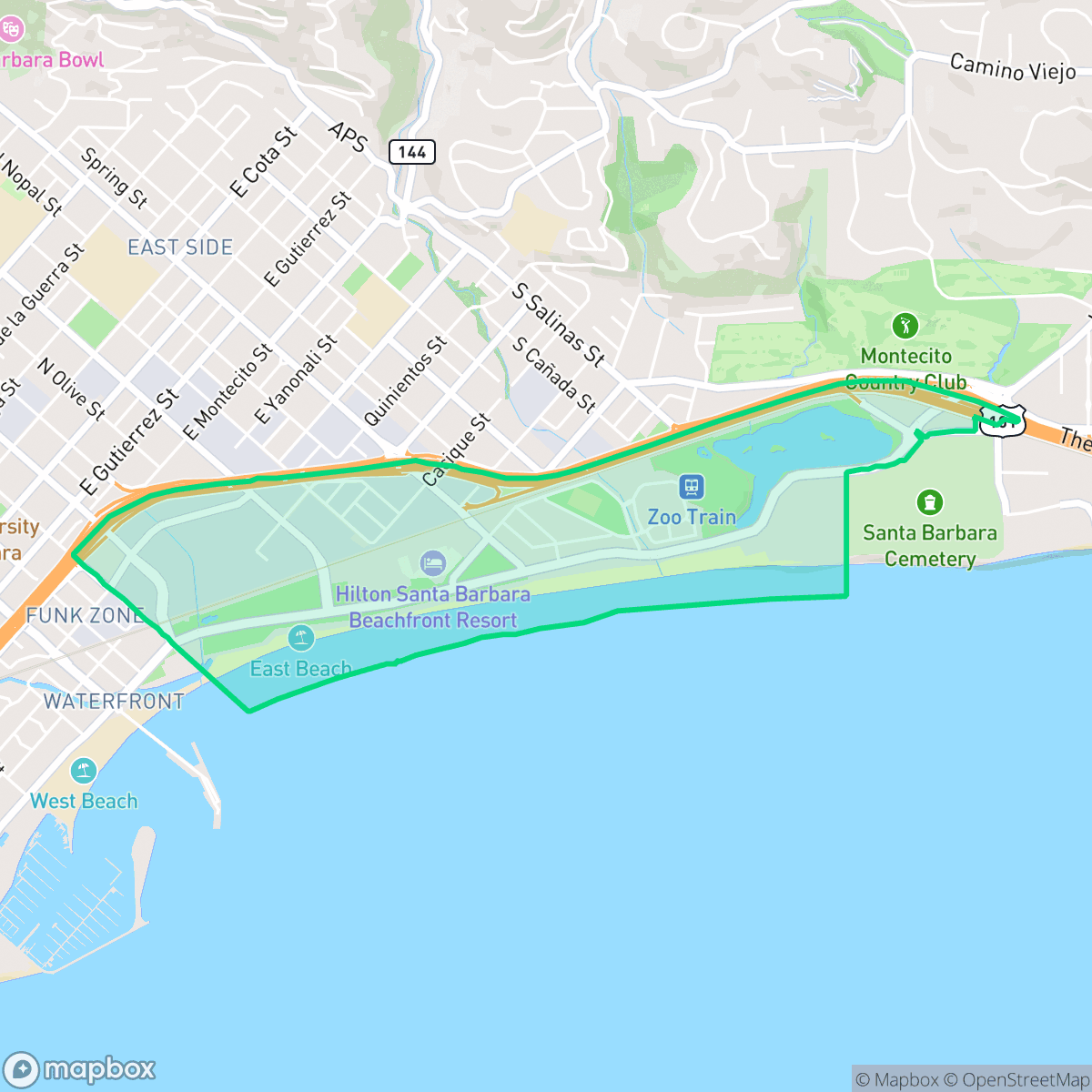
East Beach is a coastal neighborhood defined by its high walkability and immediate access to the Pacific shoreline. While the area offers exceptional air quality and dog-friendly spaces, it experiences significant noise from road traffic and faces notable challenges regarding flood and fire safety.
Key Highlights
About East Beach
Santa Barbara’s East Beach emerged as a destination for health-seekers in the 1870s. In 1891, Mayor Peter Barber championed a bond measure to beautify the waterfront, establishing the iconic, palm-lined Cabrillo Boulevard. The neighborhood’s historic character is anchored by Stearns Wharf (1872) and the Spanish-style Cabrillo Pavilion Bathhouse, built in 1926 to revitalize the community following the devastating 1925 earthquake. Preservationist Pearl Chase later helped establish Chase Palm Park in 1931. Historically, the area also hosted a Southern Pacific Railway Roundhouse, which operated from 1926 to 1961 before its 1982 demolition. Today, East Beach is defined by its active recreation, world-famous beach volleyball courts, and the weekly Santa Barbara Arts and Crafts Show, which has lined the waterfront every Sunday since the mid-20th century.
The area serves as a blend of residential streets, light commercial infrastructure, and expansive green spaces. It maintains a strong visual appeal, characterized by its coastal setting and proximity to landmarks like Chase Palm Park. Residents benefit from high rates of health insurance coverage and a community environment that aligns with the broader ideological trends of Santa Barbara. The neighborhood functions as a transition zone between the active waterfront and more quiet, suburban pockets, providing a distinct atmosphere compared to the more commercial downtown districts.
Prospective residents should weigh the benefits of a highly walkable, scenic environment against specific livability trade-offs. Acoustic comfort is notably low due to consistent road traffic noise, and the presence of industrial infrastructure, including a wastewater treatment facility, is a factor in the local landscape. According to iHuus data, the area requires careful consideration regarding environmental risks, as flood and fire safety scores are significantly below city averages. This neighborhood is best suited for those who prioritize outdoor access and coastal proximity over absolute quiet or environmental hazard mitigation.
Neighborhood Scores Across 15 Qualities
Residential spacing is roughly in line with the city average, though some central blocks feature closely packed houses with limited buffers between neighbors.
Pedestrian access is supported by a dense grid of residential streets and sidewalks, though navigation is occasionally hindered by the presence of a major highway. While sidewalk connectivity remains strong, walkability levels are slightly lower than the city average due to this highway severance.
Residential views consist primarily of standard suburban housing and mobile home parks. This area offers less visual variety and fewer luxury amenities than the Santa Barbara average, according to iHuus data.
Proximity to large golf courses and baseball fields provides ample space for exercise, though public park access is somewhat limited compared to the city average. Most greenery in this area is contained within private backyards, and some sidewalks feature narrow verges.
Dense suburban coastal development characterizes this area, featuring a blend of single-family homes and multi-unit housing that is slightly less open than the Santa Barbara average. According to iHuus data, the landscape includes significant industrial, light commercial, and active recreational zones interspersed with residential clusters.
Low-density residential streets and coastal green spaces offer a subdued atmosphere that is less active than the Santa Barbara average. While local dining and small galleries provide a steady rhythm, the area remains primarily characterized by quiet, suburban pockets near major transit corridors.
Frequent noise from nearby railroad tracks and heavy freeway traffic makes this area significantly louder than the Santa Barbara average. Residents may experience consistent auditory disturbances throughout the day according to iHuus data.
Air quality is consistently excellent with very little risk to respiratory health. This level of air purity is on par with the rest of Santa Barbara.
Industrial presence is minimal throughout the neighborhood, though a wastewater treatment plant is visible nearby. According to iHuus data, the area contains slightly more industrial-related infrastructure than the Santa Barbara average.
Health insurance coverage among residents is relatively high, though it sits slightly below the Santa Barbara city average according to iHuus data.
Voting patterns and census indicators show a very high concentration of liberal-leaning residents, which is consistent with the broader Santa Barbara area according to iHuus data.
A balanced demographic of young adults, families, and seniors characterizes this area. According to iHuus data, this age distribution is largely consistent with the broader Santa Barbara population.
Flood risk levels in this area remain undetermined because a detailed study has not yet been completed for this specific zone. According to iHuus data, the potential for flooding is slightly higher than the average found across Santa Barbara.
Address-Level Insights for East Beach


iHuus Neighborhood Intelligence Insights
Get address-level neighborhood insights for East Beach
- Street-level scores — see how individual blocks compare, not just neighborhood averages
- Micro-zone boundaries — identify quiet pockets, flood boundaries, and walkable clusters before you visit
- 15 dimensions in full — walkability, noise, air quality, school quality, insurance coverage, population age profile, urban/rural index, and more
- Boundary risk alerts — know if your address sits near a block boundary where scores drop, the kind of detail no listing will ever mention
- School insights — individual school ratings and insights, not just district-level data
- Compare before you commit — side-by-side data across neighborhoods, down to block precision
No credit card required
Compare with Any Neighborhood
| Dimension | East Beach | Alta Mesa |
|---|---|---|
| 🚶 Walkabilityavg 8.12 | ||
| 🔊 Acoustic Comfortavg 3.7 | ||
| 🤫 Privacy Indexavg 5.66 | ||
| 🎨 Visual Appealavg 7.77 | ||
| 🐕 Dog Friendlinessavg 7.45 | ||
| 🗺️ Urban-Rural Indexavg 7.13 | ||
| ✨ Neighborhood Vibeavg 5.46 | ||
| 🏥 Health Insurance Coverageavg 6.92 | ||
| 🌿 Air Qualityavg 10 | ||
| 🏭 Industrial Proximityavg 9.73 | ||
| 🌊 Flood Safetyavg 3.72 | ||
| 🗳️ Ideological Leanavg 9.64 | ||
| 👥 Population Age Profileavg 5.23 | ||
| 🔥 Fire Safetyavg 0.32 | ||
| 🏫 School Quality |
East Beach Rankings
School Districts Serving East Beach
School Insights for East Beach
Below average outcomes; significant attendance and academic challenges.
School Insights
See what's really behind every school rating near East Beach
- Individual school ratings — each school's own score with outcome context, not just a district average
- Enrollment & class size data — student-to-teacher ratio and how it compares to the state average
- Full demographics breakdown — ethnicity and gender composition for every school in the enrollment zone
- Every school in the district — all schools within the enrollment boundary ranked by rating, not just the closest one
- Grade levels & benchmarks — elementary through high school, with below/above state-average flags
No credit card required