Downtown, Santa Barbara
Updated · 2,206 residents
Downtown Santa Barbara serves as the city's vibrant urban core, defined by its exceptional walkability and active pedestrian promenade along State Street. Residents benefit from a high density of dining and cultural amenities in a setting characterized by clean air and a strong sense of community.
Key Highlights
About Downtown
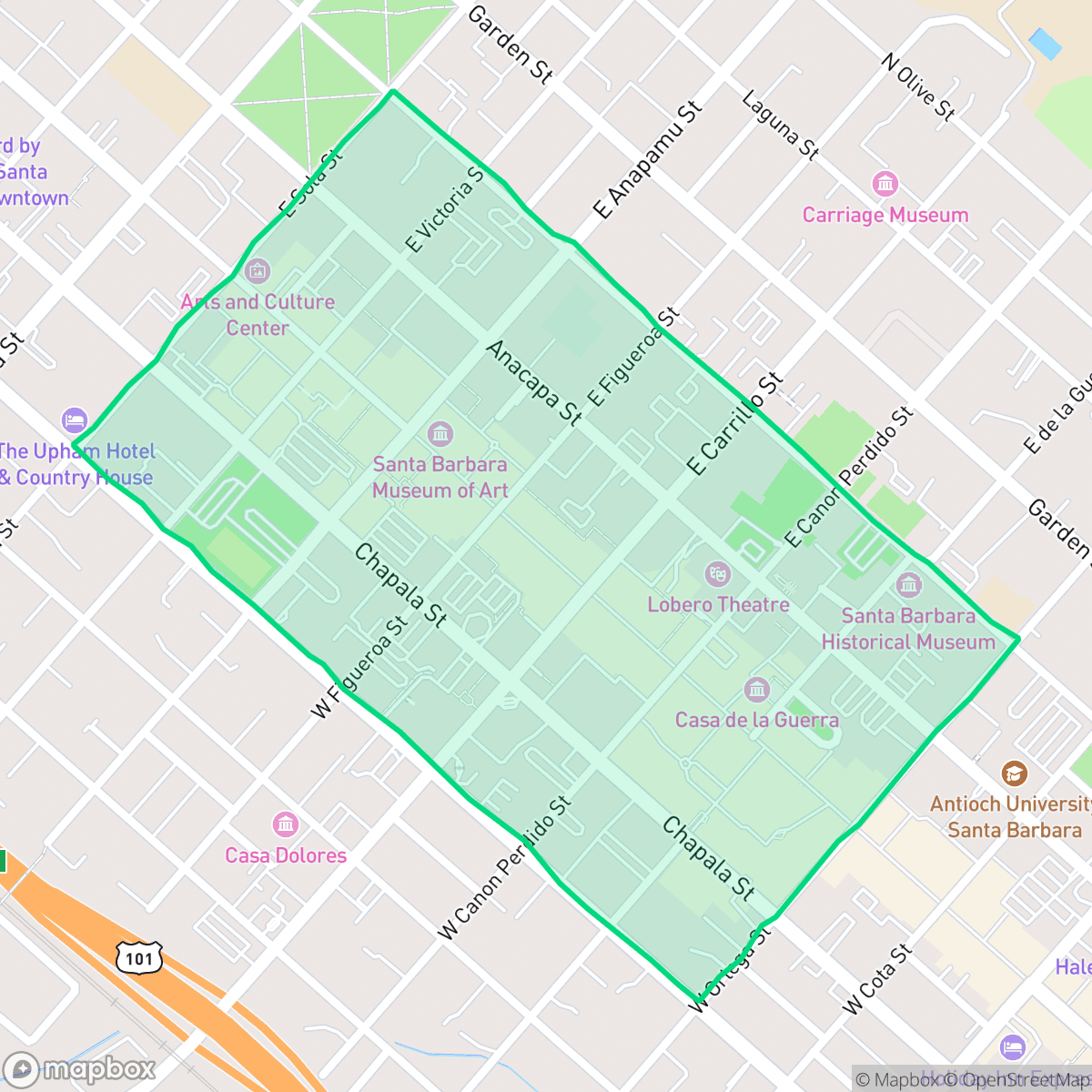
Downtown Santa Barbara is defined by its distinct Spanish Colonial Revival architecture, a stylistic mandate adopted following the devastating 1925 earthquake. This aesthetic, characterized by white stucco walls and red-tiled roofs, unifies the neighborhood's historic core. The area centers on State Street, a primary commercial artery that has evolved from a dusty thoroughfare into a pedestrian-focused promenade. Significant landmarks include the Santa Barbara County Courthouse, renowned for its sunken gardens and panoramic tower views, and El Presidio de Santa Bárbara State Historic Park, which marks the site of the city's 1782 founding. These sites anchor the neighborhood's identity, preserving the legacy of the city's Spanish and Mexican colonial roots while anchoring the modern civic and cultural life of the region.
The neighborhood functions as the primary commercial and cultural hub of the region, offering residents immediate access to diverse culinary experiences and local institutions. The area maintains a high level of air quality and a complete absence of industrial facilities, which contributes to a polished and upscale atmosphere. With a grid of wide sidewalks and high-visibility crossings, the area is exceptionally accessible for those who prefer to navigate without a vehicle.
While the neighborhood offers a convenient lifestyle, prospective residents should consider specific trade-offs. According to iHuus data, the urban density results in limited privacy between homes and a moderate level of traffic noise from surrounding streets. Additionally, the area faces an elevated risk of flooding compared to other parts of the city, and pet owners may find that the dense urban environment offers fewer accessible green spaces for daily walks. This location is best suited for individuals who prioritize proximity to city services and a high-energy environment over suburban seclusion.
Neighborhood Scores Across 15 Qualities
Buildings are often positioned close to one another with minimal distance between neighbors. This level of density is slightly higher than the Santa Barbara average, according to iHuus data.
Pedestrian navigation is exceptionally easy due to a dense grid of wide sidewalks and high-visibility crosswalks. This level of accessibility is significantly higher than the Santa Barbara city average, making most local errands achievable on foot.
Manicured yards, large homes, and luxury amenities like private pools create a highly aesthetic environment. This visual quality remains slightly above the city average according to iHuus data.
Limited wide grass verges and dense urban greenery make pet walking less convenient than in other parts of the city. While large nearby parks and athletic fields offer some space, much of the neighborhood's greenery is contained behind private fences.
Dense low-rise buildings and commercial structures characterize this area, which is notably more urban than the Santa Barbara average. According to iHuus data, the landscape features a significant mix of multi-story buildings and an established green canopy.
Diverse dining options and local landmarks create a much more active atmosphere than the typical Santa Barbara neighborhood. Residents can access a wide variety of cafes and restaurants, including Arigato Sushi and Azul Cocina Artesanal, within a high-energy environment.
Steady traffic noise from busy local streets is present; however, acoustic levels remain notably higher than the Santa Barbara city average according to iHuus data.
Air quality remains consistently high with minimal health concerns. This level of air purity is on par with the rest of Santa Barbara.
Industrial facilities, warehouses, and manufacturing hazards are entirely absent from this area. According to iHuus data, the neighborhood maintains a cleaner zoning profile than the Santa Barbara average, consisting only of residential, commercial, and recreational zones.
Health insurance access is significantly higher than the Santa Barbara city average, with nearly all residents possessing coverage according to iHuus data.
Voting patterns and census indicators show a very strong liberal leaning that is even more pronounced than the Santa Barbara city average.
Residents live alongside a balanced mix of young professionals, families, and seniors. This demographic spread is largely consistent with the broader Santa Barbara area, according to iHuus data.
Significant flood risk exists because parts of this area fall within a designated floodplain. According to iHuus data, this risk level is higher than the average for Santa Barbara.
Address-Level Insights for Downtown


iHuus Neighborhood Intelligence Insights
Get address-level neighborhood insights for Downtown
- Street-level scores — see how individual blocks compare, not just neighborhood averages
- Micro-zone boundaries — identify quiet pockets, flood boundaries, and walkable clusters before you visit
- 15 dimensions in full — walkability, noise, air quality, school quality, insurance coverage, population age profile, urban/rural index, and more
- Boundary risk alerts — know if your address sits near a block boundary where scores drop, the kind of detail no listing will ever mention
- School insights — individual school ratings and insights, not just district-level data
- Compare before you commit — side-by-side data across neighborhoods, down to block precision
No credit card required
Compare with Any Neighborhood
| Dimension | Downtown | Alta Mesa |
|---|---|---|
| 🚶 Walkabilityavg 8.12 | ||
| 🔊 Acoustic Comfortavg 3.7 | ||
| 🤫 Privacy Indexavg 5.66 | ||
| 🎨 Visual Appealavg 7.77 | ||
| 🐕 Dog Friendlinessavg 7.45 | ||
| 🗺️ Urban-Rural Indexavg 7.13 | ||
| ✨ Neighborhood Vibeavg 5.46 | ||
| 🏥 Health Insurance Coverageavg 6.92 | ||
| 🌿 Air Qualityavg 10 | ||
| 🏭 Industrial Proximityavg 9.73 | ||
| 🌊 Flood Safetyavg 3.72 | ||
| 🗳️ Ideological Leanavg 9.64 | ||
| 👥 Population Age Profileavg 5.23 | ||
| 🔥 Fire Safetyavg 0.32 | ||
| 🏫 School Quality |
Downtown Rankings
School Districts Serving Downtown
School Insights for Downtown
Below average outcomes; significant attendance and academic challenges.
School Insights
See what's really behind every school rating near Downtown
- Individual school ratings — each school's own score with outcome context, not just a district average
- Enrollment & class size data — student-to-teacher ratio and how it compares to the state average
- Full demographics breakdown — ethnicity and gender composition for every school in the enrollment zone
- Every school in the district — all schools within the enrollment boundary ranked by rating, not just the closest one
- Grade levels & benchmarks — elementary through high school, with below/above state-average flags
No credit card required