Willard, Santa Ana
Updated · 4,824 residents
Willard is a highly walkable urban neighborhood in Santa Ana characterized by its dense residential layout and vibrant, lively atmosphere. While residents benefit from excellent pedestrian access and high air quality, the area features limited private outdoor space and significant ambient noise from nearby road traffic.
Key Highlights
About Willard
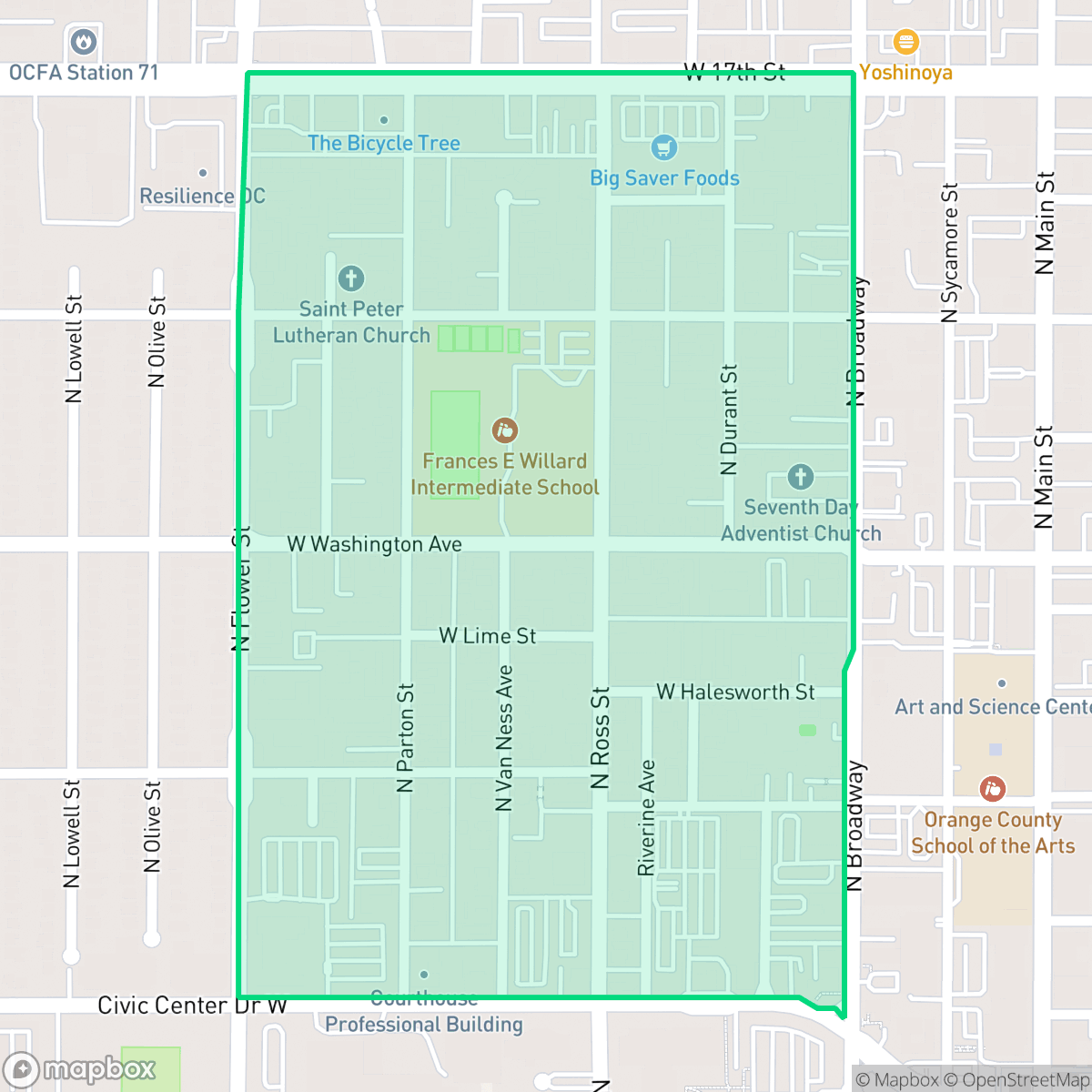
Located just north of Downtown Santa Ana, the Willard neighborhood grew significantly during the mid-20th century, resulting in an architectural landscape that transitions from early Craftsman homes to mid-century suburban, pueblo-inspired, and Mediterranean-style designs. The neighborhood is anchored by Willard Intermediate School, which opened in 1912 and was renamed in 1922 to honor suffragist and temperance reformer Frances E. Willard. The school’s grounds occupy the former estate of horticulturalist George W. Ford, who famously planted a historic Moreton Bay Fig tree on the property. Today, Willard is characterized by a dense, walkable layout and strong community activism. This local advocacy culminated in 2024 with the installation of Santa Ana’s first-ever mural crosswalk at 15th and Ross Streets, designed to enhance pedestrian safety while celebrating the neighborhood's vibrant cultural identity.
The area functions as a dense, urban residential hub that prioritizes pedestrian connectivity. According to iHuus data, the neighborhood achieves a perfect walkability score, allowing residents to easily navigate local commercial blocks and dining options like El Gran Sabor and Norms. The community maintains a lively, active vibe that contrasts with its compact, boxy residential architecture and high-density housing units.
Prospective residents should note that the high density results in limited privacy and minimal access to public green space for pets. The environment is notably loud due to consistent road traffic, and the local school performance remains a point of consideration, with significant variance between institutions like El Sol and other district schools. Additionally, the neighborhood faces challenges regarding health insurance coverage rates and lacks significant flood or fire mitigation infrastructure, making it a location best suited for those who prioritize urban accessibility over quiet suburban seclusion.
Neighborhood Scores Across 15 Qualities
Close proximity between structures and minimal setbacks create a sense of density that is more compressed than the Santa Ana average. According to iHuus data, many residential properties feature narrow separation between homes or shared walls.
Extensive sidewalk networks and well-marked pedestrian crossings make navigating the area on foot very easy. According to iHuus data, the infrastructure here provides superior pedestrian access compared to the rest of Santa Ana.
Standard tract housing and high-density apartment complexes define the area, offering a visual profile that is slightly below the Santa Ana average. Residential lots are closely spaced with minimal yard space, though some properties feature backyard pools.
Public green space and accessible parkland are relatively scarce in this area. According to iHuus data, the neighborhood offers fewer opportunities for off-leash activity compared to the Santa Ana average.
A blend of single-family homes and denser apartment complexes defines the landscape, which is slightly more developed than the Santa Ana average. According to iHuus data, the area features a mix of residential density and institutional spaces rather than expansive open land.
Frequent access to diverse local eateries and social destinations makes this area significantly more active than the Santa Ana average. According to iHuus data, the neighborhood features a dense concentration of restaurants and galleries situated along lively suburban streets.
Frequent noise from nearby railroad tracks and heavy freeway traffic impacts the area. According to iHuus data, acoustic levels are slightly higher than the Santa Ana average.
Air quality is consistently good with rare instances of elevated readings. This level of air cleanliness is higher than the Santa Ana average, according to iHuus data.
Industrial activity and heavy warehouses are absent from this area, making it significantly more residential than the Santa Ana average. According to iHuus data, the landscape consists strictly of residential, commercial, and civic uses with no detectable industrial hazards.
Health insurance access is notably lower in Willard compared to the Santa Ana average. According to iHuus data, a small portion of the resident population maintains active health coverage.
Voting patterns and census indicators show a predominantly liberal political leaning, which is more pronounced here than in the rest of Santa Ana according to iHuus data.
Residents live in a community with a diverse age distribution, featuring a comparable spread of young adults, families, and seniors to the rest of Santa Ana. According to iHuus data, no single age group significantly dominates the local population.
Address-Level Insights for Willard


iHuus Neighborhood Intelligence Insights
Get address-level neighborhood insights for Willard
- Street-level scores — see how individual blocks compare, not just neighborhood averages
- Micro-zone boundaries — identify quiet pockets, flood boundaries, and walkable clusters before you visit
- 15 dimensions in full — walkability, noise, air quality, school quality, insurance coverage, population age profile, urban/rural index, and more
- Boundary risk alerts — know if your address sits near a block boundary where scores drop, the kind of detail no listing will ever mention
- School insights — individual school ratings and insights, not just district-level data
- Compare before you commit — side-by-side data across neighborhoods, down to block precision
No credit card required
Compare with Any Neighborhood
| Dimension | Willard | Artesia Pilar |
|---|---|---|
| 🚶 Walkabilityavg 9.05 | ||
| 🔊 Acoustic Comfortavg 2.11 | ||
| 🤫 Privacy Indexavg 4.2 | ||
| 🎨 Visual Appealavg 6.18 | ||
| 🐕 Dog Friendlinessavg 5.61 | ||
| 🗺️ Urban-Rural Indexavg 6.4 | ||
| ✨ Neighborhood Vibeavg 4.4 | ||
| 🏥 Health Insurance Coverageavg 5.33 | ||
| 🌿 Air Qualityavg 7.05 | ||
| 🏭 Industrial Proximityavg 8.16 | ||
| 🌊 Flood Safetyavg 3.08 | ||
| 🗳️ Ideological Leanavg 8.63 | ||
| 👥 Population Age Profileavg 4.55 | ||
| 🔥 Fire Safety | ||
| 🏫 School Quality |
Willard Rankings
School Districts Serving Willard
School Insights for Willard
Below average outcomes; significant attendance and academic challenges.
School Insights
See what's really behind every school rating near Willard
- Individual school ratings — each school's own score with outcome context, not just a district average
- Enrollment & class size data — student-to-teacher ratio and how it compares to the state average
- Full demographics breakdown — ethnicity and gender composition for every school in the enrollment zone
- Every school in the district — all schools within the enrollment boundary ranked by rating, not just the closest one
- Grade levels & benchmarks — elementary through high school, with below/above state-average flags
No credit card required