Washington Square, Santa Ana
Updated · 5,430 residents
Washington Square is a highly walkable neighborhood in Santa Ana characterized by its dense, historic residential streets and a vibrant, diverse food scene. Residents benefit from excellent air quality and a lack of industrial proximity, though the area is notably busy with road traffic and features tightly packed housing.
Key Highlights
About Washington Square
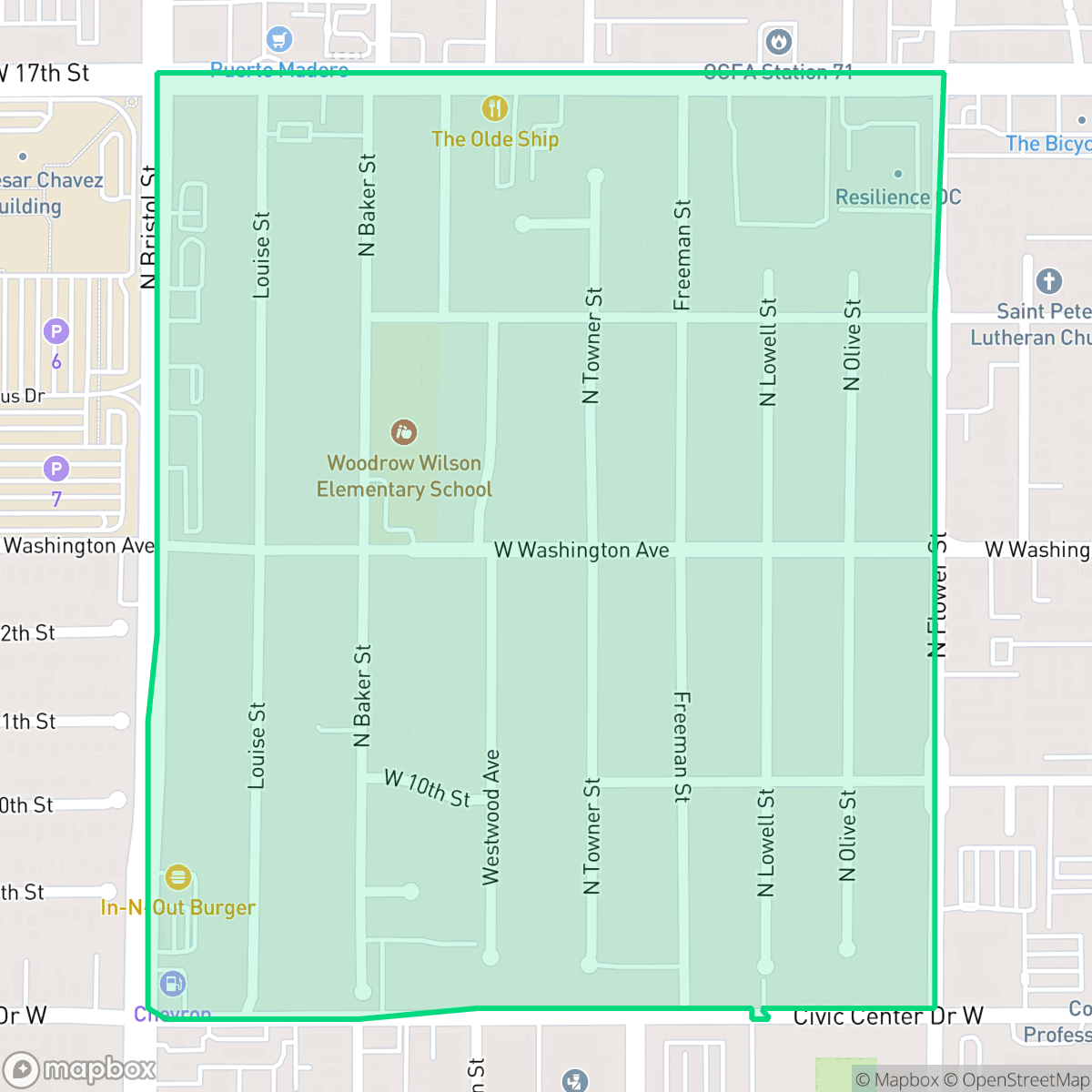
Located northwest of downtown Santa Ana, California, the historic Washington Square neighborhood was developed primarily between 1925 and 1950. During the 1930s, local contractor Emmett Rogers constructed many of the neighborhood’s homes, utilizing standard plans with customized details. The area features a rich variety of architectural styles, including Spanish Revival, Tudor Revival, Craftsman, and classic bungalows. In 1985, residents successfully organized to oppose a high-density development project, leading to the formation of the Washington Square Neighborhood Association (WSNA)—one of Santa Ana’s first neighborhood coalitions—which helped secure the site for what is now Heroes Elementary School. Notable past residents of the neighborhood include aviation pioneer Eddie Martin, founder of the nearby Eddie Martin’s Airport.
The area functions as a dense suburban hub, offering a blend of single-family homes and apartment complexes. Its high walkability reflects a consistent network of sidewalks that connect residents to local amenities, including a variety of dining options like Costa Azul and El Pico De Gallo Grill. The environment is notably free from industrial hazards, contributing to a generally high air quality index for the region.
Prospective residents should consider the trade-offs associated with its urban density, as homes are situated in close proximity with limited private yard space. The neighborhood experiences significant ambient noise primarily driven by road traffic, which is a common feature of this active suburban environment. While the local school district presents a varied academic landscape, families have access to institutions like Wilson Elementary, which holds a higher rating than others in the immediate vicinity.
Neighborhood Scores Across 15 Qualities
Residential spacing varies by block, ranging from dense multi-family units with shared walls to more traditional suburban layouts. According to iHuus data, the level of separation between neighbors is slightly higher than the Santa Ana average.
Pedestrian infrastructure is exceptionally robust, featuring a continuous sidewalk grid and clearly marked crossings on both sides of nearly every street. This level of connectivity for walkers and cyclists is slightly higher than the typical Santa Ana average, according to iHuus data.
Residential streetscapes feature uniform tract housing with small yards and boxy rooflines, consistent with the typical visual character found across Santa Ana.
Access to public green space for pets is slightly above the Santa Ana average, supported by nearby sports fields, school grounds, and small urban plazas. Residents can also utilize the continuous sidewalks and nearby golf course areas for walking dogs.
This area features a classic suburban layout consisting of single-family homes and large institutional or commercial complexes. The landscape is largely consistent with the typical urban-rural balance found throughout Santa Ana.
Active blocks with a notable concentration of local dining and social spots provide more energy than the typical Santa Ana neighborhood. According to iHuus data, these lively streets offer a diverse mix of eateries and galleries, though some quieter suburban pockets remain more tranquil.
Frequent noise from nearby freeway and railroad corridors characterizes this area. Acoustic levels are slightly higher than the Santa Ana average, according to iHuus data.
Air quality in this area is mostly clean with rare instances of elevated readings, performing better than the Santa Ana average according to iHuus data.
Industrial facilities and warehouses are absent from this area, making it significantly cleaner of heavy industry than the Santa Ana average. According to iHuus data, the neighborhood consists primarily of residential, civic, and light commercial uses with no detected hazardous infrastructure.
Health insurance accessibility in this area is in line with the Santa Ana average. According to iHuus data, a significant portion of the resident population remains uninsured.
Voting patterns and census indicators show a predominantly liberal community. This political leaning is more pronounced here than in the rest of Santa Ana, according to iHuus data.
A balanced mix of young adults, families, and older residents defines this area. According to iHuus data, the age distribution is largely in line with the broader Santa Ana area.
Flood risk levels in Washington Square are slightly higher than the Santa Ana average. According to iHuus data, the area currently lacks a detailed federal flood study, resulting in an undetermined risk level.
Address-Level Insights for Washington Square


iHuus Neighborhood Intelligence Insights
Get address-level neighborhood insights for Washington Square
- Street-level scores — see how individual blocks compare, not just neighborhood averages
- Micro-zone boundaries — identify quiet pockets, flood boundaries, and walkable clusters before you visit
- 15 dimensions in full — walkability, noise, air quality, school quality, insurance coverage, population age profile, urban/rural index, and more
- Boundary risk alerts — know if your address sits near a block boundary where scores drop, the kind of detail no listing will ever mention
- School insights — individual school ratings and insights, not just district-level data
- Compare before you commit — side-by-side data across neighborhoods, down to block precision
No credit card required
Compare with Any Neighborhood
| Dimension | Washington Square | Artesia Pilar |
|---|---|---|
| 🚶 Walkabilityavg 9.05 | ||
| 🔊 Acoustic Comfortavg 2.11 | ||
| 🤫 Privacy Indexavg 4.2 | ||
| 🎨 Visual Appealavg 6.18 | ||
| 🐕 Dog Friendlinessavg 5.61 | ||
| 🗺️ Urban-Rural Indexavg 6.4 | ||
| ✨ Neighborhood Vibeavg 4.4 | ||
| 🏥 Health Insurance Coverageavg 5.33 | ||
| 🌿 Air Qualityavg 7.05 | ||
| 🏭 Industrial Proximityavg 8.16 | ||
| 🌊 Flood Safetyavg 3.08 | ||
| 🗳️ Ideological Leanavg 8.63 | ||
| 👥 Population Age Profileavg 4.55 | ||
| 🔥 Fire Safety | ||
| 🏫 School Quality |
Washington Square Rankings
School Districts Serving Washington Square
School Insights for Washington Square
Below average outcomes; significant attendance and academic challenges.
School Insights
See what's really behind every school rating near Washington Square
- Individual school ratings — each school's own score with outcome context, not just a district average
- Enrollment & class size data — student-to-teacher ratio and how it compares to the state average
- Full demographics breakdown — ethnicity and gender composition for every school in the enrollment zone
- Every school in the district — all schools within the enrollment boundary ranked by rating, not just the closest one
- Grade levels & benchmarks — elementary through high school, with below/above state-average flags
No credit card required